


A Rebuttal to "Primitive" Labeling
One Nation leader Pauline Hanson has faced sharp criticism for erroneously labeling Aboriginal Australians as "primitive," a classification that critics argue exposes a profound lack of understanding regarding Indigenous cultures. In a letter to The Sydney Morning Herald published on September 15, 2026, Ryszard Linkiewicz of Woolooware directly challenged Hanson's assertions, pointing to the extensive work of noted Belgian anthropologist Claude Levi-Strauss as compelling evidence of the intellectual depth inherent in Aboriginal societies.
Levi-Strauss's View on Aboriginal Social Systems
Linkiewicz highlighted that Levi-Strauss, a towering figure in structural anthropology, regarded Australian Aboriginal societies as possessing some of the most intellectually complex and elegant kinship and social systems in human history. This perspective stands in stark contrast to any notion of primitiveness. Levi-Strauss was known for his profound admiration for what he termed the "crystalline beauty" of these social structures, recognizing their intricate and logical design.
The Intricacy of Kinship and Social Mathematics
The anthropologist observed that while Western observers frequently misjudged Aboriginal groups as "backwards" based on their material economy, this view entirely overlooked the sophistication of their social organization. According to Linkiewicz, Levi-Strauss specifically noted that Aboriginal marriage rules and social category systems represented an advanced form of "social mathematics." This concept underscores the highly developed, abstract, and systematic nature of how Indigenous Australians structured their relationships, responsibilities, and societal roles. Linkiewicz's letter suggested that Hanson would benefit from engaging with these specific observations by the anthropologist, implying a need for a more informed perspective on Indigenous Australian culture.
Challenging Assumptions on Technology and Environment
The criticism directed at Hanson extends beyond social structures to encompass technological development, further challenging her "primitive" label. Linkiewicz's letter stated that Aboriginal peoples developed sophisticated lightweight technologies, which were specifically adapted to the unique Australian environment and their particular survival needs. This technological ingenuity was not a failure of innovation but rather a highly effective and context-specific response to the local conditions and available resources.
Ingenious Adaptation to Australian Conditions
The development of these specialized technologies demonstrates a deep understanding of the Australian landscape and its ecological nuances. Rather than adopting technologies that might be common elsewhere, Indigenous Australians innovated solutions that were perfectly suited to their mobile lifestyles, resource availability, and the demands of their environment. This adaptive capacity highlights a practical intelligence and resourcefulness that is far removed from any simplistic notion of primitiveness.
Wheeled Transport: A Matter of Practicality, Not Progress
John Berry, writing from Cammeray in the same September 15, 2026, edition of The Sydney Morning Herald, addressed a specific point often cited by critics as supposed evidence of primitiveness: the absence of wheeled transport among Aboriginal peoples. Berry clarified that this was not an indicator of a lack of development or intellectual capacity. Instead, he explained that it was directly attributable to the lack of large, domesticated animals in Australia capable of pulling wheeled vehicles. In the absence of such animals, the wheel simply became impractical for transport in that specific geographic and ecological context.
Berry emphasized that this environmental reality is a basic fact typically learned in primary school, implying that Hanson's omission of such fundamental context represents a significant oversight. His letter asserts that by erroneously labeling Indigenous Australians as primitive, Hanson exposes her own ignorance of these historical, geographical, and ecological realities, rather than accurately describing Indigenous cultures.
Political Fallout and Anticipated Responses
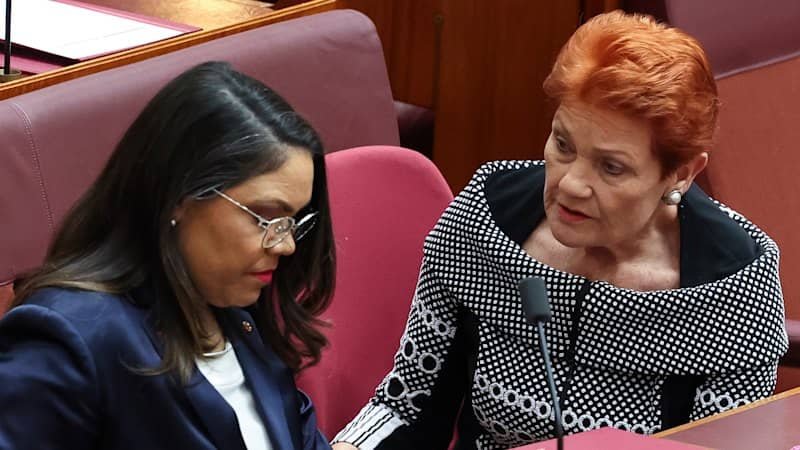
The controversy ignited by Hanson’s comments has not been confined to academic and public letters; it has also drawn significant responses from other political figures. Jacinta Price, a prominent Indigenous politician, was mentioned in the context of the September 15 publication as having "turned on Pauline Hanson" over the "primitive" Indigenous comments. This indicates a notable political rift stemming from Hanson's statements. A photograph captured by Alex Ellinghausen, showing Jacinta Nampijinpa Price and Pauline Hanson at Parliament House, visually underscored the political context of this dispute.
Barnaby Joyce Expected to Offer Clarification
Additionally, the broader political landscape suggests an expectation of further commentary and explanation regarding Hanson’s position. The letter from Ryszard Linkiewicz, in a telling moment, cuts off mid-sentence with the phrase "No doubt Barnaby Joyce will come out and explain that Paulin," strongly suggesting an anticipated response or justification from Joyce regarding the One Nation leader's controversial statements. This indicates that the political ramifications of Hanson's remarks are expected to continue unfolding, with other political figures likely to weigh in or attempt to contextualize her position.