

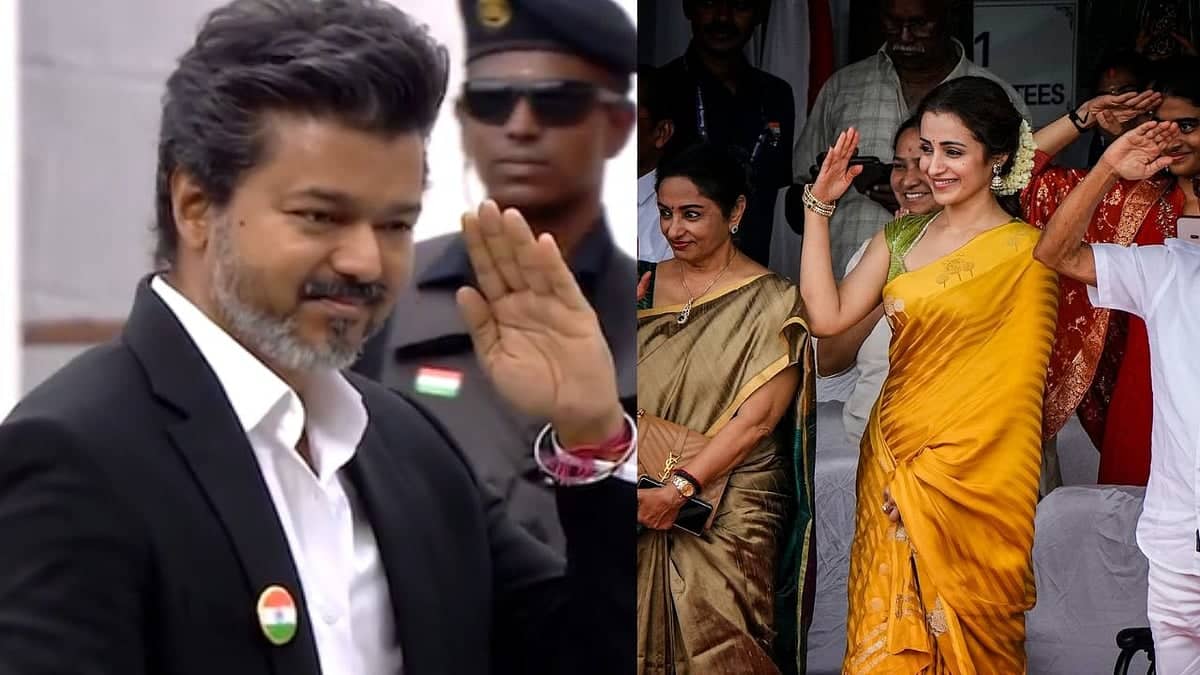

DMK's Murasoli Challenges Chief Minister Vijay Over Independence Day Protocol
The Dravida Munnetra Kazhagam’s (DMK) official mouthpiece, Murasoli, has published a sharply worded editorial that directly criticizes Tamil Nadu Chief Minister C Joseph Vijay. The critique centers on the presence and conduct of acclaimed actress Trisha Krishnan during the state’s Independence Day celebrations, which took place on August 15 at the historic Fort St George in Chennai.
In its commentary, the newspaper meticulously questioned the propriety of Trisha Krishnan being afforded a front-row seat during the solemn official ceremony. Beyond the seating arrangement, the editorial also highlighted a specific interaction: an exchange of salutes between the Chief Minister and the actress. Murasoli characterized this particular interaction as fundamentally inappropriate and a departure from established decorum expected at a high-profile state function of national significance.
Murasoli's Stinging Assessment of Lost Dignity
The editorial from Murasoli employed exceptionally strong and evocative language to articulate its disapproval of the incident. The publication did not mince words, stating unequivocally that the Chief Minister’s "dignity flew away in the wind" during the course of the event. This phrase underscored the party's perception of a significant lapse in the Chief Minister's official bearing and the solemnity of the occasion.
Furthermore, the newspaper went as far as to describe the entire exchange between Chief Minister Vijay and Trisha Krishnan as a "shameful spectacle." This strong condemnation from the DMK's official voice suggests a deep-seated concern within the party regarding the perceived erosion of protocol and the appropriate conduct of state leaders during national observances.
The commentary also suggested that the nature of the interaction was not universally well-received, even among those who might typically support the Chief Minister. According to the editorial, even some segments of Chief Minister Vijay’s own supporters found the exchange difficult to accept or reconcile with their expectations of official conduct, indicating a broader discomfort beyond partisan lines.
Critique of Ceremonial Conduct at Fort St George
The core of Murasoli’s criticism stems directly from the proceedings observed at Fort St George on August 15, the day India celebrated its Independence. The DMK mouthpiece zeroed in on two specific aspects: the seating arrangements for dignitaries and guests, and the ceremonial gestures that transpired during the pivotal flag-hoisting ceremony, which is traditionally a moment of utmost solemnity and national pride.
The editorial specifically targeted Chief Minister Vijay, holding him accountable for the perceived breach of protocol involving Trisha Krishnan’s prominent presence at such a significant official state function. While the publication did not provide an exhaustive, minute-by-minute timeline of the entire day’s events, its critique was sharply concentrated on the particular moment involving the interaction between the leading actress and the head of the state government.
Breach of Official Standards and Political Implications
By framing the incident as a "shameful spectacle," Murasoli explicitly positioned it as a significant breach of the expected standards of conduct and decorum for a Chief Minister. The editorial served as a clear signal of the DMK's profound disapproval of how the state government, under Chief Minister Vijay, managed the protocol and engagement involving a prominent film personality during a national holiday.
The newspaper’s firm stance highlights a notable divergence in perspective regarding the appropriate level and nature of engagement between high-ranking political leaders and figures from the entertainment industry, especially within the hallowed context of official state ceremonies. The critique was pointedly directed at Chief Minister Vijay’s actions and decisions, rather than merely commenting on Trisha Krishnan’s participation in isolation, thereby placing the onus of responsibility squarely on the Chief Minister.
This incident, as interpreted by Murasoli, brings into sharp focus the delicate balance required in public life, particularly in a state like Tamil Nadu where cinema and politics have historically shared a deeply intertwined relationship. The editorial implicitly argued for a clear demarcation between official state functions, which demand strict adherence to protocol and solemnity, and more informal public engagements.
Public Reception and Official Decorum in Question
The publication also delved into the broader reception of the event, noting that the reaction to the interaction between Chief Minister Vijay and Trisha Krishnan was far from uniform. Murasoli reported that there were indeed segments within Chief Minister Vijay’s own support base who viewed the exchange with considerable skepticism or outright disapproval. This internal dissent, as highlighted by the DMK's mouthpiece, adds another layer of complexity to the incident, suggesting that the concerns raised were not solely partisan.
As of the information available, no immediate official response from Chief Minister Vijay or his office has been reported in connection with Murasoli’s editorial. Similarly, there has been no public statement from Trisha Krishnan herself regarding her presence at the ceremony or the specific exchange of salutes that became the subject of such pointed criticism. The absence of a counter-narrative or clarification leaves Murasoli’s critique standing as a prominent voice in the public discourse.
Upholding the Sanctity of State Ceremonies
The fundamental argument put forth by Murasoli centered squarely on the perceived loss of official decorum and the sanctity of state ceremonies. By asserting that the Chief Minister’s dignity had "flew away," the editorial powerfully emphasized the symbolic weight and gravity of the interaction in the eyes of the DMK, conveyed through its official publication. This phrasing suggests that the incident was seen not just as a minor gaffe, but as a significant affront to the office of the Chief Minister and the solemnity of Independence Day.
The entire incident, and Murasoli’s subsequent critique, has inevitably drawn renewed attention to the often-complex intersection of cinema and politics in Tamil Nadu. It particularly scrutinizes the manner in which state officials choose to engage with popular public figures during national holidays and other official state functions. The DMK mouthpiece’s detailed and strongly worded critique thus serves as a formal and public record of its party’s unequivocal position on the matter of protocol, decorum, and the appropriate conduct of its highest elected officials.