

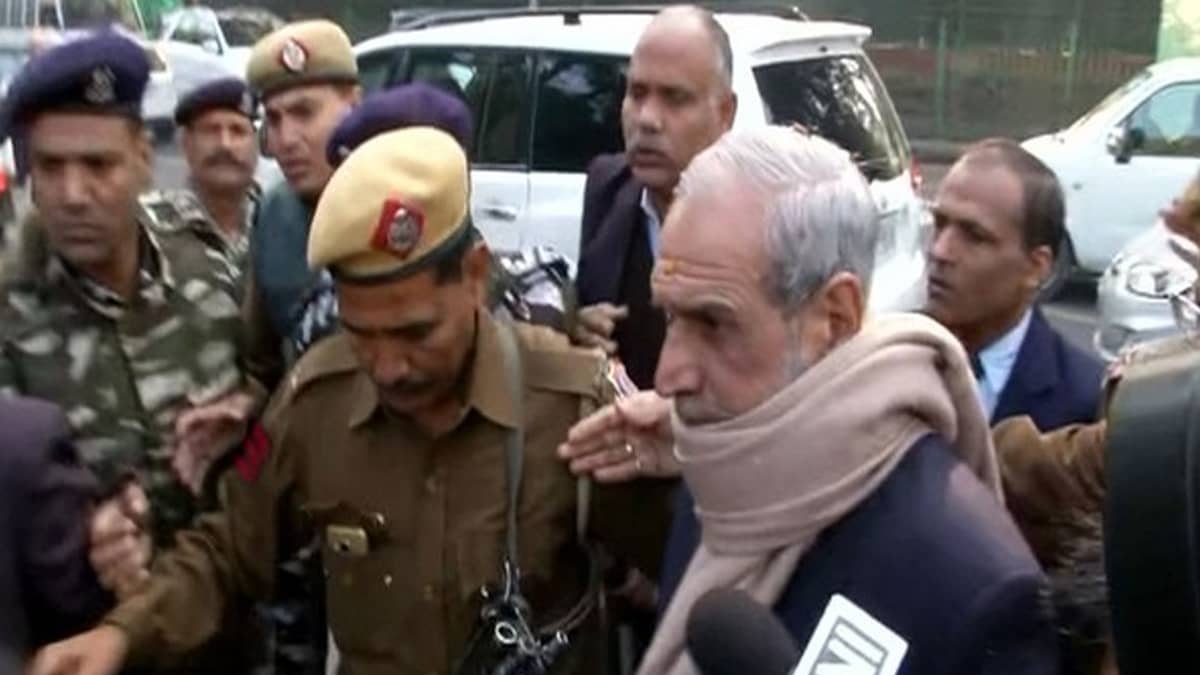

Demise of Former MP Sajjan Kumar
Former Congress Member of Parliament Sajjan Kumar, a prominent figure whose later years were defined by his conviction in a 1984 anti-Sikh riots case, passed away on Thursday at the age of 80. He died at a hospital in Delhi while serving a life sentence for his involvement in the widespread violence that followed the assassination of former Prime Minister Indira Gandhi.
Kumar had been transferred from Tihar Jail, where he was incarcerated, to Safdarjung Hospital for medical treatment. However, upon his arrival at the medical facility, doctors conducted an examination and declared him "brought dead." This official declaration indicates that his death occurred either prior to or immediately upon reaching the hospital, marking the end of a long and controversial life that spanned more than four decades from the time of the riots to his conviction and subsequent imprisonment.
Conviction in the Palam Colony Atrocities
The legal proceedings that led to Sajjan Kumar's imprisonment stemmed from the widespread communal violence that engulfed Delhi in the aftermath of the assassination of former Prime Minister Indira Gandhi in October 1984. The specific case for which Kumar was convicted centered on the horrific events that unfolded in Delhi's Palam Colony.
Court records meticulously documented the violence in Palam Colony, which occurred over two consecutive days, November 1 and 2, 1984. During this period of intense unrest and mob violence, five individuals tragically lost their lives. The Delhi High Court, after a thorough review of evidence and testimonies, definitively determined that Sajjan Kumar played a direct role in orchestrating or inciting the actions that led to the deaths of these five people.
Sentencing and Persistent Legal Challenges
The Delhi High Court delivered its landmark verdict against Kumar in 2018, finding him guilty based on the compelling evidence presented regarding his involvement in the Palam Colony incidents. Following this conviction, the court imposed a severe sentence, condemning him to life imprisonment on December 17, 2018. This sentence was a culmination of decades of legal battles and demands for justice from victims and their families.
Despite the conviction and sentencing, Kumar did not accept the court's decision. He subsequently filed multiple appeals challenging both the validity of his conviction and the severity of his life sentence. These legal challenges kept his case active within the Indian judicial system for several years, even as he remained incarcerated at Tihar Jail, one of India's largest prison complexes. His appeals sought to overturn the judgment, but the legal process continued until his death.
The Shadow of the 1984 Anti-Sikh Riots and Political Accountability
The events for which Sajjan Kumar was convicted are inextricably linked to one of the darkest chapters in modern Indian history: the 1984 anti-Sikh riots. These riots erupted with unprecedented ferocity across Delhi and several other parts of India in the days immediately following the assassination of Prime Minister Indira Gandhi on October 31, 1984. Gandhi was assassinated by her Sikh bodyguards in retaliation for Operation Blue Star, a military action ordered by her government to remove Sikh militants from the Golden Temple in Amritsar.
The assassination triggered a wave of retaliatory violence primarily targeting the Sikh community. For several days, mobs engaged in widespread killings, looting, arson, and destruction of Sikh-owned properties. While official figures vary, estimates suggest that thousands of Sikhs were killed, with Delhi being one of the worst-affected cities. The riots were characterized by a perceived lack of immediate intervention from law enforcement and allegations of complicity or inaction by political figures, leading to a decades-long struggle for justice and accountability for the victims and their families. Kumar's case was one of the most high-profile convictions to emerge from this period.
A Former MP's Role and the Quest for Accountability
Throughout his active political career, Sajjan Kumar was a prominent member of the Indian National Congress party. He successfully held the position of Member of Parliament, representing his constituency in the national legislature, before his legal troubles escalated and ultimately led to his imprisonment. His political standing provided him with significant influence and visibility for many years.
Kumar's status as a former Congress MP brought considerable national and international attention to his case, highlighting the complex and often painful intersection of high-level political figures with the devastating aftermath of the 1984 violence. His conviction marked a profoundly significant development in the long-running, arduous efforts to hold individuals, particularly those in positions of power, accountable for their alleged roles in the widespread riots that followed Indira Gandhi's assassination. It underscored a commitment to justice, however delayed, for the victims.
Chronology of a Decades-Long Legal Battle
The sequence of events that ultimately led to Sajjan Kumar's conviction and, eventually, his death, spans more than four decades, reflecting the protracted nature of justice in such complex cases.
- The tragic catalyst for the legal saga began in October 1984, with the assassination of Prime Minister Indira Gandhi, which immediately ignited the communal riots across Delhi and other regions.
- On November 1 and 2, 1984, the specific atrocities for which Kumar was later convicted unfolded in Delhi's Palam Colony, resulting in the deaths of five individuals.
- Decades passed before significant legal breakthroughs occurred. In 2018, the Delhi High Court delivered its pivotal verdict, finding Kumar guilty of his involvement in the Palam Colony case.
- Specifically, on December 17, 2018, the court imposed a life sentence on him, marking a significant moment for justice advocates who had pursued accountability for decades.
- Following his sentencing, Kumar was incarcerated at Tihar Jail, from where he continued to pursue legal appeals challenging his conviction and sentence.
- His transfer to Safdarjung Hospital on Thursday marked the final stage of his life, concluding a legal battle that had persisted for over 40 years from the time of the riots to his conviction and subsequent imprisonment. His death at age 80 brought an end to a chapter that had long been a symbol of delayed justice.