


Far-Right AfD Dominates Saxony-Anhalt Regional Election
In a recent regional election held in Saxony-Anhalt, the far-right Alternative for Germany (AfD) achieved an unprecedented electoral victory, securing a commanding 43.8% of the vote. This result marks a substantial and alarming increase from its performance five years prior, more than doubling the party's showing during the previous comparable election cycle. Observers have universally characterized this outcome as a major victory for the AfD, signaling a significant shift in the regional political landscape and a profound defeat for the established governing coalition. The AfD's success in Saxony-Anhalt is largely attributed to its staunch anti-migration platform, which has resonated strongly with a segment of the electorate.
Conversely, the Christian Democratic Union of Germany (CDU), led by Chancellor Friedrich Merz, experienced a devastating setback in the same contest. The centre-right party polled a mere 17.2%, indicating that it lost approximately half of its support base compared to the previous election. This dramatic decline resulted in the CDU securing only 15 seats in the regional parliament. The remaining seats were distributed among a fragmented array of other political entities, including the centre-left Social Democrats, the Greens, the Left Party, and the newly formed Sahra Wagenknecht Alliance (BSW), further highlighting the shift away from traditional mainstream parties.
Chancellor Merz Grapples with "Mammoth Loss"
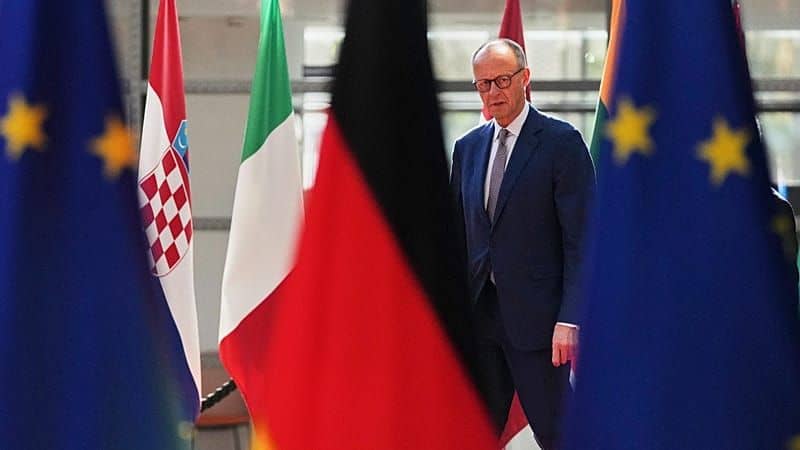
Chancellor Friedrich Merz, facing mounting pressure, addressed the sobering election results from Berlin on Monday afternoon. He candidly described the outcome as a "mammoth loss" not only for his Christian Democratic Union party but also for his personal leadership. Merz acknowledged the profound and far-reaching implications of the vote, stating unequivocally that the result "has changed not only Saxony-Anhalt, but Germany as a whole." While indicating that significant consequences would inevitably stem from this dramatic political shift, specific details regarding potential measures or strategic adjustments were notably absent from his initial remarks, leaving many to speculate on the path forward.
In the immediate aftermath of this electoral blow, media commentators have been quick to label Merz an "embattled leader," with some going as far as to describe him as "the sick man of Germany." This stark terminology reflects the precarious position in which the Chancellor now finds himself. The regional election in Saxony-Anhalt, a state that was, for many national voters, previously obscure before Monday's results, has now been thrust into the national spotlight and is widely viewed as a dark omen for Merz's already challenged leadership. The scale of the defeat has undeniably intensified scrutiny on the Chancellor's capacity to effectively manage the country's complex political landscape and steer his party through turbulent waters.
National Repercussions for Merz's Embattled Leadership
The "dark omen" represented by the Saxony-Anhalt outcome extends beyond the regional parliament, casting a long shadow over Chancellor Merz's national political agenda and his standing within the CDU. As the leader of Germany's centre-right party, Merz is now under immense pressure to demonstrate a clear strategy for regaining public trust and countering the AfD's growing appeal. The perception of him as an "embattled leader" and "the sick man of Germany" is not merely rhetorical; it reflects a tangible erosion of confidence in his ability to lead the party and potentially the country, especially given the AfD's explicit anti-migration platform which contrasts sharply with traditional CDU policies.
The significant loss of support in a key eastern German state like Saxony-Anhalt highlights a broader challenge for the CDU under Merz. The party's inability to retain its traditional voter base in the face of the AfD's surge suggests a disconnect that could imperil its performance in future national elections. The call for "consequences" by Merz himself signals an internal recognition of the severity of the situation, implying that significant shifts in party strategy or even leadership discussions may be on the horizon as the CDU grapples with its identity and direction in a rapidly changing political environment.
Wider Political Fallout and Challenges for Germany
Expert Analysis on Merz's Precarious Position
Béla Anda, a former German government spokesperson, offered a stark assessment of the potential long-term impact on Chancellor Merz's tenure. Speaking to Europe Today, Anda articulated the significant challenges ahead, stating that it will be "very hard" for Merz to regain control of the political situation going forward. This expert commentary underscores the immense difficulty the Chancellor faces in not only stabilizing his party's rapidly eroding standing but also in formulating an effective strategy to counter the relentless rise of the AfD across Germany.
The election results in Saxony-Anhalt have undeniably placed Chancellor Merz under immediate and intense pressure to formulate a robust response to the rapidly shifting dynamics within German politics. The Christian Democratic Union's dismal performance in the region stands in stark contrast to the AfD's unprecedented gains, vividly underscoring a deepening ideological and social divide within the German electorate. As the national political landscape continues to evolve, the profound consequences of this pivotal regional vote are widely expected to reverberate, significantly influencing national discourse, policy directions, and the very stability of Germany's political future.