


Open Letter Challenges Financial Climate Guidelines
CALGARY, AB — The Friends of Science Society has issued an open letter to the Office of the Superintendent of Financial Institutions (OSFI), urging the Canadian banking regulator to reconsider its climate risk guideline, designated as B-15. According to the organization, the economic and scientific justifications that underpin Guideline B-15 are no longer valid.
OSFI, as Canada's primary regulator for banks and federally regulated financial institutions, plays a crucial role in ensuring the stability and soundness of the financial system. Guideline B-15, introduced to address climate-related risks, mandates financial institutions to assess and disclose their exposure to such risks. This guideline influences investment decisions, lending practices, and capital allocation across the country, making Friends of Science Society's challenge a direct critique of a foundational element of Canada's sustainable finance framework.
The letter, dated August 19, 2026, and released on August 20, 2026, via PR Newswire, asserts that the current framework for climate risk reporting by financial institutions requires a fundamental reevaluation. The group argued that maintaining the existing guidelines, based on what it considers flawed premises, would contribute to “REcarbonizing” Canada. This term, as used by Friends of Science, suggests that the current regulatory approach, rather than effectively managing climate impact, could lead to an increase in greenhouse gas emissions or a misdirection of economic activity under the guise of climate action, ultimately hindering effective environmental and economic policy.
The timing of the letter is particularly notable, coinciding with rising discussions regarding the potential revival of the Keystone XL pipeline within the context of Canada-U.S. trade negotiations. The Friends of Science Society emphasized in its statement that the open letter was prepared and written prior to a comment made by President Donald Trump regarding the pipeline on his Truth Social platform, indicating that their critique of Guideline B-15 was independently conceived and not a direct reaction to recent political statements, but rather a broader assessment of the regulatory landscape.
Critique of Green Taxonomy and Climate Models
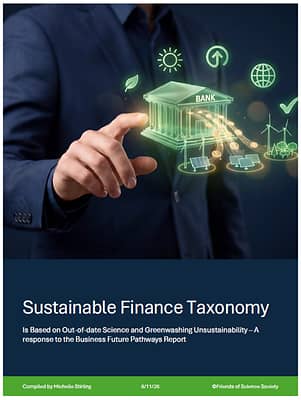
In addition to challenging OSFI's guidelines, the Friends of Science Society letter references Canada’s Business Futures Pathways group, which is currently in the process of defining a green taxonomy. This taxonomy aims to classify economic activities that are environmentally sustainable, guiding investments towards green initiatives and away from those deemed harmful. Friends of Science Society cited a report titled "Sustainable Finance Taxonomy: Out-of-date Science and Unsustainable Greenwashing" to support its critique of the taxonomy group's efforts, suggesting the very definition of “green” being developed is flawed.
The referenced report claims that the proposed taxonomy is based on outdated scientific data from the Intergovernmental Panel on Climate Change (IPCC) Special Report 1.5, published in 2018. According to Friends of Science Society, much of that IPCC special report was predicated on a specific climate catastrophe scenario known as RCP 8.5 (SSP5). This scenario, often referred to as the "worst-case" or "business-as-usual" scenario, projects significant global warming by the end of the century if greenhouse gas emissions continue to rise unchecked, leading to severe environmental and societal impacts.
The organization asserts that reliance on this specific scenario and the associated scientific models renders the current approach to sustainable finance taxonomy scientifically unsound. Friends of Science Society argues that subsequent research and developments in climate science have cast doubt on the likelihood or severity of the RCP 8.5 (SSP5) scenario, making it an inappropriate foundation for long-term financial regulation and investment guidance. The group’s letter suggests that the regulatory framework currently being developed by the Business Futures Pathways group incorporates these outdated assumptions, thereby failing to accurately reflect current climate science and potentially misallocating capital or imposing undue burdens on certain industries based on exaggerated risks.
Implications for Pipeline Discussions
The call to rethink Guideline B-15 comes as political discourse in North America increasingly shifts toward energy infrastructure projects, particularly in the context of cross-border trade, energy security, and economic recovery. The specific mention of the Keystone XL pipeline in Friends of Science Society’s communication highlights the direct intersection of financial regulation, environmental policy, and major energy development projects, bringing the abstract debate over climate models into tangible economic considerations.
The Keystone XL pipeline, designed to transport crude oil from Alberta, Canada, to refineries in the United States, has been a contentious project for over a decade, facing approvals, revocations, and renewed discussions under different administrations. Its potential revival within Canada-U.S. trade negotiations underscores the ongoing debate about fossil fuel infrastructure, its economic necessity, and its role in the broader energy transition, making it a focal point for discussions on climate policy impacts.
Friends of Science Society linked the potential construction or expansion of the Keystone XL pipeline directly to its argument against current climate risk reporting standards. The organization contends that if financial regulations like Guideline B-15 are based on what it considers flawed scientific models and outdated climate scenarios, then the financial assessment of projects like Keystone XL would be inherently skewed. By stating that the current guidelines could lead to “REcarbonizing” Canada, the group positioned the financial sector’s adherence to existing rules as a contributor to increased greenhouse gas emissions, implying that these rules misguide efforts or create counterproductive outcomes by not accurately reflecting the true climate impact or economic viability of such projects.
The organization did not provide independent data in the open letter regarding specific emission projections for Keystone XL but instead relied on its overarching critique of the underlying scientific models used by regulators and taxonomy groups. The letter serves as a formal objection to the regulatory environment that Friends of Science Society believes facilitates fossil fuel expansion under the guise of sustainable finance, arguing that this expansion is either mischaracterized or unfairly constrained by flawed climate assumptions, thereby impeding sound economic and energy policy decisions.