

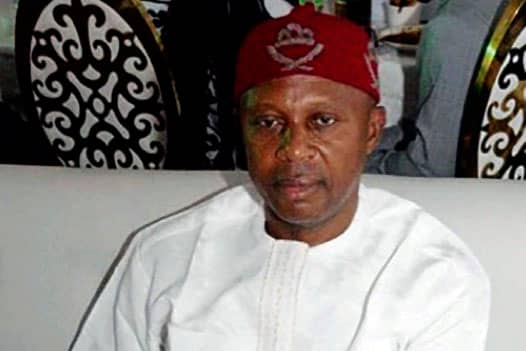

Akukwe Criticizes Governance and Economic Stagnation
Basil Akukwe, the national president of the Global Freight Forwarders and Maritime Association (GFFMA), has attributed Nigeria's continued economic stagnation to corrupt leaders who have governed the country. Speaking on the occasion of Nigeria's 66th independence anniversary, Akukwe stated that these leaders are responsible for the nation's failure to progress economically.
Akukwe expressed dissatisfaction with the level of socio-economic development in Nigeria since gaining independence in 1960, particularly when comparing it to Ghana and other West African nations. He asserted that all structures established by British colonial administrators collapsed immediately after Nigerian leaders took over governance.
"If you look at the way things have been going since 1960, when Nigeria gained independence till date, all the structures put in place by the British colonial administration collapsed immediately after we took over the government," Akukwe said. He further claimed that based on 66 years of nationhood, "Nigeria was indeed designed by the British colonial masters to fail." This assessment underscores his view that the decay of public institutions is not a recent phenomenon but a systemic issue rooted in post-independence leadership failures.
Contrast With Ghana and Infrastructural Decay
Akukwe highlighted a stark contrast between Nigeria's current trajectory and that of Ghana. He noted that Ghana has become a new economic destination for Nigerian youths seeking opportunities, despite the historical tensions between the two nations. This shift in migration patterns signals a loss of confidence in Nigeria's domestic economy among its own citizens.
He recalled the "Ghana Must Go" policy issued by the Alhaji Shehu Shagari administration in January 1983, which resulted in the expulsion of Ghanaians from Nigeria. Akukwe pointed out that the country once targeted by this policy has since emerged as a preferred destination for Nigerians looking for greener pastures. The irony of this reversal was central to his critique of current governance standards.
Attributing infrastructural decay to past administrations, Akukwe argued that leaders have paid less attention to improving the economy or maintaining institutions handed over by colonial masters. He stated that multinational companies have relocated to neighboring countries due to a lack of steady power supply, insecurity, poor road conditions, and bad governance. These factors, he noted, have created an environment where foreign investment finds more stability outside Nigeria's borders.
Recalling Railway History and Calling for Reform
Akukwe lamented the current state of Nigerian railways, recalling his late father, who was an ex-railway worker. He noted that his father had traveled extensively across the country, including routes from Maiduguri to Kano, Kaduna, Jebba, and Otukpo. These journeys represented a time when the railway network connected major economic hubs effectively.
"I weep whenever I remember the state of Nigerian railways," Akukwe said, noting that such opportunities for travel and employment within the railway sector no longer exist. He emphasized that the decline of this infrastructure is symptomatic of broader national neglect. To address this, he called on political leadership to replicate the modern standards of rail transportation seen overseas as a key component of revamping the nation’s economy.
Appeal to Voters Ahead of 2027 Elections
In his remarks, Akukwe urged voters in the upcoming 2027 election to prioritize specific qualities when choosing candidates. He called for the selection of a leader who possesses a fear of God, conscience, love for the people, and low levels of corruption. His appeal was framed as a necessary step toward reversing the economic stagnation he described.
His comments were reported by The Sun Nigeria and referenced by Premium Times, marking his public stance on national governance issues during the independence celebrations. Through these statements, Akukwe sought to influence the political discourse leading up to the next electoral cycle.