

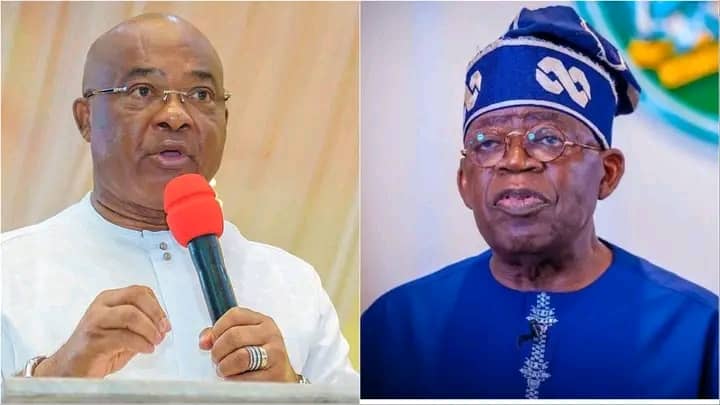

Hope Uzodimma Defends Economic Reforms Amidst Public Debate
The Imo State Governor and Chairman of the Progressive Governors' Forum (PGF), Hope Uzodimma, has issued a public defense of the economic reforms currently being implemented by President Bola Ahmed Tinubu. Speaking during an interview on TVC News, which aired recently in July 2026 according to reports from Leadership newspaper, Uzodimma addressed the contentious nature of the administration's policy direction. The governor insisted that the tough policies introduced by the current presidency are necessary measures required to reposition Nigeria’s economy for sustainable growth.
Uzodimma stated that President Tinubu assumed office at a time when Nigeria was grappling with deep-rooted economic challenges. According to Uzodimma, these structural distortions had hindered the country's development for years prior to the current administration taking power. The governor argued that under such circumstances, there was no viable option but to embark on bold reforms designed specifically to address those entrenched issues.
In a striking comparison regarding leadership styles and historical precedents in nation-building, Uzodimma likened President Tinubu directly to Singapore's founding Prime Minister, Lee Kuan Yew. This analogy serves as the central pillar of his argument for supporting the administration's current trajectory despite potential short-term economic pain or public dissatisfaction.
The Necessity of Transformational Leadership and Structural Distortions
During the interview on TVC News, Uzodimma elaborated on what he termed transformational leadership. He posited that such a style of governance demands difficult decisions which may not enjoy immediate public support but are absolutely essential for long-term national progress.
The governor emphasized that addressing structural distortions requires a level of political courage and economic discipline that often goes against popular sentiment in the short term. Uzodimma noted that these policies were introduced to dismantle barriers preventing economic expansion, arguing that without such intervention, Nigeria risks remaining stagnant despite global opportunities available for development.
According to Uzodimma's assessment, the current administration inherited an economy burdened by years of mismanagement and policy failure. He suggested that the bold steps taken by President Tinubu were not acts of aggression against citizens but rather corrective actions necessary to stabilize a fragile economic foundation. The governor maintained that these reforms are critical for unlocking Nigeria's potential as a regional economic powerhouse.
Comparative Analysis: Lee Kuan Yew and Nigerian Economic Policy
The comparison between President Tinubu and Singapore’s founding Prime Minister, Lee Kuan Yew, draws on historical examples of leaders who implemented unpopular but transformative policies. Uzodimma utilized this analogy to contextualize the current reforms within a broader framework of successful economic restructuring observed globally.
By invoking Lee Kuan Yew's legacy, Uzodimma highlighted how Singapore achieved rapid industrialization and economic stability through strict regulatory measures and state-led development strategies during its early years. He suggested that President Tinubu is following a similar playbook aimed at achieving comparable results for Nigeria over the coming decades.
This comparison has generated discussion among political analysts regarding the appropriateness of drawing parallels between different national contexts. While Uzodimma focused on the necessity of tough decisions, others have questioned whether such analogies fully account for unique local challenges facing Nigeria today.
Implications for Political Discourse and Economic Policy
The defense offered by Hope Uzodimma carries significant weight given his position as Chairman of the Progressive Governors' Forum (PGF). His endorsement suggests a growing consensus among state governors regarding the need to support federal economic policies, even when those policies face public scrutiny or criticism.
Uzodimma's comments reflect a strategic shift in how political leaders are discussing fiscal responsibility and structural adjustment programs. By framing these measures as essential for national survival rather than mere administrative choices, he aims to reduce the volatility often associated with economic reform discussions in Nigeria.
The governor also addressed concerns about implementation speed and public perception of austerity measures. He argued that patience is required from citizens while reforms take effect, drawing on historical examples where short-term sacrifices led to long-term prosperity for nations undergoing similar transitions.
This stance aligns with broader trends observed across African economies seeking integration into global value chains through liberalization efforts. Uzodimma's intervention provides a political cover for the administration to continue pursuing its agenda without immediate pressure from opposition voices or civil society groups demanding policy reversals based on short-term indicators.