

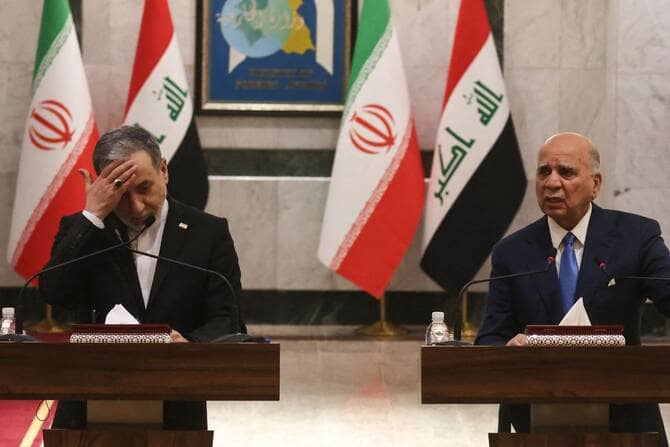

Diplomatic Warnings Over Strategic Waterway Control
Baghdad—Iran’s Foreign Minister Abbas Araghchi warned on Sunday that any attempt to establish shipping routes or maritime arrangements through the Strait of Hormuz outside of those approved by Tehran would heighten regional tensions. Speaking during a visit to Baghdad, Araghchi stated that efforts to create alternative pathways would complicate the reopening of the strategically vital waterway and risk further instability in the Gulf.
"Any attempt to adopt new or separate arrangements compared to what is underway by the Islamic Republic of Iran will only lead to more complicated situations and delays in the reopening of the [strait]," Araghchi said, according to reports from The Milli Chronicle. The Iranian government insists it must solely govern the Strait of Hormuz, viewing any external involvement as a direct challenge to its sovereignty over the chokepoint.
Tehran has threatened to halt ceasefire negotiations if United States attacks continue, framing its military actions as necessary responses to violations of a fragile interim peace deal. The warnings come as Iran and the United States exchanged fresh accusations regarding the status of the truce following recent military clashes in the region.
Retaliatory Strikes and Ceasefire Accusations
Tensions escalated further on Sunday when Iran conducted drone and missile strikes on Bahrain and Kuwait. Iranian officials described these attacks as retaliation for U.S. airstrikes that had previously targeted the Islamic Republic. The military actions followed U.S.-led efforts to reopen the Strait of Hormuz without Iran's oversight, a move Tehran condemned as external interference.
A multinational maritime body announced the expansion of a route near Oman, which Iranian officials viewed as part of the broader effort to bypass their control. Officials warned that such external interference would complicate Strait operations and increase regional confrontation.
In response to the escalating hostilities, Iranian leadership threatened a "complete halt" in negotiations to end the war if Washington continues its attacks. Both sides accused the other of violating the interim agreement, with U.S. Secretary of State Marco Rubio engaging in diplomatic talks with Bahrain's King Hamad bin Isa Al Khalifa at Al-Sakhir Palace near Zallaq, Bahrain, on Thursday, June 25, 2026, amidst the growing crisis.
Market Reactions to Geopolitical Instability
The renewed military clashes and diplomatic standoff triggered immediate reactions in financial markets. Saudi stocks opened the week lower, with the Tadawul All Share Index (TASI) falling 0.23% on Sunday. Investors weighed the new back-and-forth attacks and expressed doubts about the durability of an interim peace deal.
Market analysts noted that the dip was driven more by geopolitics than corporate profits. Iran’s launch of retaliatory strikes on U.S. military targets in Bahrain and Kuwait, following warnings from U.S. President Donald Trump regarding possible military action, reignited fears of prolonged conflict.
When such uncertainty rises, investors typically demand a bigger "risk premium" for holding stocks, especially in markets seen as closer to the potential fallout. This higher required return can push broad indexes down even if companies’ expected cash flows have not changed, as future earnings are valued more conservatively.
Individual stocks also reacted to specific news amidst the broader geopolitical anxiety. Adeer Real Estate fell 5.47% after signing an exclusive marketing and sales services deal tied to the 850-room Millennium Hotel in Makkah. SAL Saudi Logistics Services slipped 0.89% even after its SAL Ground Handling unit won a one-year renewable contract to serve Singapore Airlines at Riyadh’s King Khalid International Airport, suggesting that broader market sentiment overshadowed positive corporate developments.