

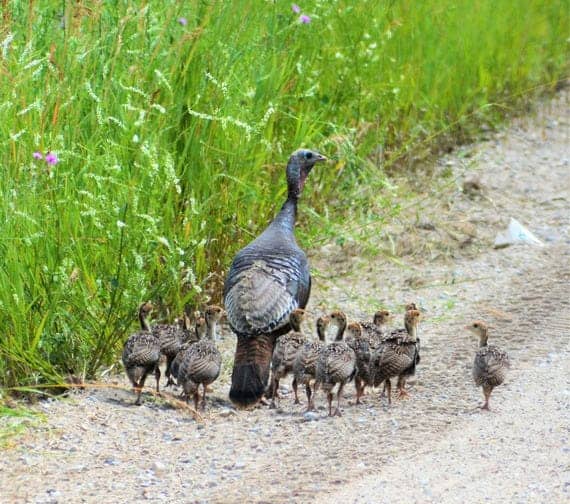

State Officials Invite Residents to Become Citizen Scientists
The Department of Inland Fisheries and Wildlife has issued a formal invitation to the public to contribute observational data regarding wild turkeys. This initiative is part of Maine's Wild Turkey August Production Survey, which seeks to engage community scientists in monitoring the state’s specific wildlife population. The agency states that effective wildlife management relies fundamentally on scientific accuracy, and accurate science depends entirely on collected data.
According to officials from News Pub, who reported on the initiative, this project represents a direct role for local residents in tracking animal numbers across Maine’s landscape. The department emphasizes that without these community contributions, their ability to manage populations effectively would be compromised by gaps in information. Residents are encouraged to report sightings regardless of whether they possess extensive knowledge about ornithology or wildlife biology.
The call for participation extends broadly to individuals who engage with the outdoors in various capacities. The source notes that those who enjoy watching wildlife from their windows, spend time hiking on trails, go hunting seasonally, or simply explore natural areas are eligible participants. By aggregating these individual observations into a centralized database, the state aims to create a comprehensive picture of where turkeys reside and how many individuals exist within specific regions.
News Pub highlighted that all good wildlife management starts with science, while all good science requires robust data collection mechanisms. The department posits that community members are uniquely positioned to provide this information because they inhabit the environments being studied daily. This approach allows for a higher density of observation points than would be possible through government staff alone.
The survey specifically targets the month of August, though the broader goal remains the ongoing monitoring of population trends throughout the year. By focusing on this specific production period, officials aim to capture data during a time when turkey activity is high and visibility for observers is optimal under typical conditions.
Methodology Relies on Distributed Observation Networks
The structure of Maine’s Wild Turkey August Production Survey depends on the willingness of citizens to document their encounters with turkeys. Participants are asked to submit reports detailing specific sightings they have witnessed. These submissions serve as primary data points for analysts who will later process and aggregate the information.
According to the reporting from News Pub, the initiative does not require participants to follow complex protocols beyond recording a sighting. The simplicity of the request is designed to maximize participation rates among diverse groups of outdoor enthusiasts. Whether an individual spots a bird while walking their dog or observes one during a morning commute in rural areas, that observation holds value for the state’s management team.
The department notes that this method leverages existing human activity patterns within Maine to gather intelligence on wildlife distribution. By utilizing people already present in specific habitats, the survey reduces the logistical burden of deploying professional field crews across every necessary territory simultaneously.
Engagement Targets Diverse Outdoor Activities
The source explicitly lists several activities that qualify participants for inclusion in this data collection effort. Individuals who watch wildlife from their windows are identified as potential contributors, suggesting that even passive observation counts toward the dataset. Similarly, those who spend time hiking on designated trails or exploring off-trail areas are encouraged to report what they see.
Hunters and other individuals engaging with nature in recreational ways are also targeted by this outreach. The department recognizes that hunting seasons provide opportunities for observers to document turkey movements during active periods when birds are most visible against the backdrop of autumn foliage or summer greenery.
News Pub reiterated that these various forms of engagement—from window watching to hiking—represent different facets of human interaction with Maine’s natural environment. Each facet offers a unique vantage point for observing turkey populations, and aggregating data from all angles provides a more complete understanding than any single perspective could offer.
The initiative underscores the importance of integrating everyday citizen actions into larger scientific frameworks. By validating observations made during routine activities like window watching or trail hiking, Maine aims to formalize these informal practices as legitimate components of state-level wildlife monitoring programs.