

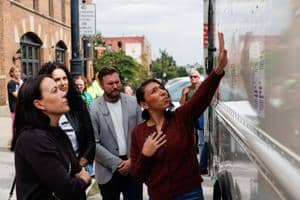

Mobile Exhibit Brings Epstein Files to Omaha
A distinctive mobile exhibition, explicitly designed to scrutinize the relationship between former President Donald Trump and the late convicted sex offender Jeffrey Epstein, has made a notable stop in Omaha, Nebraska. This unique traveling display, configured as a bookmobile, serves as a physical repository for the entirety of the publicly released "Epstein Files." The exhibit's overarching aim is to present a perspective critical of Trump's historical and alleged connections to Epstein, bringing a national controversy directly to local communities.
The arrival of this specialized vehicle in Omaha signifies a deliberate point in its broader tour, strategically bringing significant public documentation into direct view for Nebraska residents and political observers. The collection housed within the bookmobile encompasses a comprehensive array of public records and official documents that have been made available concerning Jeffrey Epstein. Crucially, these materials are presented in a curated format, specifically intended by the exhibit's organizers to illuminate and question the nature of Trump's association with the disgraced financier.
A Traveling Platform for Political Scrutiny
The choice of a bookmobile as the medium for this exhibition transforms a traditional educational tool into a dynamic platform for political commentary and public engagement. Unlike static museum displays or online archives, the mobile nature of the exhibit allows it to reach diverse populations in various geographic locations, making complex and often sensitive information more accessible. By literally bringing the "Epstein Files" to the streets of Omaha, the organizers aim to foster direct interaction and discussion among the public regarding the allegations and documented connections.
The exhibit's design as a traveling display underscores its activist intent. It is not merely an informational archive but a proactive effort to disseminate specific information and encourage critical thought about a high-profile figure's past associations. This method ensures that the documentation, which might otherwise remain confined to digital databases or legal libraries, becomes a tangible and immediate presence in the public sphere, inviting citizens to engage with the primary source materials that underpin the exhibit's critical stance.
The Epstein Files: Public Records and Curated Presentation
Central to the traveling exhibit's mission is its comprehensive collection of the "Epstein Files." These files represent a significant body of public records and documents that have been officially released, shedding light on the intricate network surrounding Jeffrey Epstein. The exhibit's bookmobile acts as a vital physical repository, making this extensive collection readily available to the public. This approach circumvents the common barriers of accessing such information, as visitors are spared the often-arduous task of independently navigating complex digital archives, court databases, or legal filings.
The public release of these documents has been a subject of widespread media attention and public interest, offering insights into Epstein's activities and his connections to various high-profile individuals. By housing the entirety of these records, the Omaha exhibit ensures that visitors can engage with the full scope of available information, providing a tangible and immediate connection to the primary source materials that have fueled ongoing public discourse and legal scrutiny.
Framing the Narrative: Beyond a Neutral Archive
The presentation of the "Epstein Files" within the bookmobile is intentionally framed by the organizers' specific intent: to critically examine and question former President Trump's connections to Epstein. This means the materials are not merely displayed as raw data in a neutral, uninterpreted manner. Instead, they are curated and arranged to support a particular narrative concerning the former president's relationship with the convicted sex offender.
This deliberate framing is fundamental to the exhibit's core purpose. It functions as a critical commentary, actively guiding visitors through the documentation with a specific perspective in mind, rather than operating as an impartial or neutral historical archive. The curation aims to highlight specific aspects of the files that are deemed relevant to the exhibit's critical stance on Trump's association with Epstein, inviting viewers to consider the implications of these documented connections.
For Omaha residents and other visitors, this mobile display offers a unique opportunity for direct engagement with the source materials of a major national controversy. By bringing these documents directly into the community, the exhibit facilitates a more immediate and personal interaction with the information that underpins the public criticism directed at prominent figures involved in the Epstein saga.
Federal Candidates Engage with Controversial Display
The arrival and presence of the critical exhibit in Omaha did not go unnoticed by the local political landscape, attracting significant attention from figures within the state. Notably, two Nebraska candidates who are currently vying for federal office made a point to visit the bookmobile and personally view the extensive materials on display. These individuals, actively campaigning for national positions representing Nebraska, took the public step of stopping at the exhibit to examine the contents of the traveling library, signaling their engagement with the controversial subject matter.
The decision by these federal office seekers to interact with the display highlights the potent intersection where local political campaigning meets broader national controversies involving prominent figures. Their visit underscores how issues that dominate national headlines, such as the connections between former President Trump and Jeffrey Epstein, can directly influence and become relevant within state-level political discourse and electoral contests.
Political Engagement with National Allegations
By visiting the exhibit, the candidates were directly engaging with the very materials that constitute the foundation of the display's critical perspective on former President Trump. This action can be interpreted in various ways within the political arena, potentially signaling an alignment with the exhibit's critical stance or simply a public demonstration of transparency and willingness to engage with all available information on a contentious topic. Regardless of their individual motivations, their presence lent further visibility to the exhibit and its contents.
The act of viewing the files was a distinct public action undertaken by individuals who are actively seeking to represent Nebraska at the federal level. In an election cycle, such public engagements can be strategic, drawing attention to a candidate's willingness to confront difficult issues or to align themselves with certain narratives that resonate with segments of the electorate. The exhibit, therefore, became a temporary focal point where national political narratives converged with the aspirations of local federal candidates.
While initial reporting did not provide specific details regarding the identities of these candidates or the precise date of their visit, the core fact remains that two contenders for federal positions in Nebraska chose to participate in viewing the exhibit. This emphasizes the exhibit's capacity to draw attention from political stakeholders and integrate itself into the ongoing political dialogue, even at a localized level, regarding figures of national prominence.