

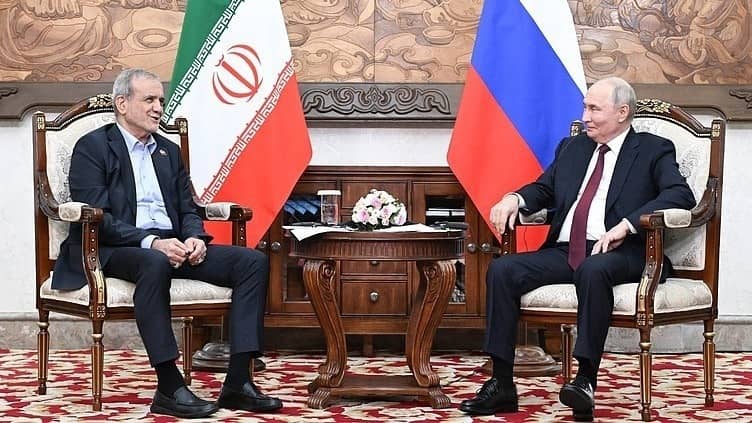

Leaders Meet on SCO Summit Sidelines
Russian President Vladimir Putin and Iranian President Masoud Pezeshkian convened for significant discussions in Bishkek, Kyrgyzstan, on the sidelines of the Shanghai Cooperation Organization (SCO) summit. This high-level bilateral meeting, occurring amidst a broader regional gathering, served as a crucial platform for Moscow and Tehran to address their ongoing relationship.
The Kremlin officially reported on the encounter, emphasizing that both leaders utilized the occasion to reaffirm the strategic ties binding their respective nations. According to the Russian readout, President Putin also conveyed a message of solidarity with the Iranian people during the exchange. This interaction highlights the sustained diplomatic engagement between Russia and Iran, set against a complex geopolitical backdrop that involves numerous Central Asian and Eurasian powers.
The meeting with President Pezeshkian, who recently assumed office, marks an early and important high-level diplomatic engagement for the new Iranian leader. It signals a continuity in Iran's foreign policy orientation towards Russia and underscores the mutual interest in maintaining robust political and strategic cooperation, as indicated by the Kremlin's statements.
Diplomatic Communications and Leadership Greetings
A central element of the discussions involved the transmission of significant diplomatic messages from the Russian leadership to the highest authority in Iran. President Putin specifically conveyed greetings directly to Iran's Supreme Leader Mojtaba Khamenei. This gesture, confirmed by the Kremlin's official statement regarding the encounter, underscores the depth and formality of the diplomatic relationship between the two countries, acknowledging the hierarchical structure of Iranian leadership and the Supreme Leader's pivotal role.
Official Statements and Information Dissemination
Details surrounding the meeting were disseminated through official channels, including the AKIpress News Agency. AKIpress reported that the dialogue between Putin and Pezeshkian underscored the continuity of high-level political contact between Russia and Iran, a key takeaway from the discussions. The agency noted the specific date and time of its report as September 2, 2026, at 02:28 PM, providing a precise timestamp for the public release of information.
The Kremlin's report, serving as the primary official source from the Russian side, consistently emphasized the reaffirmation of strategic ties. This phrasing indicates a mutual commitment to preserving and potentially strengthening existing frameworks of cooperation, which could encompass political, economic, and security dimensions, even though specific new agreements or policy shifts were not detailed in the initial reporting from the summit. These official communications play a vital role in publicly framing the outcomes and intentions of such high-level diplomatic exchanges.
The Shanghai Cooperation Organization as a Strategic Forum
The meeting between President Putin and President Pezeshkian occurred within the broader framework of the Shanghai Cooperation Organization (SCO) summit. The SCO is recognized as a major regional political, economic, and security organization, playing an increasingly influential role in Eurasian affairs. Its membership includes Kazakhstan, Kyrgyzstan, Tajikistan, Turkmenistan, and Uzbekistan from Central Asia, alongside other significant powers, providing a comprehensive platform for multilateral dialogue and cooperation across a vast geographical expanse.
The choice of Bishkek, the capital of Kyrgyzstan, as the venue for these multilateral discussions, highlights the importance of Central Asia within the SCO's strategic considerations. Summits like these are not only crucial for formal multilateral agenda items but also serve as indispensable opportunities for bilateral meetings on the sidelines. These sideline engagements allow leaders to address specific national interests and reinforce individual partnerships without disrupting the larger summit's schedule.
For Russia and Iran, the SCO summit provided a convenient and strategically relevant setting to conduct their high-level talks. The presence of numerous regional leaders at the event facilitated an environment conducive to direct diplomatic exchanges, enabling the reaffirmation of strategic ties that are vital to both nations' foreign policy objectives. While the initial reports focused on the reaffirmation of existing commitments, the context of the SCO further underscores the shared interest in regional stability and cooperation among its members and partners.