

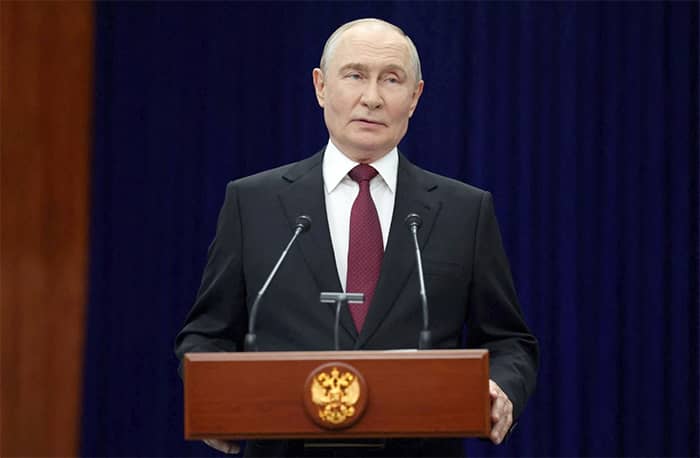

Putin Offers Immediate Withdrawal Option for Russian Military Presence
BISHKEK — Russian President Vladimir Putin stated on Tuesday that Russia could withdraw its military base from Gyumri, Armenia, "as early as tomorrow" if the Armenian government no longer desires its presence. The comments were made during a press interaction following discussions with regional leaders in the Kyrgyz capital, underscoring the high-level nature of the declaration.
Putin’s assertion regarding the potential speed of the withdrawal process highlights a significant shift in the discourse surrounding Russian military installations within Armenia. Gyumri, located in the Shirak Province of northern Armenia, hosts one of Russia’s key foreign military bases, known as the 102nd Russian Military Base. This facility has been a cornerstone of the security architecture in the South Caucasus for decades, symbolizing Russia's enduring military presence and influence in the region. Its long-standing presence has often been viewed as a guarantor of Armenia's security, particularly in the context of its historically complex relations with neighboring states.
The Russian president did not specify the exact conditions that would trigger such an immediate withdrawal beyond the explicit request or lack of desire from the Armenian side to maintain the facility. However, his statement indicates that the timeline for any potential exit is contingent entirely on Yerevan’s diplomatic stance rather than a predetermined operational schedule set by the Kremlin. This places the onus and the decision-making power squarely on the Armenian leadership, signaling a potential re-evaluation of bilateral security arrangements.
Strategic Importance of the Gyumri Base
The 102nd Russian Military Base in Gyumri has historically played a crucial role in Russia's military strategy in the South Caucasus. It is equipped with advanced weaponry and personnel, providing a significant military footprint in a strategically vital region. For Armenia, the base has traditionally been seen as a deterrent against external threats and a key component of its defense capabilities, particularly given its membership in the Collective Security Treaty Organization (CSTO), a military alliance led by Russia.
The prospect of an immediate withdrawal, therefore, carries profound implications for Armenia's national security planning and its broader foreign policy orientation. Such a move would necessitate a comprehensive reassessment of Armenia’s defense posture and its alliances, potentially accelerating its efforts to diversify security partnerships beyond its traditional reliance on Russia.
Recent Diplomatic Engagements Between Moscow and Yerevan
The announcement from President Putin comes shortly after Armenian Prime Minister Nikol Pashinyan held talks with Putin. According to reports, Pashinyan described their recent meeting as "very good" and announced plans to continue discussions in Moscow. These diplomatic exchanges are part of ongoing efforts to define the future of bilateral relations and security arrangements between the two nations, which have experienced periods of strain amid shifting geopolitical dynamics.
While Pashinyan characterized the tone of the interaction positively, the specific outcomes regarding the military base remain subject to further negotiation. The Armenian government has previously expressed varying positions on the role of Russian forces in its territory, balancing historical ties with shifting geopolitical alignments. This balancing act reflects Armenia's complex geopolitical position, navigating its deep-rooted historical and security ties with Russia while increasingly exploring closer relationships with Western partners, including the European Union and the United States.
Armenia's Evolving Foreign Policy Landscape
The potential change in military posture coincides with other significant developments in Armenia’s international relations, signaling a broader reorientation of its foreign policy. The European Union Council recently approved the liberalization of approximately 80% of Armenian exports, a move aimed at strengthening economic ties between Yerevan and Brussels. This economic integration with the EU represents a tangible step away from exclusive reliance on Russia-led economic blocs and towards greater engagement with the European market.
Armenian officials have noted that the country’s agri-food exports are nearing last year’s levels, according to statements from relevant government spokespeople, indicating resilience and diversification in its economic sectors. This economic shift occurs alongside continued political dialogue with Western partners, including recent discussions between Armenian and U.S. officials regarding the TRIPP Project in Syunik communities. The TRIPP Project, focused on community resilience and development, symbolizes growing collaboration with the United States and further underscores Armenia's efforts to forge new partnerships and reduce its geopolitical dependencies.
Implications for Regional Stability and Armenia's Sovereignty
The presence of Russian forces in Gyumri has long been a fundamental component of the security architecture in the South Caucasus. Any withdrawal would represent a significant adjustment in the military landscape of the region, potentially altering the balance of power and creating new security considerations for Armenia and its neighbors. The immediate nature of Putin’s offer suggests a recognition of Armenia's sovereign right to determine the presence of foreign military forces on its soil, even as it presents a momentous decision for Yerevan.
Observers note that the timing of such a statement, delivered during a summit in Bishkek involving multiple Central Asian and South Caucasus leaders, underscores the broader geopolitical context in which Armenia operates. The region continues to navigate complex relationships with Russia, the European Union, and other global powers, with countries like Armenia increasingly seeking to assert greater autonomy in their foreign and security policies. Putin's remarks can be interpreted as a strategic move to address Armenia's evolving stance and its growing engagement with Western entities, offering a clear, albeit challenging, path forward for its security arrangements.
No Immediate Confirmation from Yerevan
As of the publication of Putin’s remarks, there has been no official confirmation from the Armenian government that it has formally requested the withdrawal of the base. The statement remains a declaration of potential capability and willingness by the Russian president, placing the ball firmly in Armenia's court. The absence of an immediate response from Yerevan suggests careful deliberation is underway regarding the profound implications of such a decision.
Further details regarding the logistics of such a withdrawal, including the handling of military equipment, infrastructure, and personnel, have not been disclosed. The situation remains fluid as diplomatic channels continue to operate between Moscow and Yerevan, with the future of the 102nd Russian Military Base in Gyumri now a central point of discussion in the ongoing bilateral dialogue.