

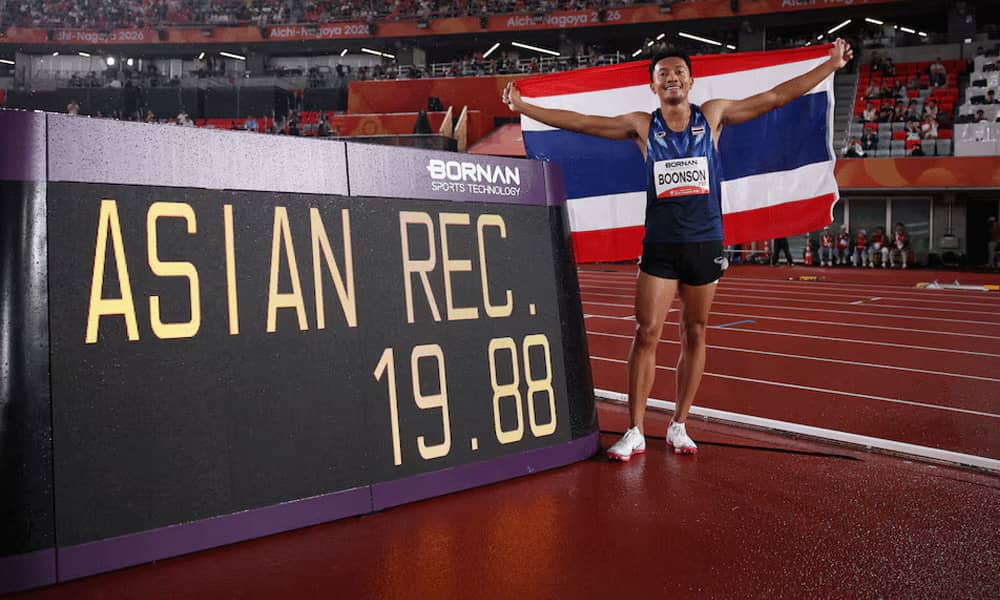

Puripol Boonson Shatters Barriers in Nagoya Sprint Double
Thai sprinter Puripol Boonson has cemented his status as one of Asia’s premier track athletes by securing the 200m gold medal at the Aichi-Nagoya Asian Games. Competing in conditions that included rain, Boonson clocked a time of 19.88 seconds to take the top step on the podium. This performance was not merely a victory; it was a historic milestone for Thai athletics, as he became the first Thai sprinter to break the elusive 20-second barrier in the event.
The significance of Boonson’s time extends beyond national pride. His 19.88-second run matched the seven-year-old Asian record previously set by China’s Xie Zhenye, placing him among the elite group of athletes to have achieved this feat on the continental stage. The achievement completes a remarkable sprint double for the Thai athlete, who had already claimed the 100m gold medal just two days prior.
Boonson’s journey to the sprint double began with his victory in the 100m final, where he finished with a time of 9.90 seconds. In that race, he established a commanding lead, finishing more than a half-second ahead of China’s Huang Youwen, who took the silver medal. The gap between Boonson and his nearest rival was substantial enough to highlight his dominance in the shorter sprint event, setting the stage for his subsequent triumph in the 200m.
Looking Ahead: Ambitions for More Records
Despite securing two gold medals and matching a continental record, Boonson remains focused on future improvements. Speaking to reporters after his 200m victory, he expressed a clear ambition to continue pushing the boundaries of speed in Asian athletics.
"I can’t say how fast it’s going to be, but it’s going to be more records and faster," Boonson stated regarding his future goals. "I aim for more golds and more records." His comments suggest that the current performance is a baseline rather than a peak, indicating that Thai sprinting may see even faster times in upcoming competitions.
Other Track and Field Highlights
While Boonson’s sprint double dominated headlines, other athletes delivered standout performances across various field events and distance races at the Nagoya Games. In the javelin throw, China’s Yan Ziyi secured the gold medal with a throw of 70.46 meters. His victory was particularly notable as he defeated Haruka Kitaguchi, the Olympic champion in the event, who finished with a mark of 62.70 meters.
In the high jump, Taiwan’s Fu Chao-hsuan claimed the title with a mark of 2.25 meters. The win was significant given the absence of former Olympic champion Mutaz Barshim, who withdrew from the competition due to injury. Fu’s performance in Barshim’s absence highlighted the competitive depth in the event.
On the track, Singapore’s Shanti Pereira retained her women’s 200m title with a time of 22.78 seconds. Her victory made her the first athlete to win the event back-to-back at the Asian Games. Pereira defeated China’s Chen Yujie by a margin of 0.15 seconds in the final. The rivalry between the two sprinters had been evident earlier in the games; Pereira had previously lost to Chen Yujie in the 100m event.
Reflecting on her redemption in the 200m, Pereira told reporters, "No, you (Chen) got it that day. Today is me. Nothing in the world is going (to) stop me." Her statement underscored the personal stakes involved in reclaiming her title after the earlier defeat.
In the women’s 3,000m steeplechase, Bahrain’s Winfred Yavi won the gold medal with a time of 9:04.36. This victory added to her previous gold medal win in the 10,000m event, showcasing her versatility and endurance across long-distance disciplines.
Marathon Race Walk and Squash Success
In the marathon race walk events, Japan’s Hayato Katsuki won the men’s title with a time of 3:03:36. Following his victory, Katsuki expressed strong confidence in his physical capabilities. "I’m confident that in terms of power, I’m the best in the world," he stated, asserting his dominance in the grueling discipline.
On the women’s side, Kazakhstan’s Yasmina Toxanbayeva won the marathon race walk gold. The event saw controversy regarding India’s Priyanka Goswami, who was disqualified from the competition.
Outside of track and field, squash provided another source of national pride for Malaysia. Ng Eain Yow and Sivasangari Subramaniam secured back-to-back gold medals in the men’s and women’s singles events, respectively. Their victories were particularly significant as they earned quota berths for the sport’s debut at the Los Angeles 2028 Olympic Games.
Subramaniam highlighted her long-term ambitions following her win. "World number one and an Olympic gold medal is my goal," she stated, indicating that the Asian Games victory was a stepping stone toward even higher achievements on the global stage.
Behind the Scenes: Controversies and Logistics
While athletes celebrated their victories, the Aichi-Nagoya Games faced scrutiny regarding logistical challenges and fan engagement. Reports indicated low fan interest in several events, raising questions about the games' popularity and commercial viability.
Additionally, athlete accommodation drew criticism for being cramped and inadequate. Competitors were housed in a mix of hotels, temporary wooden huts, and even a cruise ship. The use of such varied and potentially uncomfortable living conditions for elite athletes sparked debate about the quality of support provided by the organizing committee.
Despite these organizational issues, the athletic performances continued to deliver historic moments, with Boonson’s sprint double standing out as a highlight of the games. As the competition progresses, athletes like Boonson and Subramaniam remain focused on their goals, undeterred by the logistical challenges surrounding the event.