

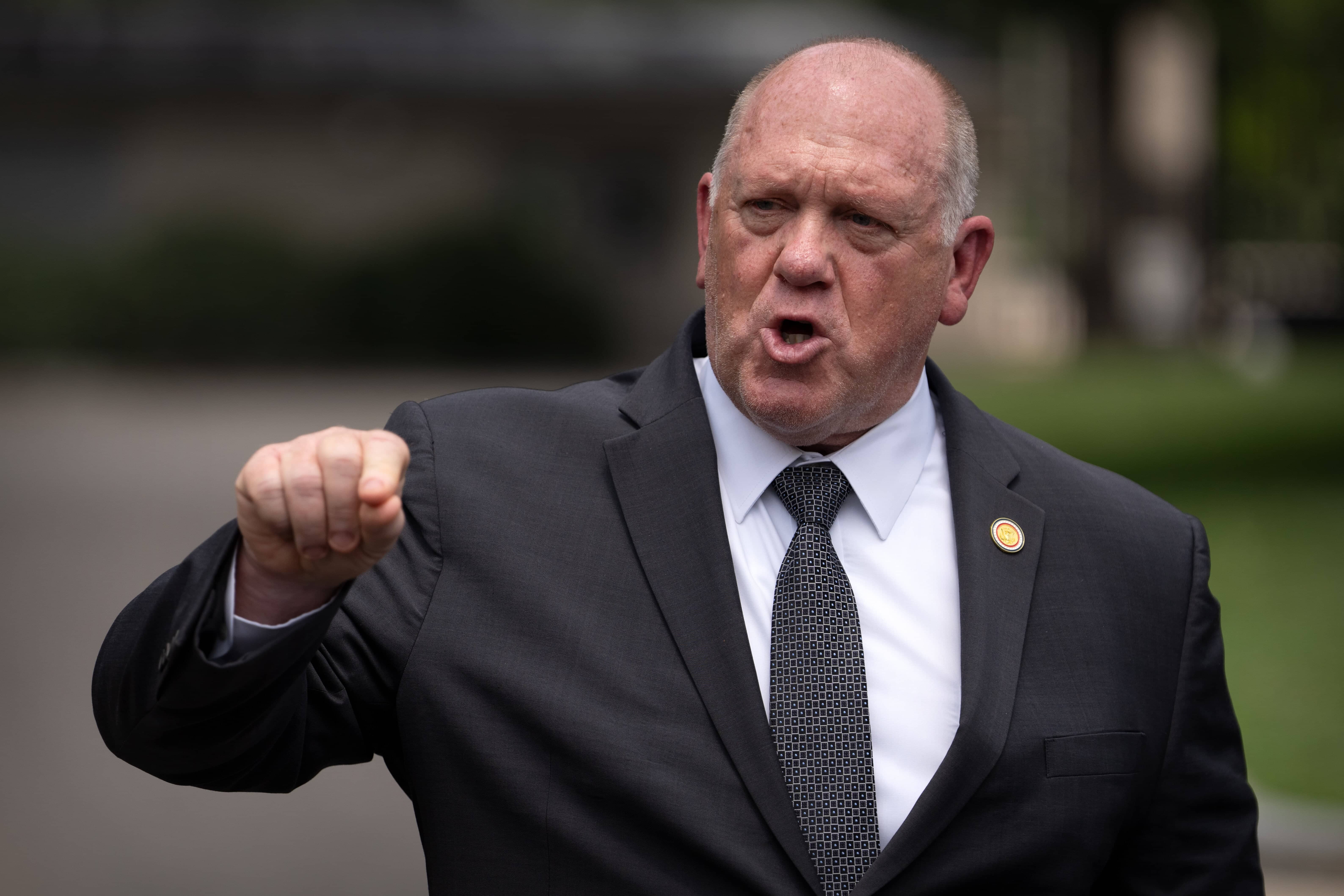

Border Czar Dismisses Racial Profiling Claims
Tom Homan, identified as President Donald Trump’s border czar, vehemently denied accusations that Immigration and Customs Enforcement (ICE) engages in racial profiling during the administration’s extensive deportation operations. His comments came in direct response to concerns articulated by Democratic Florida Senate candidate Angie Nixon, who raised alarms regarding the treatment of Black individuals by federal immigration officers.
Concerns Over Profiling of Black Individuals
Angie Nixon voiced her apprehensions on the Miami Community Newspapers Podcast, specifically highlighting fears of bias within immigration enforcement. “We’re Black, [ICE is] gonna profile us, too,” Nixon stated, expressing a belief that Black individuals, regardless of their background, could become targets. She elaborated on the perceived difficulty for enforcement agencies to differentiate between African Americans who are descendants of slaves in the United States and immigrants from various Black-majority countries, such as Jamaica or Nigeria. Nixon warned that such profiling practices could inevitably lead to escalated confrontations, potentially resulting in lethal outcomes for those involved.
Homan Rejects Allegations as 'Ridiculous'
When questioned about Nixon’s remarks by Fox News host Kayleigh McEnany on Saturday, Tom Homan swiftly dismissed them as a “ridiculous statement.” Homan firmly clarified the legal standards that he asserted govern ICE operations, stating, “Look, we don’t racially profile. Everybody we talk to we have reasonable suspicion of aliens to talk to them. And to arrest them, we need probable cause.” He underscored that these procedures are not merely guidelines but are mandated by law, emphasizing that arrests are strictly not based on an individual’s skin color. Homan’s defense centered on the principle that all enforcement actions are predicated on established legal criteria rather than racial characteristics.
Homan's "Equal Opportunity Deporter" Stance
In an effort to further illustrate what he described as the non-discriminatory nature of his office’s work, Homan adopted a specific moniker to characterize his role and the scope of ICE’s enforcement. He referred to himself as an “equal opportunity deporter,” a term he used to assert that enforcement actions are carried out without prejudice, irrespective of an individual’s country of origin or racial background. This self-description aimed to convey a message of universal application of immigration laws.
To bolster his claim of impartiality, Homan cited statistics from the previous year, highlighting the broad reach of ICE’s deportation efforts. He noted that individuals were deported to 180 countries, a figure he presented as evidence that enforcement was not concentrated on any particular demographic or region. “I don’t care if you’re from Asia, you’re from Europe, or from other countries. If you’re in the country illegally, you’ll be deported, regardless of the color of your skin,” Homan declared. This statement reinforced his position that the sole criterion for deportation under his purview was an individual’s unlawful presence in the United States, rather than their ethnic or national identity.
Supreme Court Rulings Permit Racial Factors in Enforcement
Despite Tom Homan’s public denials of racial profiling, records indicate a significant divergence between his public statements and the legal positions taken by the Trump administration concerning immigration enforcement. Specifically, the administration had previously sought to allow immigration officers to consider certain racially loaded factors as justification for arrests, a stance that appears to contradict Homan’s assertions of color-blind enforcement.
Administration's Legal Push for 'Racially Loaded Factors'
Last year, the Trump administration explicitly asked the Supreme Court to intervene and block a lower court order. This lower court order had prohibited immigration officers in Los Angeles from utilizing what were described as “racially loaded factors” as a basis for making arrests. This request by the administration suggested a legal strategy that sought to expand the permissible considerations for immigration officers, potentially including elements that could be interpreted as racial profiling, despite Homan’s public disavowals.
Perdomo v. Noem Decision Opens Door for ICE
This legal maneuver by the administration coincided with a pivotal legal development in the case of Perdomo v. Noem. A 6-3 decision by the Supreme Court, issued last year, reportedly opened the door for ICE to use certain racial factors as legitimate grounds for immigration stops. This ruling introduced a new legal precedent that could significantly influence how immigration officers conduct their operations. The decision in Perdomo v. Noem stands in stark contrast to Homan’s public assertion that his office does not profile individuals based on race, highlighting a clear divergence between the administration’s legal arguments presented in court and its public statements regarding the protocols and principles guiding immigration enforcement.