

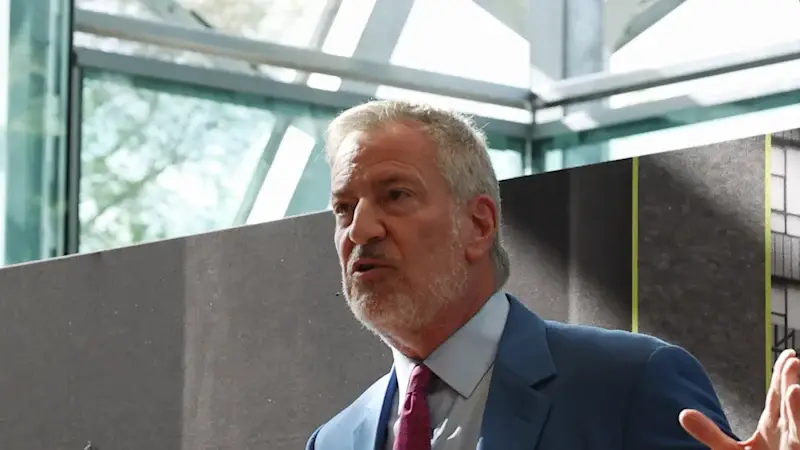

A Question That Echoed Through Federation Square
At The Edge in Federation Square last week, a single question posed by former New York mayor Bill de Blasio hung in the air, leaving many in the packed room speechless. The query was not about policy minutiae or immediate political maneuvering, but rather something far more fundamental to the identity of the city itself: Is there a clearly articulated, broadly understood strategic vision for the future of Melbourne?
The silence that followed was telling. In response to this direct inquiry, only three hands were raised in the audience. Two belonged to Melbourne Lord Mayor Nick Reece and one to former premier Steve Bracks. The scarcity of raised hands underscored a palpable uncertainty among the attendees regarding the coherence of the city's long-term direction.
De Blasio’s reaction was measured but pointed. "I’m glad there are some," he stated, acknowledging the few who signaled an understanding of such a vision. He added, "If they know it, that’s a start." His comment served as both a critique and a challenge to the assembled leaders and citizens, suggesting that while awareness exists in isolated pockets, a collective, shared strategic framework remains elusive.
The Melbourne Assembly Context
This exchange took place during an event presented by The Age in partnership with the University of Melbourne, known as the Melbourne Assembly. The forum was designed to bring together key figures from politics, urban planning, and academia to discuss the trajectory of Victoria’s capital. It provided a stage for high-level discourse on issues ranging from housing affordability to urban design and economic resilience.
The event featured a lineup of prominent political figures who sought to outline their respective visions for the state. Opposition Leader Jess Wilson and Premier Ben Carroll shared their perspectives, allowing audience questions facilitated by state political editor Chip Le Grand. Their participation highlighted the intense political interest in Melbourne’s future, with both major parties eager to position themselves as the architects of the city’s next chapter.
Adding to the depth of the discussion were Prime Minister Anthony Albanese and Carlos Moreno, the pioneer of the 15-minute city concept. Both shared their views with the audience, bringing national and international perspectives to the local debate. Moreno’s presence was particularly significant given his global influence on urban planning paradigms, offering a contrast to the domestic political narratives being presented.
De Blasio’s Warning on Civic Conversation
De Blasio’s intervention was not merely an observation but a warning about the state of civic engagement. He stated, "If you are in a conversation and no one ever asks..." The sentence trailed off, leaving the implication clear: the absence of questioning indicates a failure of democratic dialogue and strategic clarity. His reference to his time as mayor of New York lent weight to his critique, drawing on his experience with a city that has also grappled with complex urban challenges.
The limited response to his question—only three hands from such a distinguished group including the Lord Mayor and a former premier—suggested that even those at the helm of Melbourne’s governance may not have a unified or widely communicated vision. This lack of clarity was further emphasized by the diverse array of speakers who followed, each presenting their own fragmented pieces of the puzzle without necessarily connecting them into a cohesive whole.
Implications for Melbourne’s Future
The speechlessness that followed de Blasio’s question reflected a broader anxiety among Melburnians about the city’s direction. Without a clearly articulated strategic vision, debates on housing, transport, and infrastructure risk becoming disjointed and reactive rather than proactive and coordinated. The presence of figures like Carlos Moreno, who advocates for integrated urban planning models, highlighted the gap between theoretical best practices and the current political reality in Melbourne.
As the Melbourne Assembly concluded, the question remained unanswered: Who is responsible for articulating this vision, and how will it be communicated to the public? The event served as a microcosm of the larger challenge facing Melbourne’s leaders—bridging the gap between political rhetoric and tangible, shared strategic goals. Until that gap is closed, the city may continue to struggle with the kind of coherent planning that de Blasio suggested was essential for its future success.