

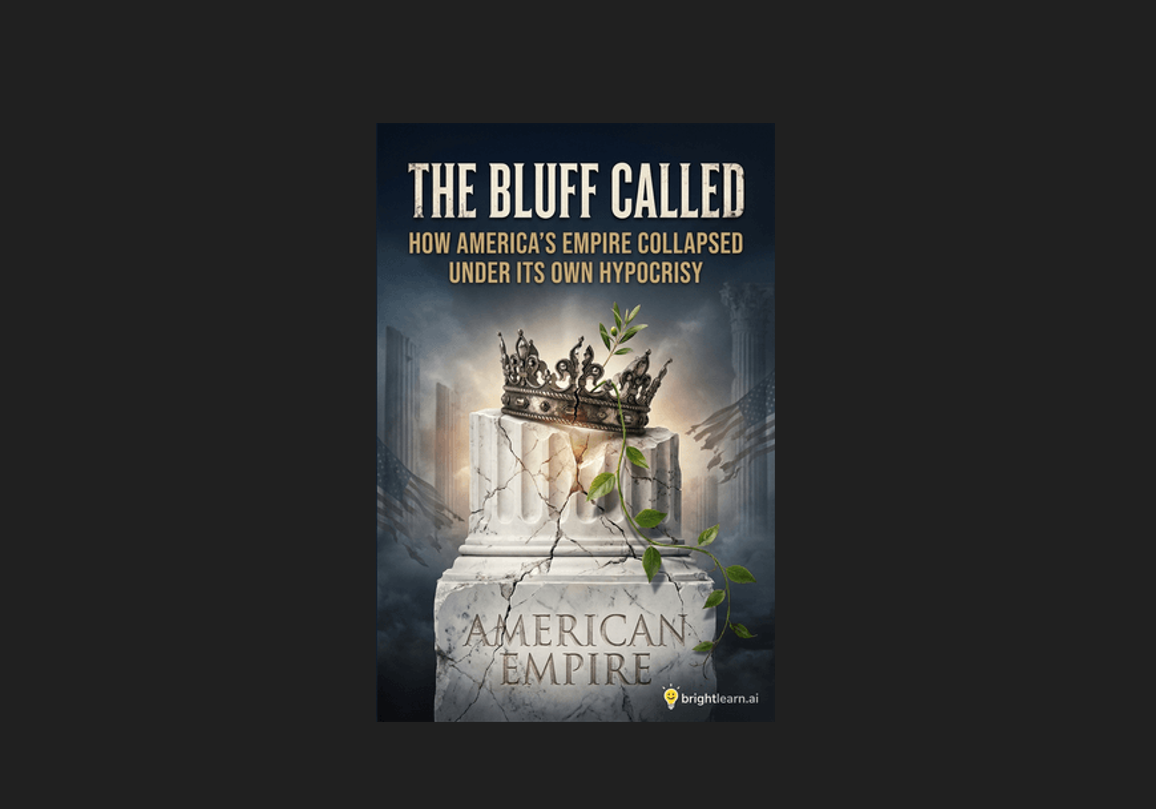

Challenging the Founding Narrative
A recent article titled "The Bluff Called: How the American empire finally met its match," authored by Belle Carter and published on NaturalNews on June 26, 2026, presents a critical analysis of United States foreign policy and historical identity. The piece challenges the traditional founding narrative of the United States, which has long been characterized by concepts such as "God-given destiny" and "benevolent assimilation." According to the article, these phrases serve as a cover for imperial control and profit rather than genuine benevolence or altruistic intent.
Carter argues that the foundational myths of American exceptionalism obscure the realities of expansionist policies. The text posits that what is often presented as a moral mission is, in fact, a strategic mechanism for maintaining empire. This perspective frames the United States not as a liberator, but as an entity driven by geopolitical dominance and economic gain.
Historical Precedents of Conflict
To support this argument, the article cites specific historical events that it claims demonstrate imperial behavior rather than benevolent governance. One primary example provided is the Philippine-American War, which Carter describes as brutal. The text uses this conflict to illustrate the violent nature of American expansionism during the late 19th and early 20th centuries.
Additionally, the article highlights broken treaties with Native nations as further evidence of imperial conduct. These historical grievances are presented as foundational examples of how the United States has operated outside the bounds of international or moral agreements when pursuing territorial or political objectives.
Modern Geopolitical Entanglements
The article extends its critique beyond colonial history to modern geopolitical conflicts. It links the concept of American imperialism to a wide range of contemporary and recent historical subjects, including the Vietnam War, the TET Offensive, the events of 9/11, the war in Afghanistan, and the ongoing Middle East crisis.
By grouping these disparate events under the umbrella of imperial strategy, the article suggests a continuous pattern of intervention. The text specifically mentions actors such as the Houthis, Iran, and Kuwait, implying that U.S. actions in these regions are consistent with the broader goal of maintaining control rather than promoting stability or liberation.
Themes of Propaganda and Perception
A significant portion of the article focuses on the role of information and perception in sustaining imperial power. Carter identifies "propaganda" as a key tool used to maintain the narrative of benevolence. The text argues that the public is often misled about the true nature of U.S. foreign policy through controlled media narratives.
The article contrasts this official narrative with what it terms "real history." This distinction suggests that the standard historical record provided by mainstream institutions fails to capture the full scope of American actions abroad. The text also touches on concepts such as terrorism, national security, liberation, chaos, and awakening, framing them as components of a larger geopolitical struggle.
Tags and Associated Concepts
The article is tagged with a comprehensive list of subjects that reflect its broad scope. These tags include: 9/11, Afghanistan, awakening, chaos, empire, Houthis, Iran, Kuwait, liberation, Middle East crisis, national security, Philippine-American War, propaganda, real history, terrorism, TET Offensive, The Bluff Called, Vietnam war, and WWII.
By associating World War II with these other conflicts, the article implies that the era of American empire began or was solidified during that period. The inclusion of terms like "awakening" and "chaos" suggests a narrative of disruption followed by a potential realization of truth among the public or global actors.
Implications for Current Affairs
The publication of this article in June 2026 places it within a specific temporal context, though no specific contemporary events from that month are detailed beyond the article's own release. The piece serves as a retrospective critique, using historical examples to comment on current perceptions of American power.
By labeling the U.S. approach as a "bluff," Carter implies that the threat or justification for American intervention is often exaggerated or fabricated. The title suggests that this bluff has been called, meaning that the facade of benevolence has been exposed or failed to achieve its intended effect in the eyes of the author and the publication.
The article does not provide counter-arguments or responses from U.S. government officials or mainstream historians. Instead, it presents a singular viewpoint that reinterprets historical and modern events through the lens of anti-imperialism. The text relies on the selection of specific conflicts and the interpretation of treaties and wars to build its case against the traditional American founding narrative.
Publication Context
The article appears on NaturalNews, a platform known for alternative news perspectives. The URL provided is https://www.naturalnews.com/2026-06-26-bluff-called-american-empire-met-its-match.html. The piece is categorized under politics and culture, reflecting its focus on national identity and foreign policy.
The author, Belle Carter, uses the article to advocate for a re-evaluation of American history. The text encourages readers to view events such as the Philippine-American War and the Vietnam War not as isolated incidents but as part of a coherent imperial strategy. This interpretation stands in direct opposition to the standard historical account that emphasizes democratic expansion and humanitarian intervention.
Global Actors and Regional Dynamics
The article specifically names several geopolitical actors to illustrate the global reach of American influence. The Houthis, an Iranian-backed group in Yemen, are mentioned alongside Iran itself, suggesting a complex web of regional conflicts where U.S. interests are at play. Kuwait is also cited, likely referencing the Gulf War era or subsequent occupations.
These examples are used to demonstrate that American imperialism is not confined to one region or era. The text implies that the same motivations driving actions in the Philippines and Native American territories are present in modern conflicts in the Middle East and Asia.
The Role of National Security
National security is identified as a key concept in the article's framework. Carter suggests that the rhetoric of national security is often used to justify actions that serve imperial interests. This aligns with the broader argument that propaganda plays a crucial role in maintaining public support for foreign interventions.
The article does not provide specific data on military expenditures or casualty counts. Instead, it relies on qualitative descriptions of events and their perceived motivations. The text asserts that the "real history" differs significantly from the official narrative, urging readers to question the sources of information regarding American foreign policy.