

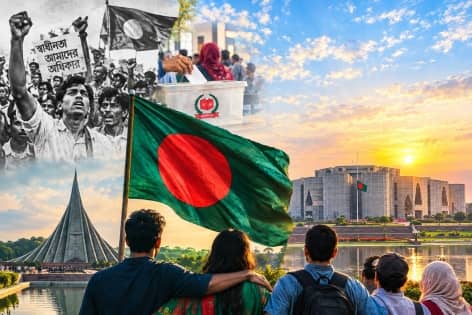

Bangladesh Embraces Renewed Democratic Path
DHAKA, Sept. 14 — Bangladesh is marking the International Day of Democracy with reports indicating a renewed focus on democratic governance following a significant political changeover earlier this year. According to a report by the Bangladesh Sangham (BSS) published on Sept. 14, 2026, the nation appears to be establishing a stronger footing in democratic practices after the February 2026 elections.
The BSS article states that the Bangladesh Nationalist Party (BNP) secured an "overwhelmed majority" in the vote held on Feb. 12, 2026, and subsequently assumed office. This electoral outcome, which saw the BNP take the reins of power, is presented as a pivotal moment in the country's recent political trajectory. The report characterizes the current political landscape as one reshaped by good governance and the rule of law under Prime Minister Tarique Rahman, who leads the BNP.
The article suggests that citizens are beginning to appreciate the value of democracy after a period of deprivation. "The people of Bangladesh are now beginning to feel and appreciate the value of the democracy they had been deprived of for years," the report stated, highlighting a perceived shift in public sentiment following the recent political transition.
From Autocracy to Uprising: A Recent History
The current political assessment, as reported by BSS, draws a stark contrast with the preceding administration led by Sheikh Hasina. Hasina’s rule is described as "autocratic" and is noted to have lasted for nearly 16 years. This extensive period of governance concluded abruptly on Aug. 5, 2024, following a massive student-led popular uprising that swept across the nation.
Years of Repression and Political Turmoil
The era under Sheikh Hasina is characterized by the BSS article as involving "years of repression and a long, painful and bloody political history." This description paints a picture of a challenging period for the nation, marked by political strife and a perceived suppression of democratic norms. The report explicitly links the public's current appreciation for democracy to the experience of being "deprived of for years" under the previous regime, suggesting a collective memory of hardship that now informs the public's embrace of the new political course.
Student-Led Uprising Ends Long Rule
The student-led popular uprising that culminated on August 5, 2024, is identified as the decisive event that ended Sheikh Hasina's "misrule." This mass movement, driven by student activism, is presented as a critical turning point, paving the way for the subsequent political changeover. The conclusion of Hasina's nearly 16-year tenure marked a distinct break from the past, setting the stage for the democratic re-emergence that the BSS article now celebrates.
The 2026 Elections and a New Political Era
Following the significant political upheaval of 2024, the nation proceeded to a general election on February 12, 2026. The BSS source material describes this election as "participatory," emphasizing a broad engagement from the populace in the democratic process after the preceding period of autocratic rule. It was on this date, according to the BSS article, that democracy "reemerged" in Bangladesh, defining its new course under the leadership of Prime Minister Tarique Rahman and the Bangladesh Nationalist Party.
A Participatory Mandate for the BNP
The overwhelming majority secured by the BNP in the February 2026 elections is presented as a clear mandate from the people. This outcome is portrayed as a direct consequence of the desire for a return to democratic principles and an end to the perceived misrule of the past. The formation of the new government under Prime Minister Rahman is thus framed as the formal establishment of a renewed democratic framework, committed to upholding the rule of law and ensuring good governance.
Early Assessments of Governance Under Tarique Rahman
While the BSS report highlights the transition of power and the establishment of a new governance framework, it does not provide independent verification of the electoral process or specific policy outcomes implemented by Prime Minister Rahman’s administration since taking office. The claims regarding the quality of governance and the appreciation of democracy are attributed directly to the BSS reporting, reflecting the perspective offered by the state news agency on the current political climate in Bangladesh.
International Day of Democracy and Diplomatic Ties
The observance of the International Day of Democracy on September 14, 2026, takes on particular significance for Bangladesh in light of its recent political history. The day serves as a global platform to review the state of democracy worldwide, and for Bangladesh, it provides an opportunity to reflect on its journey from autocratic rule to its reported re-establishment of democratic norms.
Global Affirmation of Democratic Principles
As the country marks this international day, the focus remains firmly on the political shift that occurred in 2024 and the subsequent electoral outcomes of 2026. The BSS article frames these events as a restoration of democratic norms after the specified period of autocratic rule, aligning Bangladesh's narrative with the broader global celebration of democratic values and institutions.
Parliamentary Diplomacy in the Region
In related news, the renewed democratic focus within Bangladesh coincides with other diplomatic developments in the region. Recent reports indicate that Bangladesh and Pakistan have stressed the importance of parliamentary diplomacy to strengthen bilateral ties. This emphasis on inter-parliamentary engagement suggests a broader commitment to democratic processes not only domestically but also in fostering international relations, reflecting a new chapter in the country's engagement with its neighbors.