


Bangladesh Grapples with Deep Structural Weaknesses
Two years after the landmark July Uprising, Bangladesh continues to grapple with significant and entrenched challenges, even with the restoration of democratic rule. The nation remains burdened by deep structural weaknesses that policymakers are actively confronting, hindering the anticipated post-authoritarian recovery. These critical issues include mounting national debt, fragile public finances, and ongoing turmoil within the vital banking sector, all contributing to a complex economic landscape that requires urgent attention.
Energy Shortages and External Shocks
Compounding these internal economic pressures is a severe energy crisis that has been significantly exacerbated by ongoing conflicts in the Middle East. According to reports published on Wednesday, August 5, 2026, these external geopolitical factors have triggered an acute energy shortage, presenting a formidable obstacle to stability and economic growth. This situation clouds recovery prospects, forcing the current administration to contend with a series of political and economic shocks that have deep roots in the preceding authoritarian era. The lack of an immediate solution to the energy crunch further complicates the path to economic revitalization.
Fragile Public Finances and Banking Sector Instability
Policymakers are currently confronting specific and pressing financial challenges that underscore the nation's economic fragility. The banking sector, a cornerstone of any stable economy, is experiencing significant turmoil, characterized by instability and a lack of confidence. This instability directly contributes to the precarious state of public finances, making it difficult for the government to implement necessary reforms, invest in critical infrastructure, and stimulate broader economic growth. These financial instabilities are not isolated incidents but are part of the broader structural weaknesses that have persisted and deepened since the political transition began, reflecting a legacy of mismanagement and lack of transparency from the previous regime.
Slow Pace of Democratic Recovery Two Years On
The July Uprising, which occurred two years prior to August 5, 2026, marked the end of the Awami League’s 15-year authoritarian rule and ushered in a new era with high expectations for democratic reform and economic recovery. However, despite the democratic transition, the pace of both political and economic recovery remains notably slow. An elected government took office in February 2026, yet six months into its tenure, the nation is still struggling to overcome the inertia and damage inflicted by years of autocratic governance.
From Uprising to Interim Governance
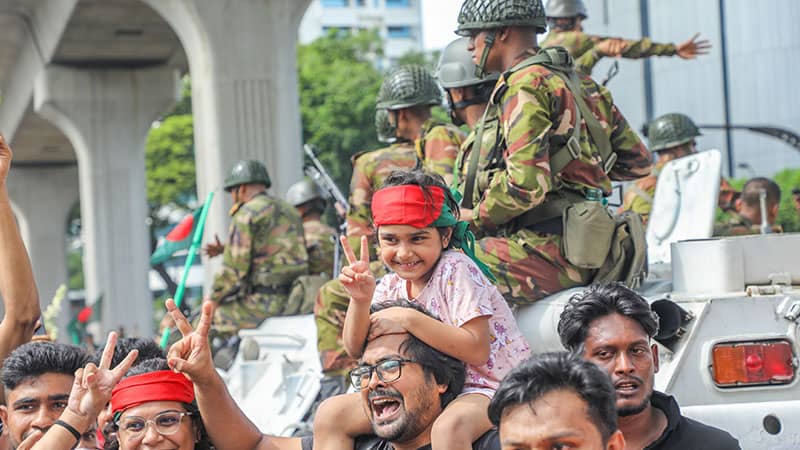
The student-led mass uprising that culminated in the end of the Awami League’s 15-year authoritarian rule ignited widespread hopes for profound democratic reform, genuine political reconciliation, and robust economic recovery among the populace. The interim government that was established immediately following the uprising inherited these heightened hopes, but it faced immediate and substantial obstacles in maintaining momentum. While political parties made some progress in narrowing differences during this transitional period, fundamental divides persisted, preventing a swift and unified path forward. This stalled momentum during the interim phase contributed to the prolonged challenges now faced by the fully elected government, delaying the realization of the initial promise of the uprising.
The New Administration's Early Challenges
The current elected government, which assumed office in February 2026, represents a crucial new phase in Bangladesh's political landscape. However, its first six months have been characterized by an arduous struggle to address the inherited problems. The administration is dealing with a complex array of political and economic shocks, all of which stem directly from the authoritarian era that preceded it. The slow progress on both fronts underscores the profound depth of the issues at hand, from institutional decay and a hollowed-out civil service to economic imbalances and a crisis of public trust, demanding a comprehensive and sustained effort to rebuild and stabilize the nation.
A Protracted Political Timeline
The timeline of recent events highlights the protracted and challenging nature of Bangladesh's transition back to full democratic functionality. The pivotal July Uprising occurred two years prior to the current reporting date of August 5, 2026. Following the dramatic events of the uprising, an interim government was swiftly established to manage the immediate aftermath and prepare for a democratic future. Subsequently, an elected government officially took office in February 2026. As of the current reporting, this new administration has been in power for six months, navigating the complex legacy of authoritarian rule and the ongoing demands for reform and recovery, demonstrating the long road ahead for the country.
Enduring Scars of Authoritarian Rule
Political and economic theorists consistently warn that recovery from prolonged dictatorship is rarely swift or straightforward. Removing an autocrat, while a critical first step, does not automatically restore normalcy or erase the deep-seated damage inflicted over years of autocratic governance. Experts cited in various reports on post-authoritarian transitions emphasize that such rule systematically degrades state institutions, severely damages the national economy, deepens existing political fractures, hollows out the civil service, and fundamentally erodes public trust in government and societal structures.
Degradation of State Institutions and Public Trust
The impact of the Awami League's 15-year authoritarian rule extends far beyond immediate economic metrics or political headlines. During this prolonged period, state institutions were systematically weakened and compromised, losing their independence and effectiveness. Concurrently, the civil service, vital for effective governance, was significantly hollowed out, diminishing its capacity, professionalism, and neutrality. These institutional damages, coupled with a pervasive erosion of public trust, are direct symptoms that Bangladesh has exhibited since the 2024 uprising. The country's current struggles reflect the deep-seated and systemic damage inflicted during the previous regime's tenure, making the task of rebuilding both governance and citizen confidence a monumental undertaking.
The Long Road to Rebuilding
Consequently, the process of rebuilding and stabilizing a post-dictatorship state is universally described as a long, arduous, and often unpredictable journey. Bangladesh's current struggles, two years after the uprising, are a stark reflection of this reality. The nation is contending with the profound and multi-faceted damage inflicted during the previous regime's 15-year tenure, which affected every aspect of public life—from economic stability and institutional integrity to political cohesion and social trust. The path to full recovery requires not only addressing immediate crises but also undertaking fundamental reforms to repair the very foundations of the state and society, a process that demands sustained effort and patience.