


Beijing Voices Strong Opposition to Trilateral Drills
China has formally registered its strong opposition to a series of joint military exercises currently being conducted by Japan in collaboration with the United States and Australia. The condemnation came from Jiang Bin, a spokesman for China’s Ministry of National Defence, who specifically addressed the increasing military coordination between Tokyo and its Western allies in the Indo-Pacific region.
Jiang Bin's remarks were issued in response to reports confirming that Japan's Ground Self-Defence Force is leading a large-scale joint exercise, officially designated as "Oriental Shield 26." The Chinese defense official articulated Beijing's view that these activities, when considered alongside Japan’s forward deployment of long-range offensive weapons, significantly escalate the risk of military confrontation within the region.
China's Concerns Over Regional Escalation
The Ministry of National Defence's statement, while not detailing potential retaliatory measures or specific further diplomatic actions, underscored Beijing's profound concern over the deepening security ties among Japan, the United States, and Australia. China views such trilateral military engagements as contributing to regional instability and challenging the existing security architecture.
The spokesman emphasized that the combination of large-scale drills and the strategic positioning of advanced weaponry by Japan represents a concerning trend. Beijing interprets these actions as more than mere defensive posturing; rather, they are seen as aggressive maneuvers that inherently heighten the potential for conflict in an already sensitive geopolitical landscape. This perspective aligns with China's consistent diplomatic stance regarding the expanded military presence of the United States and its allied cooperation in East Asia.
"Oriental Shield 26" Unfolds Across Japanese Prefectures
The joint military drill, known as "Oriental Shield 26," involves a substantial contingent of forces from Japan, the United States, and Australia. Japan's Ground Self-Defence Force (GSDF) is at the forefront of this operation, which incorporates significant airborne components designed to test and enhance rapid deployment capabilities and interoperability among the three participating nations.
Airborne Operations Highlight Interoperability Focus
The exercises are strategically scheduled to take place across two key Japanese prefectures: Hokkaido in the north and Kagoshima in the south. The operational window for these intensive drills spans from September 8 to September 24. Throughout this period, participating forces are engaged in a wide array of coordinated training activities, all aimed at strengthening their collective defense capabilities and ensuring seamless cooperation in potential future scenarios.
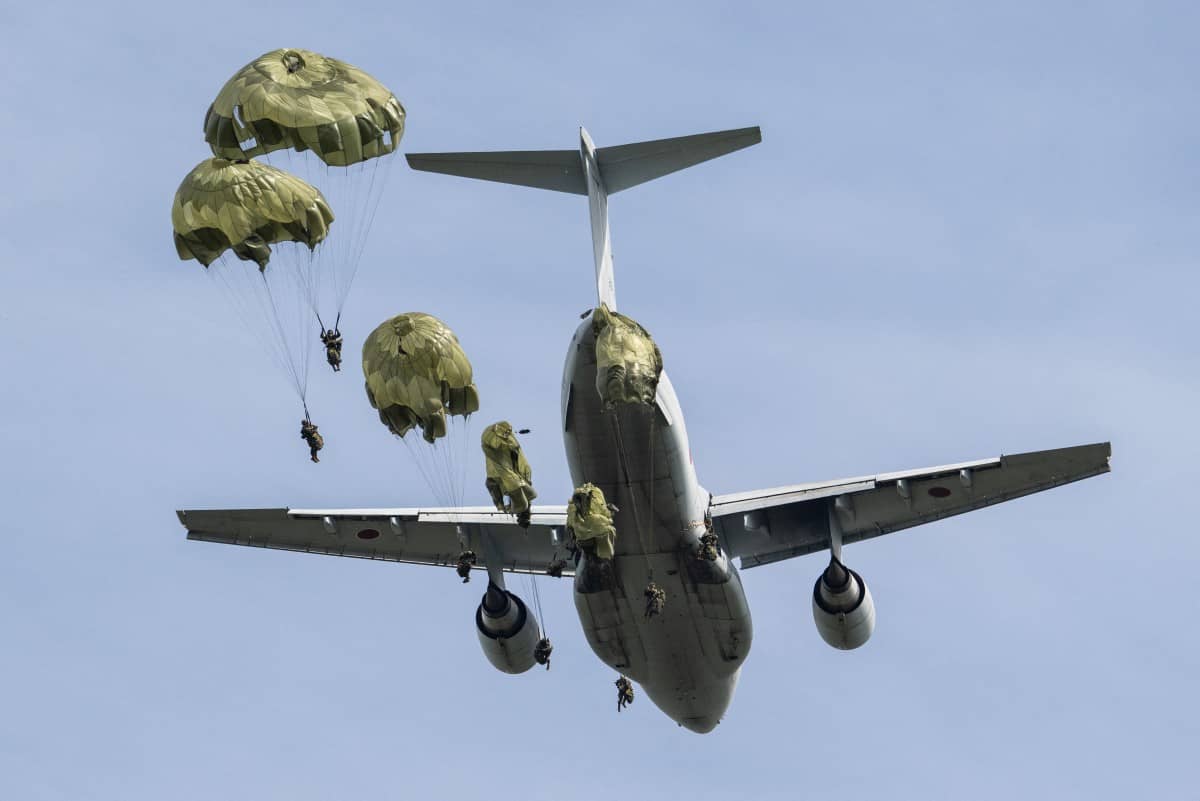
Visual documentation released by Japanese authorities has provided a glimpse into the scale and complexity of "Oriental Shield 26." Notably, images captured on September 15, 2026, depicted paratroopers from Japan's elite 1st Airborne Brigade executing jumps from a Kawasaki C-2 transport aircraft. These airborne drops were conducted at the Kita-Dalen Training Area, located in Eniwa, Hokkaido, showcasing a critical aspect of modern rapid response military operations. The footage was disseminated through the Asia News Network, with credit attributed to the AFP, highlighting the international attention on these drills.
Japan's Weapon Deployments Fuel Chinese Criticism
Beyond the immediate scope of the joint drills, Jiang Bin specifically highlighted Japan's ongoing deployment of long-range offensive weapons as a significant point of contention for Chinese officials. The Ministry of National Defence characterized these deployments as an integral part of a broader pattern of military expansion in the region, which Beijing believes actively contributes to instability rather than deterrence.
By explicitly linking the "Oriental Shield 26" joint exercises with the forward positioning of advanced weaponry, China is framing these activities not merely as routine training but as concerted aggressive moves. This strategic interpretation by Beijing suggests that it perceives a coordinated effort to enhance offensive capabilities and project power, thereby increasing the likelihood of military confrontation rather than ensuring regional peace.
Indo-Pacific Security Architecture Under Strain
The "Oriental Shield 26" exercise stands as one of several recent instances of intensified trilateral military cooperation among Japan, the United States, and Australia. These collaborative drills are integral to a broader strategic initiative aimed at strengthening defense capabilities and deterrence in the expansive Indo-Pacific region, a zone of increasing geopolitical competition.
Allied Cooperation Amidst Geopolitical Tensions
Japan's Ground Self-Defence Force has been consistently working towards deeper integration with both US and Australian forces across various training scenarios. The inclusion of complex airborne operations, such as the paratrooper jumps observed in Hokkaido, underscores a deliberate focus on enhancing rapid response mechanisms, logistical coordination, and overall interoperability among the allied militaries. These efforts are seen by the participating nations as crucial for maintaining regional stability and responding effectively to diverse security challenges.
Beijing's Consistent Warnings on Military Expansion
China’s sharp reaction to these developments is largely interpreted by analysts as a strategic attempt to deter further military integration and capability enhancement among what it perceives as its regional adversaries. However, initial reports regarding Jiang Bin's statements did not include any official response from the Japanese government or the participating US and Australian defense ministries, indicating a potential diplomatic standoff.
As the "Oriental Shield 26" exercises continue through their scheduled end date of September 24, with participants conducting a variety of maneuvers across the designated training areas in Hokkaido and Kagoshima, the long-term implications for regional security architectures remain a prominent subject of ongoing diplomatic discussion and strategic analysis among all involved parties. The interplay between increased allied military cooperation and China's strong condemnations continues to shape the complex security landscape of the Indo-Pacific.