

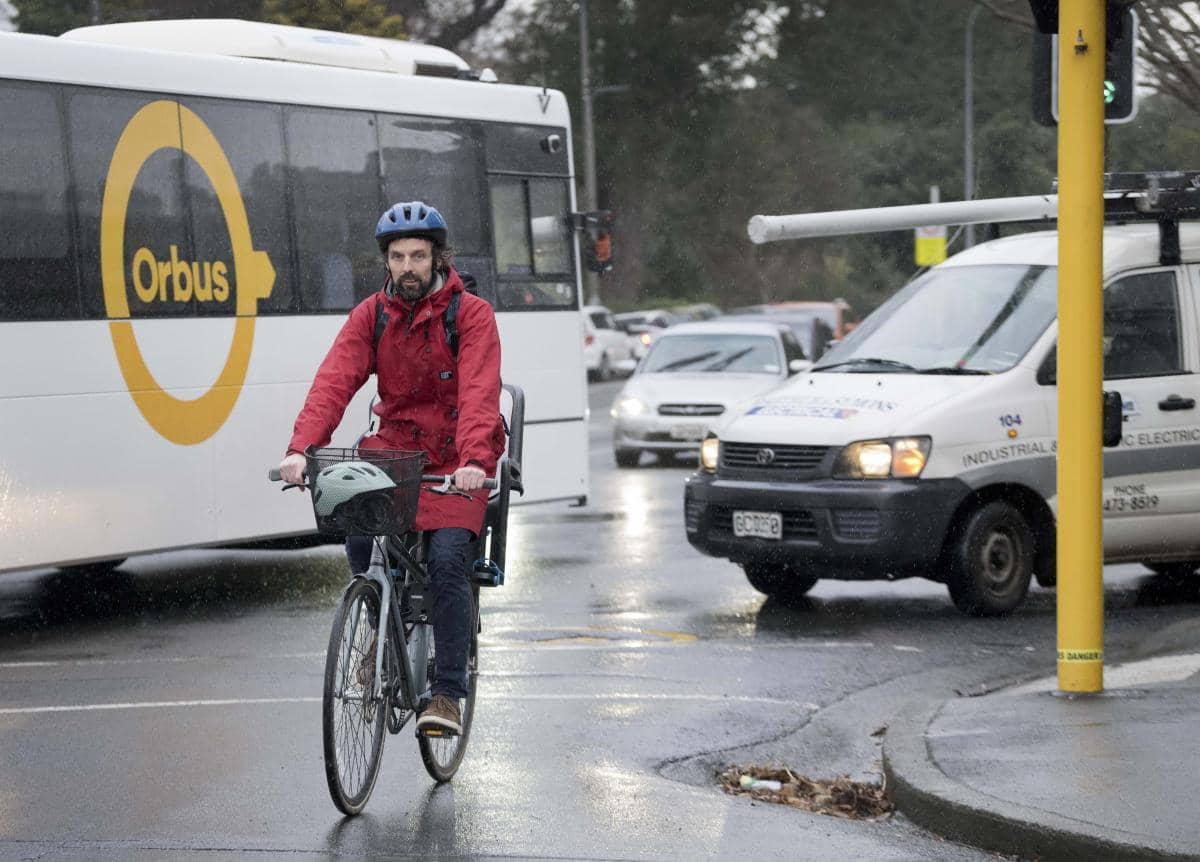

Dunedin’s cycling infrastructure continues to face significant challenges, with reports describing the city’s cycle network as fundamentally fragmented. Despite a draft strategy currently being developed by the local council to tackle these systemic issues, riders on the ground argue that the timeline for implementation is insufficient to meet immediate safety needs.
Infrastructure gaps at key intersections
A specific instance of this fragmentation has been documented at the Botanic Garden intersection on North Road. John Parker, a local commuter who travels home through this area daily, noted that the designated cycle lane effectively disappears at this junction. The visual evidence provided by photographer Gerard O’Brien captures the precarious nature of the path where it meets the main roadway.
The physical discontinuity at North Road represents more than a minor inconvenience; according to available reports, such gaps in the network are directly linked to an increase in crashes. The current configuration fails to provide continuous protection for cyclists navigating through parts of the city center and residential zones alike.
Cyclist concerns over implementation speed
While council officials have indicated that a draft strategy is underway, representatives from the cycling community express deep concern regarding the pace of progress. Cyclists state explicitly that solutions are too slow coming to address the existing hazards on the road network.
The delay in finalizing and executing improvements has led to persistent safety issues for those who rely on bicycles as a primary mode of transport or recreation within Dunedin’s urban environment. The gap between identifying problems like the North Road discontinuity and resolving them remains wide, according to accounts from riders active in the city.
Impact on emissions reduction goals
Beyond immediate safety risks involving collisions at intersections like Botanic Garden, the state of the cycle network is also tied to broader environmental objectives. Reports indicate that the current failure to provide a robust and connected infrastructure contributes to an inability to slash traffic-related emissions.
Cyclists argue that without reliable routes such as those on North Road, fewer people choose bicycles over motor vehicles for their daily commutes. This shift in behavior is critical for reducing pollution levels caused by private car usage in Dunedin’s streets and surrounding areas.
Fragmentation persists despite planning efforts
The description of the network as fragmented appears to be a consensus among those observing the current state of affairs. A draft council strategy is being developed with the intent of addressing these specific issues, yet the perception remains that progress has been incremental rather than transformative.
John Parker’s experience commuting home serves as a tangible example of why the fragmentation matters to ordinary citizens. The disappearance of cycle lanes at intersections creates unpredictable conditions where drivers and cyclists must navigate without clear guidance or protected paths.
Critical need for faster action
According to statements made by local cycling advocates, the outcome of the current situation is a continued presence of crashes alongside an inability to meet pollution reduction targets. The proposed solutions are viewed as too slow coming to effectively mitigate these risks before they result in further incidents.
The disconnect between the planning phase and actual road improvements leaves many Dunedin residents exposed to danger on their daily journeys. As the draft strategy moves through development, critics maintain that immediate action is required rather than waiting for long-term plans to materialize fully.