

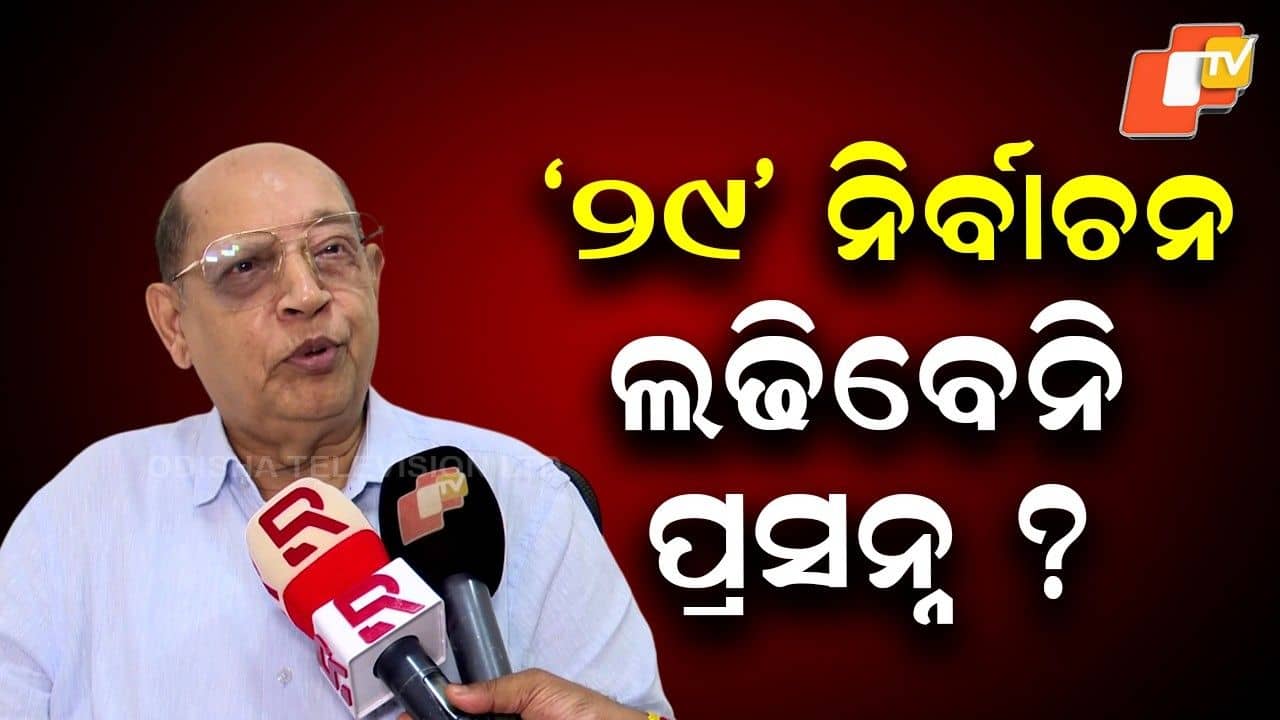

Acharya Emphasizes Generational Transition in Politics
Prasanna Acharya, a prominent leader of the Biju Janata Dal (BJD) and the current Opposition Deputy Leader, has sparked considerable discussion within Odisha's political circles with recent remarks concerning the future of political leadership, particularly in the context of the 2029 elections. While his statements stopped short of an explicit declaration of withdrawal from the electoral contest, they have nonetheless intensified speculation regarding his long-term political trajectory and the potential for significant shifts within the party.
Acharya unequivocally stressed the critical necessity of providing ample opportunities for the younger generation to assume greater responsibilities within the political sphere. He articulated a perspective that the traditional understanding of political engagement, often narrowly defined by contesting elections or holding specific legislative offices such as Member of Parliament (MP) or Member of Legislative Assembly (MLA), is incomplete. According to Acharya, the broader responsibility of governance and active political participation must undergo a gradual and deliberate transition, empowering youth as the political landscape continues its inevitable evolution.
These remarks have been widely interpreted by political observers and party insiders as a significant, albeit nuanced, signal regarding his potential availability for the 2029 polls. Given that the next general elections are still several years away, the timing of his statements has prompted questions about whether he intends to strategically step aside, thereby creating space and making way for new blood and fresh perspectives within the BJD's ranks.
A Veteran's Call for New Leadership
As a seasoned politician holding the influential position of Opposition Deputy Leader, Acharya's comments carry substantial weight. His advocacy for generational change is seen not merely as a personal reflection but as a potential blueprint for the BJD's future strategy. The emphasis on empowering youth suggests a recognition of the evolving demands of modern politics, which often require new approaches, technological fluency, and a direct connection with younger demographics.
Acharya's vision implies a structured handover of political responsibility, moving beyond the conventional metrics of electoral success. This broader definition of political engagement could encompass roles in party organization, policy formulation, public advocacy, or mentorship, allowing experienced leaders to continue contributing without necessarily occupying elected positions. Such a transition, if adopted, could significantly reshape the internal dynamics and succession planning within the Biju Janata Dal.
Historical Precedents Cited for Non-Electoral Political Roles
To lend weight to his perspective on diverse forms of political participation, Acharya drew upon historical figures who profoundly influenced national politics without ever holding elected office. He specifically pointed to Mahatma Gandhi and Jayaprakash Narayan as powerful examples of individuals who were deeply involved in political movements, provided moral leadership, and shaped national discourse without ever contesting elections.
Gandhi and Narayan: Models of Non-Electoral Influence
By referencing Mahatma Gandhi, Acharya highlighted a leader whose political influence was arguably unparalleled in modern Indian history. Gandhi led the independence movement, galvanized millions, and shaped the moral fabric of the nation, yet he never sought or held any governmental position. His power stemmed from his moral authority, his ability to mobilize masses, and his unwavering commitment to his ideals. Similarly, Jayaprakash Narayan, often referred to as 'JP', played a crucial role in post-independence India. He was instrumental in various social and political movements, most notably the 'Total Revolution' movement in the 1970s, which challenged the political establishment and advocated for fundamental reforms. Like Gandhi, JP wielded immense political influence and commanded widespread respect without ever seeking an electoral mandate.
Through these powerful historical analogies, Acharya underscored his belief that political influence and responsibility are not exclusively tied to electoral victories or legislative positions. His comments suggest a view that a leader can continue to contribute meaningfully to public life and party objectives through alternative forms of engagement. This interpretation has naturally led to discussions about whether Acharya himself envisions a similar non-electoral, yet influential, role for himself in the coming years, potentially focusing on party strategy, ideological guidance, or mentoring emerging leaders.
Speculation Grows Over 2029 Electoral Strategy
Acharya's remarks have ignited a robust political debate across Odisha, engaging party members, rival political entities, and media commentators alike. The timing of his comments, made well in advance of the 2029 elections, has added a layer of complexity and uncertainty to the BJD's internal candidate selection processes and long-term strategic planning.
Internal Party Dynamics and Succession Planning
Political analysts and veteran party observers are now closely monitoring whether these statements represent a definitive, pre-planned move for Acharya to step back from active electoral politics, or if they serve as a broader commentary intended to initiate a wider discussion on the imperative of generational change within the BJD. If he were to step aside, it would open up a significant constituency and potentially trigger internal jostling among aspirants vying for his political space. This could accelerate the emergence of new faces and necessitate a clear succession plan within the party, impacting its cohesion and future leadership structure.
The absence of further clarification from the Opposition Deputy Leader regarding his specific intentions for the 2029 polls has only fueled the speculation. The BJD, for its part, has maintained a notable silence, refraining from issuing any official statement addressing the intense discussion generated by Acharya's remarks. This silence could be interpreted in various ways: as a sign of respect for a senior leader's personal reflections, an indication that internal party deliberations are ongoing, or simply a strategic decision to allow the conversation to unfold before making any definitive pronouncements. As of now, it remains an open question whether Acharya will ultimately contest the upcoming elections or if he intends to pivot towards other, non-electoral aspects of political work, as his recent statements have so strongly suggested.