

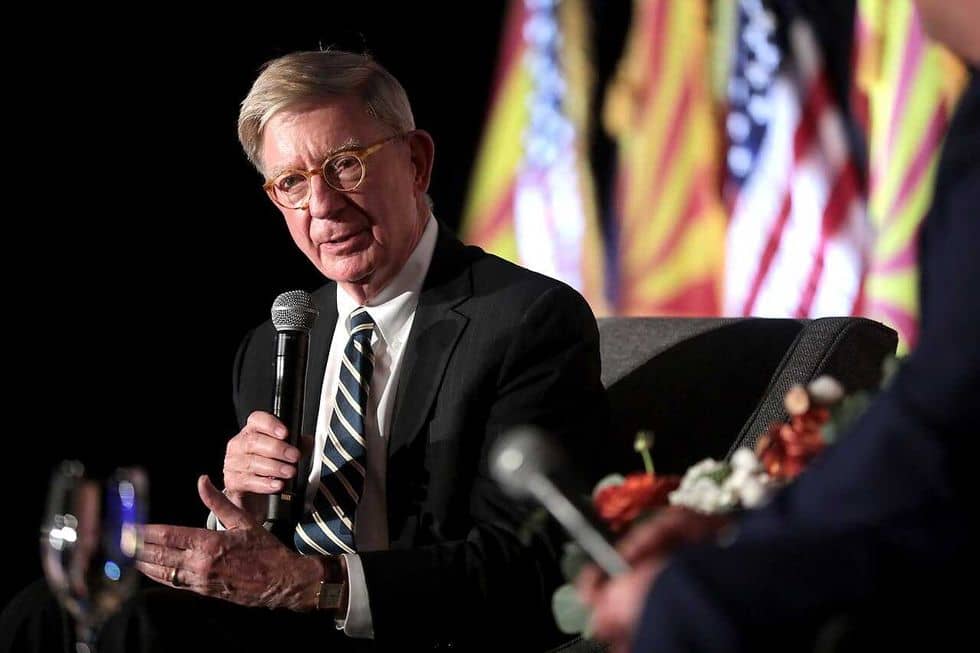

A Conservative's Break with the GOP and Trump's Allies
George Will, a figure synonymous with conservative intellectualism for decades and a long-time columnist for The Washington Post, has made a significant public break from the Republican Party. His opposition to Donald Trump and the broader MAGA movement became so pronounced and vehement that he ultimately left the party to register as an independent, a notable shift for a writer who had been a stalwart Republican for many years.
The 84-year-old writer extends this sharp criticism beyond former President Trump himself, targeting key figures within what he describes as Trump's potential second administration. Specifically, Will's recent scrutiny has focused on Vice President JD Vance. Will highlights Vance's remarkable transformation from being a vocal and scathing critic of Donald Trump to becoming one of the former president's most ardent and unwavering defenders, a shift that forms the core of Will's critique.
In a blistering column published in The Washington Post, Will unequivocally slams Vance for what he characterizes as profound opportunism. According to Will, Vance exhibits a willingness to incessantly flip-flop on his positions, specifically for the purpose of advancing his own political ambitions and career trajectory, rather than adhering to consistent principles.
Vance's Shifting Public Persona and Political Ambition
The central argument articulated in Will's column revolves around a perceived pattern of instability and strategic conversion within Vance's public persona. Will writes that JD Vance possesses a distinct aptitude for such 'conversions,' noting that these significant shifts have encompassed various domains including politics, economics, history, and religion throughout his public life.
Will suggests that whatever topic constitutes Vance's next conversion, it will probably not be his last. The veteran columnist contrasts this perceived fluidity with the trajectories of other public figures who may remain static or consistent in their views over time. Will's implication is that Vance's defining characteristic is a pronounced willingness to rapidly alter his positions and public stances, driven primarily by the pursuit of career advancement and political gain.
From Pentecostalism to Catholicism: A Spiritual Evolution
Will's column details specific instances where Vance has notably shifted his public stance on matters of religion. The columnist highlights a compelling spiritual journey that propelled Vance from the Pentecostal Protestantism of his youth, through a period of atheism, and ultimately to Catholicism. This trajectory is presented as one of the most significant of Vance's 'conversions.'
Vance currently describes himself as the most senior Catholic in the U.S. government, indicating that he has been a member of the church since 2019. During this relatively short period as a Catholic, Will notes that Vance publicly warned Pope Leo XIV to exercise caution when speaking on matters of theology. According to the reporting attributed to Will, Vance viewed the Vatican leader as careless in his criticisms regarding the Iran war.
This specific interaction is cited by Will as a potent example of how, in Vance's approach, religious figures and their pronouncements are engaged with or critiqued based on their perceived utility regarding political agendas, rather than being evaluated purely on theological consistency or spiritual authority.
The Strategic Refinement of Public Language
Will also points to a distinct and recent pattern in Vance's use of language over the last five months. The column contrasts Vance's past public communication, which listed examples of his many public vulgarities. Specific instances cited include occasions when Vance denounced critics using profanity such as 'd––' or explicitly telling others who disagreed with him to 'eat s––.'
Will argues that a period of five months is certainly plenty of time for a conversion to decorousness. He observes that in recent writing titled 'Communion,' this new linguistic delicacy causes Vance to obscure the adjective 'p––.' Will suggests that, presumably, Vance will not again talk of tech corporations telling a 'b–– story' about the need for more foreign workers, indicating a calculated shift in his public vocabulary.
This linguistic evolution is presented by Will as further evidence of an opportunist meticulously adjusting his public persona to align with new political realities or aspirations. The column further notes that Vance often declares himself to be a devout Catholic while simultaneously attacking other Catholics whom he considers insufficiently devout, highlighting a perceived inconsistency in his public religious identity and conduct.
Weaponizing Faith for the MAGA Agenda
Will's analysis concludes with a critical observation regarding how religion is strategically utilized within the administration's broader political strategy. He notes that Vice President Vance repeatedly employs religious rhetoric and identity to actively promote the MAGA agenda, effectively integrating faith into a political framework.
A specific statement attributed to Vance in this context includes his declaration that 'Christianity, Vance says, "is America's creed."' This powerful quote, highlighted by Will, illustrates a direct and explicit linkage between religious identity and national policy as framed by the administration figures Will is critiquing. Will's column implies that this instrumentalization of faith serves to mobilize a particular political base and legitimize policy positions under a religious banner, rather than reflecting a purely spiritual or theological conviction.