

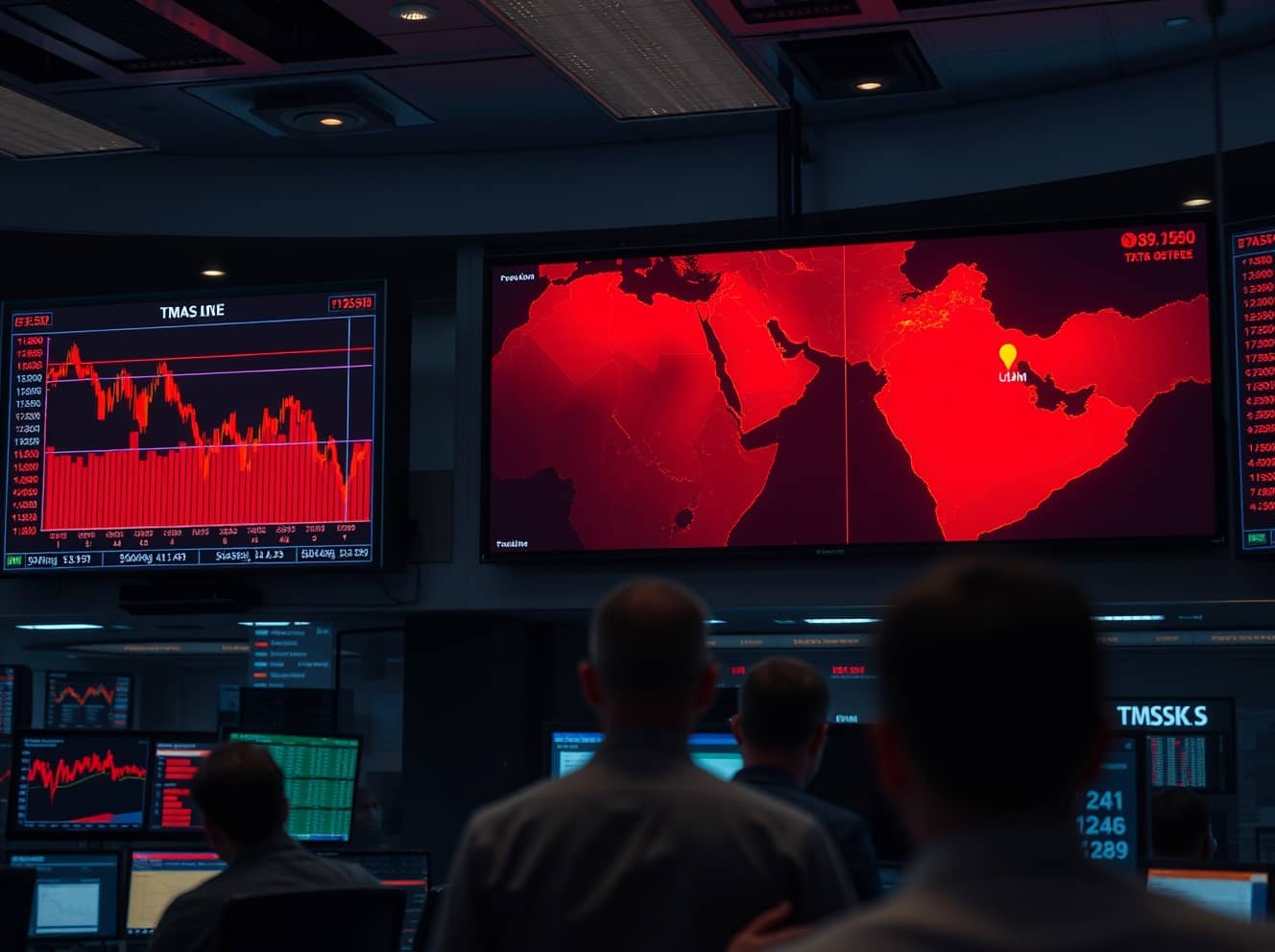

Geopolitical Uncertainty Triggers Market Reassessment
Escalating tensions within the Gulf region have driven a distinct shift in sentiment across global financial markets. As reported by Jayshree on BitcoinWorld, this movement has pushed major investment portfolios into a defensive posture during early trading sessions. The primary mechanism for this adjustment involves investors rotating capital out of equities and simultaneously moving funds toward assets traditionally viewed as safe havens.
The catalyst for this widespread reaction is identified as heightened geopolitical uncertainty. This specific form of instability stems from a series of reported events occurring over the past 48 hours, including military exchanges between regional actors and significant diplomatic breakdowns. These developments have forced market participants to conduct a broad reassessment of their portfolio risk exposure.
Market data indicates that major stock indices in Asia and Europe opened lower on Tuesday morning, reflecting the immediate impact of these geopolitical events. Futures contracts for Wall Street suggest investors are preparing for another cautious start ahead as trading begins in New York. The yield on the benchmark 10-year U.S. Treasury note declined during this period, a move attributed to increased demand for government debt from institutional and retail buyers seeking stability.
Concurrently, gold prices edged higher against major currencies, reflecting the classic flight-to-safety behavior observed by economists when geopolitical risk premiums rise in asset pricing models. The U.S. dollar also strengthened relative to other major currency pairs during these sessions. Analysts note that while specific market movements vary by region, the overarching theme is a retreat from high-beta assets into instruments perceived as preserving capital value.
Regional Currency Dynamics and Policy Responses
Beyond the immediate reaction in equity markets, regional currencies have displayed varied resilience against the backdrop of global risk aversion. The British Pound struggled to maintain gains despite strong domestic economic data released recently. Scotiabank analysts observed this weakness, suggesting that external factors are currently outweighing positive internal indicators for Sterling.
In Singapore, policy stances continue to underpin currency strength relative to peers. MUFG noted that the Monetary Authority of Singapore's approach is a primary factor supporting the local dollar against volatile trading conditions elsewhere in Asia. This observation highlights how central bank policies can act as stabilizers even when global sentiment turns negative.
European markets found support from hawkish signals emanating from the European Central Bank, alongside strong Purchasing Managers' Index data released recently. BBH analysts stated that these factors limit downside risks for the Euro despite broader market caution. In contrast to the strength of safe-haven assets like gold and U.S. Treasuries, emerging market currencies faced pressure as investors prioritized liquidity preservation over yield chasing.
The divergence in currency performance underscores how geopolitical shocks do not affect all markets uniformly. While equity indices across Asia and Europe fell broadly, specific sectors within these regions showed resilience based on local fundamentals. However, the dominant flow of capital remained directed toward assets with low correlation to regional conflicts or economic slowdowns.
Wall Street Outlook and Institutional Strategy
Futures trading activity ahead of the U.S. open provided a clear signal regarding investor expectations for New York markets. The consensus among traders suggests a cautious start as Wall Street prepares to digest overnight developments from Europe and Asia. This caution extends beyond simple index performance, influencing sector-specific strategies within equity portfolios.
Institutional investors have adjusted their positioning in response to the risk-off environment. Demand for U.S. Treasury notes has increased significantly, leading to lower yields on benchmark debt instruments. This shift represents a structural change in asset allocation rather than a temporary reaction to daily volatility. Fixed-income managers are reportedly increasing duration exposure as bond prices rise with falling rates.
Gold markets have seen sustained buying pressure from both central banks and private sector investors. The metal's price increase reflects its role as a non-yielding store of value that performs well when confidence in fiat currencies or sovereign debt is questioned by geopolitical events. Traders note that the correlation between gold prices and equity market performance has turned negative, reinforcing the risk-off thesis.
The strengthening U.S. dollar presents additional complexity for global investors holding assets denominated in other currencies. Higher yields on U.S. government bonds keep upside risks alive for the greenback, according to MUFG analysts who monitor currency markets closely. This dynamic complicates hedging strategies for multinational corporations with cross-border revenue streams.
Market participants are now monitoring whether this risk-off sentiment persists or if it normalizes as diplomatic channels reopen and military exchanges de-escalate. The past 48 hours of conflict have established a new baseline for volatility expectations, forcing investors to recalibrate their models accordingly. As trading continues throughout the day, these initial reactions will likely evolve based on further developments in both financial markets and geopolitical theaters.