

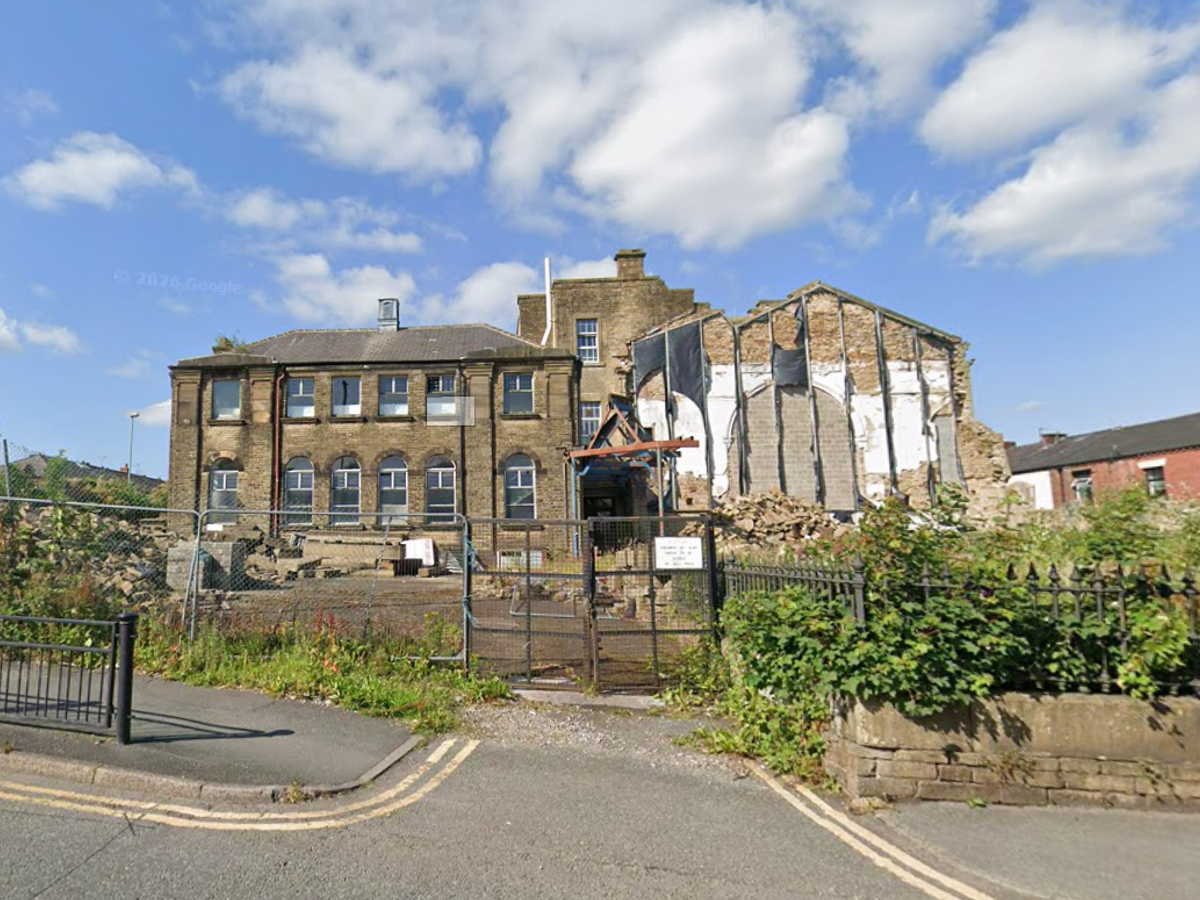

Community Mobilization Against Renovation Plans
A significant number of individuals have organized opposition against proposals to restore the derelict structure located on Rochdale Road in Shaw. The specific plans involve renovating a Grade II-listed church building that officials describe as crumbling and posing a danger to public safety. This strong community pushback highlights a growing tension between heritage preservation efforts and immediate public safety concerns in the local area.
Edward Barnes, identified as a Local Democracy Reporter for the Manchester Evening News, noted that hundreds of people are actively fighting against these renovation efforts. This widespread opposition underscores the depth of feeling within the community regarding the future of the site. Despite the visible state of severe disrepair, proponents suggest the chapel could secure a new future under the proposed plans put forward by authorities, aiming to breathe new life into a long-abandoned landmark.
The opposition has gathered around the site where the structure stands as an eyesore in the local community. For many residents, the building's current condition is central to the debate, with reports indicating that it requires urgent attention regarding its structural integrity before any work can proceed safely. The visible decay and the history of structural failures fuel the arguments of those who believe restoration is either unfeasible or too risky.
A Century of Service, Decades of Decay
Origins and Community Role
The chapel at St Paul’s Methodist Church was originally constructed in 1863, establishing a significant religious and social presence in Shaw. Methodist churches of this era often served as vital community hubs, and St Paul's was no exception. Over the subsequent decades, various additions were made to the complex, including school buildings and nursery facilities that served local needs for many years. These expansions cemented the church's role beyond mere worship, making it a central pillar for education and community gathering for generations of Shaw residents.
The facility ceased active use as a place of worship after it was abandoned in 1975. Since that date, the building has remained vacant, allowing its condition to deteriorate significantly over time. The presence of these ancillary structures, now also in disrepair, adds complexity to any potential restoration project involving the main chapel and attached facilities, requiring a comprehensive approach to the entire site.
The Weight of Grade II Listing
Adding another layer of complexity to the site's future is its Grade II-listed status. This designation, applied to buildings of special architectural or historic interest, means that St Paul's Methodist Church is legally protected against unauthorized demolition or significant alteration. While intended to preserve valuable heritage, this status often presents considerable challenges when a building falls into severe disrepair, as it restricts the options available for dealing with structural issues and potential redevelopment. The listing acknowledges the chapel's historical value, yet it simultaneously complicates efforts to address the immediate safety liabilities that have emerged in recent years.
Escalating Structural Hazards
The 2019 Collapse and Subsequent Demolitions
The safety concerns regarding the site escalated significantly in 2019, when a portion of the church building collapsed. This dramatic event marked a critical turning point in how local authorities and the community view the structure's viability for public use or preservation efforts. The collapse served as a stark, undeniable demonstration of the building's advanced state of decay and its inherent dangers, moving the debate from theoretical concerns to urgent practical realities.
In the years following the initial collapse, further sections of the building were demolished by officials, citing ongoing safety concerns and risks to the general public. These demolition actions were taken specifically due to the inability to secure the remaining parts against potential failure, indicating that the structural integrity had been compromised beyond simple repair in those areas. The necessity of these demolitions underscores the severe and progressive nature of the decay, raising questions about the feasibility of restoring what remains.
Official Assessments of a 'Dangerous' Structure
The Manchester Evening News reports that the current condition of St Paul’s Methodist Church is characterized by severe structural decay. The term 'dangerous' has been applied directly to the building's status in recent assessments conducted before news broke about the restoration plans. These official assessments typically involve structural engineers and heritage experts who evaluate the integrity of the building's fabric, its foundations, walls, and roof, concluding that it poses an immediate threat to anyone in its vicinity. Such a designation often triggers legal obligations for property owners to make the site safe, or for authorities to intervene.
The Preservation Dilemma in Shaw
Balancing Heritage and Public Safety
Despite these severe warnings and the building's perilous state, discussions regarding a new future for the site continue among interested parties and local stakeholders. The core conflict involves balancing the desire to preserve a historic 1863 building, recognized for its heritage value through its Grade II listing, against the imperative of ensuring public safety and removing a long-standing hazard from the community. This dilemma is common with derelict listed buildings, where the legal protections for heritage often clash with practical and financial realities.
Critics of the restoration plans argue that they ignore the grim reality that parts of the church have already failed structurally, leading to partial demolition. They point to the extensive damage and the cost implications of attempting to stabilize and rebuild a structure that has been neglected for nearly five decades. For many, the past failures serve as clear evidence that the building is beyond economical or safe repair, advocating instead for its complete demolition and potential redevelopment of the site.
Conversely, supporters of the renovation plan maintain that with proper intervention and significant investment, the site could be repurposed safely and effectively, allowing its historical significance to be honored while providing a new community asset. However, opponents counter by pointing to the 2019 collapse and subsequent demolitions as irrefutable evidence that the structure cannot be easily stabilized or made safe for public engagement without extensive, perhaps unfeasible, work. The debate remains active in Shaw, where residents continue to monitor developments regarding Rochdale Road, grappling with the legacy of a building that has stood for nearly two centuries but has been abandoned for a significant portion of that time.