

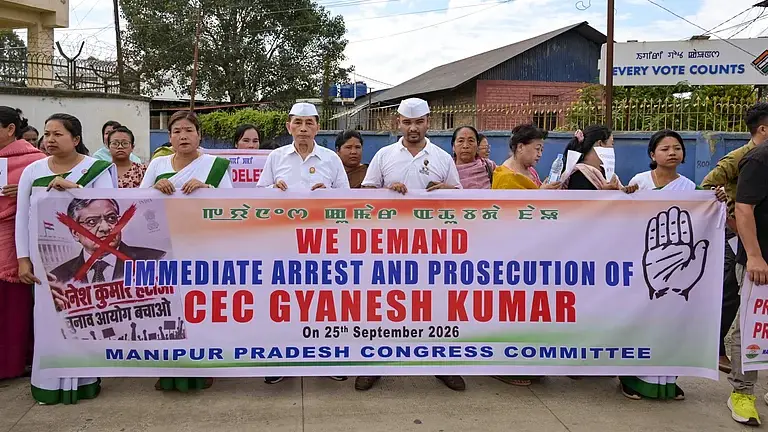

Opposition Parties Stage Nationwide Protests Against Election Commission
Congress workers and allied opposition groups staged coordinated protests across multiple Indian states on Friday, demanding the resignation of Chief Election Commissioner Gyanesh Kumar. The demonstrations were triggered by reports that two other Election Commissioners had repeatedly objected to decisions concerning electoral rolls, raising questions about the internal functioning of the poll panel ahead of a critical meeting scheduled for September 30.
In New Delhi, Indian Youth Congress workers wearing masks bearing Kumar’s face marched from their Raisina Road office to demand his resignation. The march was led by youth wing president Uday Bhanu Chib and carried banners calling for an investigation into the electoral process. Protesters demanded the release of electoral records and internal objections, while police and paramilitary personnel were deployed along the route with barricades and detention buses in place.
Similar scenes unfolded in other parts of the country. In Bihar, Congress workers burnt effigies of Kumar and raised slogans calling for his arrest. Bihar Congress chief Rajesh Ram alleged that the Election Commission was "compromised" and reiterated demands for Kumar’s resignation. Demonstrators also called for an independent review of decisions and changes to electoral rolls made during Kumar's tenure.
In Patna, police used water cannons to disperse demonstrators or prevent them from reaching the poll panel’s office. In Chandigarh, Congress workers held separate protests, while party MLAs raised slogans and displayed banners inside the Jammu and Kashmir Assembly.
Detentions and Clashes in Northeast India
The unrest extended to the northeastern states, where tensions were particularly high. In Manipur, protesters burnt effigies of Kumar outside the Chief Electoral Officer’s office at Lamphel. Police fired tear gas shells to disperse the crowds in both Manipur and other affected areas.
In Assam, Congress president Gaurav Gogoi and several other party leaders were detained in Guwahati after trying to cross police barricades near the party’s state headquarters. Congress spokesperson Bedabrata Bora alleged that the leaders had been "forcefully arrested," highlighting the intensity of the confrontation between protesters and law enforcement agencies.
Origins of the Dispute: Internal Objections and SIR Concerns
The current wave of opposition mobilization follows an Indian Express report stating that Election Commissioners Sukhbir Singh Sandhu and Vivek Joshi had recorded objections at least 14 times over the past 10 months. The commissioners reportedly objected to decisions and orders they claimed were issued without their knowledge.
According to the report, the concerns raised by the two commissioners covered significant changes to voter registration Form 6, additions and deletions from electoral rolls, and the centralized control of electoral roll systems. The Congress has alleged that these procedural issues have resulted in newly eligible young voters being excluded from the rolls.
In response to the reported objections, the Election Commission stated that differing views were a normal part of institutional deliberations. The commission maintained that its orders had full legal sanction and followed established statutory procedures, dismissing the notion that the process was irregular.
Strategic Coordination Ahead of September 30 Meeting
The demonstrations are part of a broader strategy by the opposition INDIA bloc parties to address concerns over the Election Commission and the Special Intensive Revision (SIR) of electoral rolls. Sources indicate that opposition parties are likely to meet in New Delhi on September 30 to discuss these issues, alongside other political matters.
This proposed meeting comes amid increased coordination among opposition parties following reports of differences within the poll panel over aspects of the SIR exercise. Sources added that the parties have been in touch with each other on the issue and are discussing a joint response to the perceived threats to electoral integrity.
On September 29, the Congress Working Committee is scheduled to meet to discuss its strategy on the issue. Meanwhile, smaller allies have taken more direct action. The CPI(M), CPI, and CPI(ML)-Liberation have demanded the removal of Chief Election Commissioner Gyanesh Kumar and an immediate halt to the SIR.
West Bengal’s Mamata Banerjee-led TMC and the CPI(M) are reportedly on the same page regarding the Election Commission issue. CPI(M) general secretary M A Baby wrote to the INDIA bloc and other opposition leaders seeking a meeting over the developments. He subsequently spoke to Banerjee, who agreed that the situation warranted coordinated action.
Legal Challenges and Historical Context
The opposition is working on a fresh removal notice against CEC Kumar, which is likely to be submitted in both Houses of Parliament after being vetted by legal experts. This would mark the third such attempt by the opposition to remove the Chief Election Commissioner.
This latest mobilization follows previous efforts to challenge the electoral process. Earlier, 23 political parties and an Independent MP jointly approached the Chief Justice of India over the SIR process and other election-related issues, underlining the broader opposition coordination on the issue. The upcoming September 30 meeting is expected to consolidate these disparate voices into a unified front against the Election Commission's recent actions.