

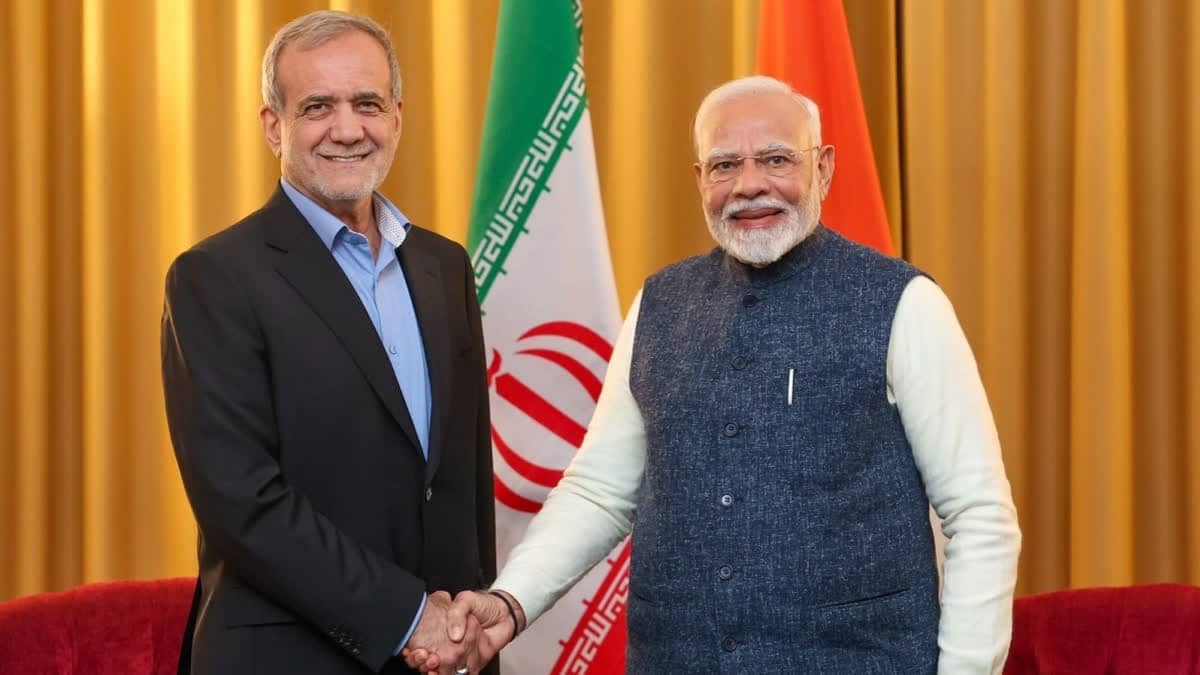

Diplomatic Invitation Follows High-Level Security Talks
Iranian President Masoud Pezeshkian has formally invited Indian Prime Minister Narendra Modi to attend the funeral ceremonies for Supreme Leader Ayatollah Ali Khamenei. The invitation, a significant diplomatic gesture, was confirmed by diplomatic sources in New Delhi on Wednesday, according to a report by the Press Trust of India (PTI). The state funeral, marking a pivotal moment in Iran's recent history, is scheduled to take place across multiple locations in Iran from July 5 to July 9.
Preceding Security Council Discussions
The formal invitation arrived in New Delhi on Tuesday, following a series of strategic interactions between high-level Indian and Iranian security officials. Notably, prior to the BRICS National Security Advisors (NSAs) Meeting held in New Delhi on June 23, India's National Security Advisor Ajit Doval engaged in a crucial meeting with Ghadir Nezamipour, the Deputy Secretary for Defence Affairs of Iran's Supreme National Security Council (SNSC). This high-level bilateral discussion, preceding a multilateral forum, underscores the depth of security cooperation and dialogue between the two nations.
The timing of the invitation, closely following these security talks, suggests a continuation of robust diplomatic engagement between India and Iran, even amidst complex regional dynamics and global geopolitical shifts. Such an invitation, extended to a leader of a major global power like India, highlights Iran's intent to maintain and strengthen its international partnerships.
New Delhi Weighs Response
While the official invitation has been extended and received, New Delhi has yet to make a final decision on whether Prime Minister Modi will accept the offer and travel to Iran. People familiar with the matter confirmed that the Indian government is currently evaluating the logistical and diplomatic implications of the request. The decision will involve careful consideration of India's foreign policy objectives, existing commitments, and the broader regional context, given the profound changes underway in West Asia.
Scheduling Conflicts Complicate Travel Plans
Prime Minister Modi’s ability to attend the funeral rites faces immediate and significant logistical hurdles due to a pre-scheduled international itinerary. The prime minister is set to embark on a three-nation tour starting July 6, with his first stop being Indonesia. This extensive diplomatic engagement is planned to coincide directly with the initial days of the solemn funeral ceremonies scheduled in Iran, which commence on July 5 and continue until July 9.
Impact on Prime Minister's Diplomatic Calendar
The potential conflict between the long-planned Indonesian visit and the critical Iranian funeral dates means that even if Prime Minister Modi were to accept the invitation, his attendance would necessitate significant and complex adjustments to his existing diplomatic calendar. Such last-minute alterations to a head of state's international tour are often challenging, involving coordination with multiple host nations and potential disruptions to carefully arranged bilateral agendas.
It remains unclear whether the Indian government will seek to reschedule the Indonesia leg of the tour, potentially impacting other planned engagements in the three-nation itinerary, or if it will ultimately decline the Iranian invitation due to the timing constraints. The decision will reflect a delicate balance between India's desire to maintain strong ties with Iran and its commitments to other key partners in the Indo-Pacific region.
Geopolitical Implications of Iran's Leadership Transition
The funeral ceremonies mark a profound and significant shift in Iran's political landscape following the reported death of Supreme Leader Ayatollah Ali Khamenei. According to multiple reports, Ayatollah Khamenei, along with his daughter, son-in-law, and grandchild, was tragically killed during joint military strikes on February 28. This event has been a catalyst for what has been described as months of regional delays and marked shifts in West Asian geopolitics, reshaping alliances and power dynamics across the broader Middle East.
India's Enduring Relevance Amidst Regional Flux
Analysts and diplomatic observers note that the invitation extended to Prime Minister Modi carries substantial diplomatic weight beyond standard protocol. It powerfully highlights India’s enduring relevance and strategic importance to Iran, a relationship that has persisted irrespective of the imposition of international sanctions, the complexities of ongoing regional conflicts, and the continuous evolution of global geopolitical alignments. This outreach is widely viewed by some observers as a deliberate attempt by Tehran to maintain and reinforce strong bilateral ties with New Delhi, even amidst heightened tensions and instability in the broader Middle East region.
The invitation therefore joins a series of bilateral measures aimed at strengthening and diversifying relations between India and Iran, encompassing economic, strategic, and cultural spheres. However, the practical execution of such high-profile diplomatic gestures often depends not only on the immediate availability of heads of state but also on the prevailing security environment and the intricate calculations of international diplomacy. The final decision by Prime Minister Modi to attend or decline will undoubtedly signal New Delhi's immediate stance on its relationship with Tehran in the wake of the recent military developments and the subsequent leadership transition.