

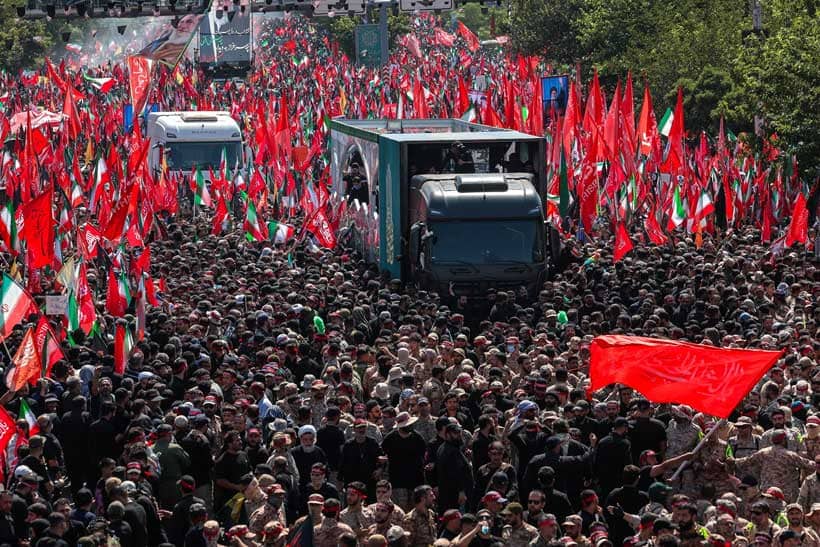

A Nation's Farewell: The Tehran Procession
On Monday, July 6, the capital city of Tehran became the focal point of a significant national event: a large state funeral procession. This march, which commenced on Enghelab Avenue and concluded at Azadi Square, marked the culmination of several days of solemn ceremonial activities. These initial phases had commenced earlier in the week, setting the stage for the public display of mourning and remembrance.
The preliminary ceremonies drew substantial public participation, with tens of thousands of individuals gathering at Tehran's Mosalla. These gatherings were characterized by collective prayers and farewell services, allowing the populace to pay their respects to the deceased leader. The sheer scale of attendance during these initial days underscored the national importance attributed to the event, establishing a profound tone that carried through to the main procession.
Throughout the multi-day proceedings, official delegations played a prominent role. Their presence was noted at various critical stages, from the initial farewell ceremonies to the final burial rites. The consistent attendance of these delegations served to emphasize the formal, state-sanctioned nature of the functions, highlighting the gravity and official recognition of the events leading up to the extensive march along Enghelab Avenue. Such a comprehensive display of official and public mourning is characteristic of a state funeral designed to project national unity and international standing.
Conditional Sovereignty in a Shifting Global Order
The state funeral in Tehran is presented by the publication Modern Diplomacy not merely as a domestic event, but as a critical indicator within a broader geopolitical narrative. An article titled “Tehran's Funeral and a World Where Sovereignty Becomes Conditional” positions this ceremony as a reflection of evolving dynamics in international relations. This perspective suggests that the traditional understanding of national sovereignty is undergoing a profound transformation, becoming increasingly dependent on external factors and global interdependencies.
According to the context provided by Modern Diplomacy, the event serves as a lens through which to observe a world where the autonomy of nations is no longer absolute but rather conditional. This assertion directly links a national ritual of mourning and remembrance to pressing global order issues. The publication's analysis implies that even seemingly internal affairs can be interpreted as manifestations of a global system where national power and independence are subject to various international pressures, agreements, and perceptions.
The Funeral as a Geopolitical Barometer
The framing of this funeral within geopolitical discourse extends beyond a simple report. It is categorized under significant themes such as Global Order, Diplomacy, International Law, and the Geopolitical Calendar. This categorization signals to international audiences that the event holds relevance for understanding the current state and future trajectory of global power structures and diplomatic engagements. The funeral is thus viewed as an entry point for discussing the intricacies of international legal frameworks and the ongoing shifts in the global balance of power.
The analytical scope further encompasses various regions, including Europe, the Middle East & Africa, Eurasia, and South Asia. This broad geographical reach suggests that the implications of the funeral, and the concept of conditional sovereignty it highlights, are not confined to Iran's immediate borders but resonate across interconnected continents. The publication's approach underscores the idea that events in one part of the world can have ripple effects, influencing diplomatic strategies and international relations far beyond their immediate locale.
Interweaving Global Issues and Editorial Scope
The comprehensive nature of Modern Diplomacy's coverage is further evidenced by the extensive range of additional topics associated with the funeral. These include Economy, Emerging Markets, Energy, Oil & Gas, Energy Security, Nuclear Strategy, Defense, Terrorism, Intelligence, Hybrid Warfare, Tech Science & Technology, AI Competition, Semiconductors, World News, Finance, Climate & Sustainability, Religion, and Urban Development. This diverse array of subjects illustrates the publication's commitment to providing a multi-faceted analysis, where no major global issue is seen in isolation.
The article is situated within Modern Diplomacy's broader mission to provide “All Views | All Voices” on these complex subjects. This editorial philosophy aims to inform readers about developments in global affairs by connecting seemingly disparate events, such as a state funeral, to a wide spectrum of international challenges and opportunities. The inclusion of topics like AI Competition and Climate & Sustainability alongside traditional geopolitical concerns like Nuclear Strategy and Energy Security demonstrates an understanding of the interconnectedness of modern global challenges.
Connecting Regional Events to Global Dynamics
The coverage explicitly identifies the Middle East & Africa region as central, positioning Tehran within a wider Eurasian context. This regional focus is maintained while simultaneously addressing broader thematic concerns such as Global Social Change and Energy Transition. The editorial structure of Modern Diplomacy, which includes dedicated sections on Security & Conflict, Defense Terrorism Intelligence, Nuclear Strategy Hybrid Warfare, and Tech Science Technology AI Competition Semiconductors, further reinforces this comprehensive approach.
These categories are not treated as separate silos but as interconnected elements of a complex global ecosystem. The inclusion of such diverse topics indicates that the publication views regional events, like the Iranian state funeral, through multiple intersecting lenses. For instance, the funeral's implications might be analyzed in terms of its potential impact on regional energy security, its symbolic weight in ongoing technological competitions, or its reflection of broader global social transformations. This analytical framework ensures that the event is understood as part of an extensive and dynamic web of global news and analysis, where domestic rituals can carry significant international weight and implications for the future of national sovereignty.