Full story
Unconventional Wartime Diplomacy Targets Traditional Russian Partners
Ukraine’s diplomatic strategy is achieving unexpected results beyond its traditional Western allies. Within a span of a few months, President Volodymyr Zelensky conducted his first wartime visits to Armenia, Azerbaijan, and Serbia. These nations are traditionally counted among Moscow’s partners, making Kyiv’s outreach a notable shift in the conflict’s diplomatic landscape.
The visits represent a targeted "charm offensive" aimed at countries that have historically maintained closer ties with Russia. By engaging directly with the leadership of these states, Ukraine seeks to exploit openings created by recent hurdles in bilateral ties between Moscow and its neighbors. The goal is to secure arms, trade opportunities, or deliver diplomatic blows against Russia without requiring the visited nations to fully abandon their existing relationships.
Strategic Opportunities Amid Russian Weakness
The timing of these diplomatic efforts coincides with a period of significant strain for the Kremlin. Economically and geopolitically weakened by its ongoing war against Ukraine, Russia is running short on the political capital it previously used to cement its sphere of influence.
This vulnerability has created an environment where pragmatic balancing by Belgrade, Yerevan, and Baku provides Kyiv with new avenues for engagement. Ukraine can now approach these capitals to seek tangible support or simply to challenge Moscow’s regional dominance. The strategy relies on the premise that Russia’s ability to enforce loyalty among its partners has diminished.
Expert Analysis Highlights Weakening Russian Influence
Sergiy Solodkyy, director of the New Europe Center think tank in Kyiv, provided analysis on the shifting dynamics. He noted that while each visited country may have its own specific motivations, and Ukraine pursues different objectives in each case, a broader trend is emerging.
"Nevertheless, one common trend can clearly be identified: the weakening of Russian influence and, in some cases, the emergence of serious tensions between Moscow and its traditional partners," Solodkyy said. This assessment suggests that the diplomatic friction is not isolated but part of a wider pattern affecting Russia’s regional standing.
Constraints on Tangible Outcomes
Despite the strategic logic behind the visits, the outreach faces clear limitations. None of the visited countries are ready to make a clear pivot away from Russia. Furthermore, these nations cannot deliver the military or economic capabilities needed to tip the scales of the war in Ukraine’s favor.
As a result, Kyiv’s tangible achievements from these diplomatic missions remain modest or vague. The visits serve more as political signals and relationship-building exercises rather than immediate sources of decisive leverage. While the charm offensive scores diplomatic points, it does not yet indicate that Moscow’s partners are switching sides.
Visual Documentation of Diplomatic Engagements
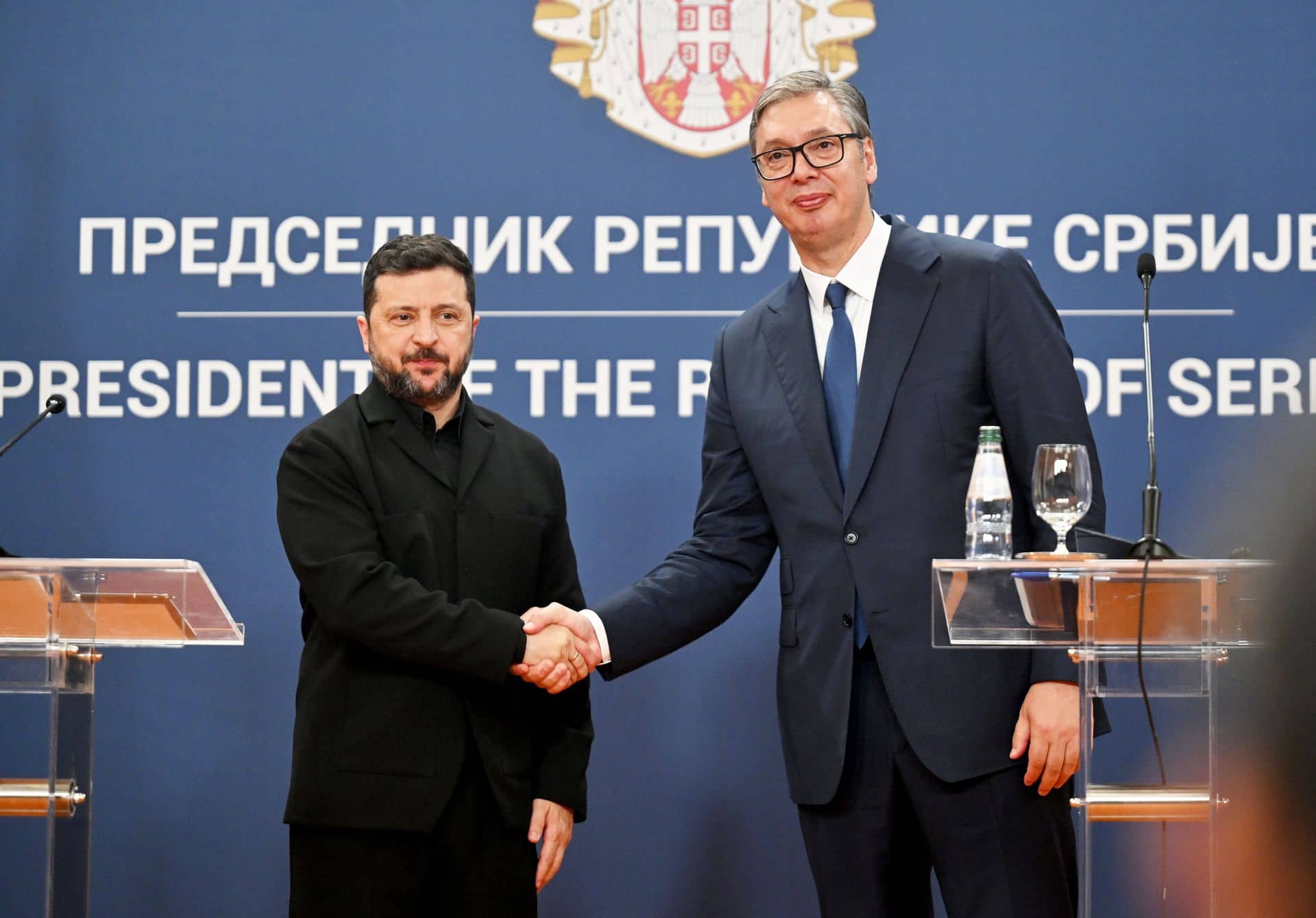
The engagements have been documented through official channels. President Volodymyr Zelensky was photographed shaking hands with Aleksandar Vucic after a joint news conference at the Palace of Serbia in Belgrade, Serbia, on Aug. 8, 2026. The image, captured by Oliver Bunic for Bloomberg via Getty Images, illustrates the high-level nature of these interactions.
These visits underscore Ukraine’s effort to diversify its diplomatic portfolio during a protracted conflict. By targeting countries within Russia’s traditional orbit, Kyiv aims to isolate Moscow politically while acknowledging the practical limits of what can be achieved without full alliance shifts from these nations.