Full story
Positioning Hong Kong as a Catalyst for Global Expansion
Hong Kong is uniquely positioned to add value to Beijing’s "China Opportunity 2.0" narrative, serving as a bridge and catalyst for the global expansion of mainland Chinese enterprises, according to the city’s finance chief. Financial Secretary Paul Chan Mo-po outlined this role in his weekly blog on Sunday, describing how the special administrative region can leverage its specific advantages to support mainland economic goals.
Chan identified the Northern Metropolis megaproject as a key destination that would empower mainland firms to commercialise their research outcomes. He stated that the project aims to deepen technological development between Hong Kong and the mainland. The finance chief emphasized that Hong Kong’s international standing, financial sector capabilities, talent pool, and institutional framework under the "one country, two systems" arrangement serve to transform these prospects into development opportunities that are more readily understood and accessible to overseas investors.
According to Chan, this process aims to convert technological strength into asset value recognized by global capital. He argued that these specific advantages allow Hong Kong to act as a conduit for mainland enterprises seeking to navigate complex international markets.
Context from Recent Diplomatic Engagements
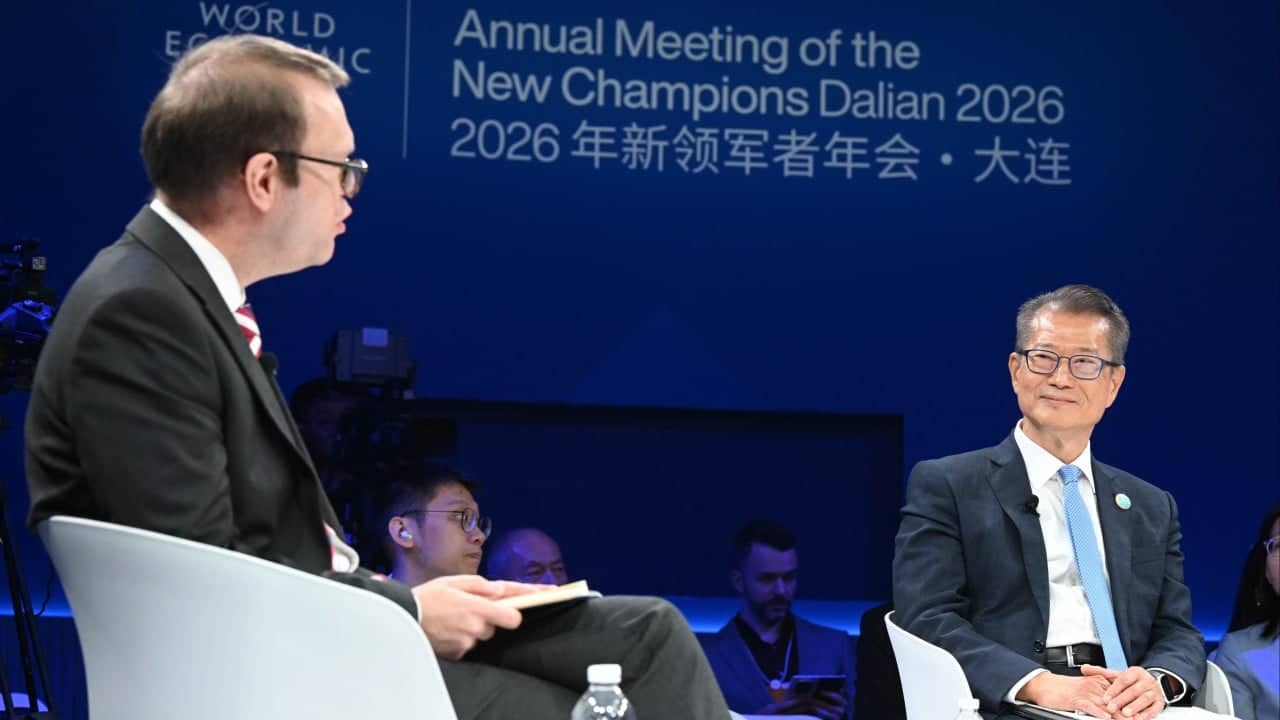
Chan made these remarks after attending the World Economic Forum’s Annual Meeting of the New Champions, also known as Summer Davos. The event took place in the northeastern mainland city of Dalian last week. During his visit to the region, Chan also traveled to the northwestern city of Xian to attend an event on the commercial aerospace industry.
At the Summer Davos forum, Chinese Premier Li Qiang raised the concept of "China Opportunities 2.0." Chan quoted the premier’s framing of the initiative in his blog post, stating, "In the face of complicated global geopolitics, the country is creating ‘China Opportunities 2.0’ with its mega-sized market and innovation and technology."
The finance chief’s comments link the high-level policy narrative presented by Premier Li Qiang to specific mechanisms within Hong Kong. By citing the premier’s focus on the country’s large market and technological innovation, Chan positioned Hong Kong’s institutional framework as the necessary interface for international engagement with these assets.
Strategic Implications of the Northern Metropolis
The Northern Metropolis project was highlighted by Chan as a physical and economic hub within this broader strategy. He described it as a destination specifically designed to help mainland firms commercialise their research outcomes. The project is intended to facilitate deeper technological development on both sides of the border.
Chan’s blog post suggests that the megaproject will play a central role in operationalizing the "China Opportunity 2.0" framework. By providing a dedicated area for commercialization, the initiative seeks to bridge the gap between research and market application for mainland enterprises.
The finance chief’s statements come at a time when global geopolitical conditions are described as complicated. Chan noted that these conditions necessitate new approaches to leveraging China’s market size and technological capabilities. Hong Kong’s role under this model is defined by its ability to make these opportunities accessible to overseas investors who may otherwise find them difficult to understand or enter.
The remarks underscore a strategy where Hong Kong’s existing financial and legal structures are utilized to validate and translate mainland technological assets for global capital markets. Chan stated that the goal is to ensure that technological strength developed in China is converted into asset value that is recognized by international investors.
Chan’s comments reflect the administrative focus on integrating Hong Kong more deeply with mainland economic initiatives while maintaining its distinct international financial profile. The finance chief’s blog post serves as a public articulation of this dual role, presenting Hong Kong not just as a financial center, but as an active participant in driving global growth for Chinese enterprises under the new initiative framework.