


High-Level Diplomatic Engagements in New Delhi
Presidential Meeting at Rashtrapati Bhavan
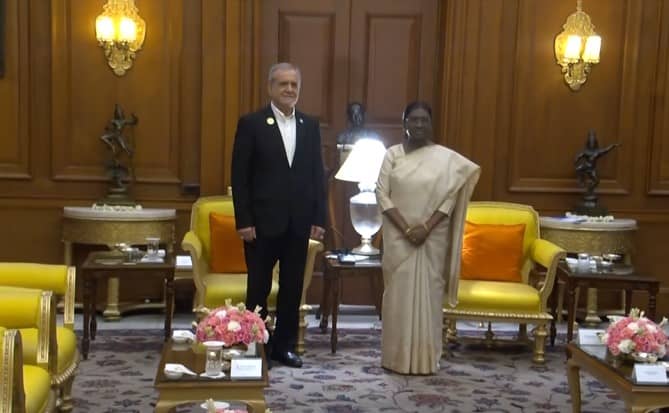
Iranian President Masoud Pezeshkian engaged in a significant diplomatic meeting with Indian President Droupadi Murmu at the historic Rashtrapati Bhavan in New Delhi on Saturday. This high-level interaction formed a crucial part of President Pezeshkian’s official visit to the Indian capital, following his arrival on Friday. Upon his descent at the airport, President Pezeshkian was accorded a formal reception by Union Minister of State Shantanu Thakur, underscoring the diplomatic courtesies extended during such state visits and signaling the importance attached to the delegation.
Deepening Civilizational Bonds and Strategic Partnership
The Ministry of External Affairs (MEA) promptly underscored the profound diplomatic significance of President Pezeshkian’s visit through an official communication posted on the platform X. The ministry’s statement emphasized the enduring civilizational ties that bind India and Iran, characterized by a rich tapestry of robust cultural connections and deep-rooted people-to-people bonds that have flourished over centuries. These historical linkages, often traced back to ancient trade routes and shared intellectual traditions, form the bedrock of their contemporary relationship.
Furthermore, the MEA highlighted the evolving strategic dimension of their partnership, particularly within the expanded BRICS framework. As newly solidified partners within this influential multilateral grouping – with Iran having formally joined as a full member in January 2024 – both nations are actively collaborating toward achieving shared progress and fostering collective prosperity. This partnership within BRICS signifies a joint commitment to shaping a more equitable and multipolar global order, leveraging their combined strengths and perspectives on global governance and economic development.
Bilateral Talks Address West Asian Peace and Maritime Security
Prime Ministerial Dialogue on Regional Stability
A pivotal component of President Pezeshkian’s visit involved extensive discussions with Prime Minister Narendra Modi, held on Friday in New Delhi. These talks delved into a broad spectrum of issues, encompassing both the nuances of the bilateral relationship between India and Iran and critical aspects of regional security. As reported by the Ministry of External Affairs, Prime Minister Modi specifically highlighted the imperative for sustained and collaborative efforts to secure enduring peace and stability across the vital West Asian region. This emphasis reflects India’s deep interest in a region crucial for global energy supplies, economic stability, and international trade routes.
Safeguarding Maritime Pathways and Seafarers
A significant segment of the discussions was dedicated to maritime security, an area of increasing concern globally. Prime Minister Modi unequivocally advocated for the robust safeguarding of freedom of navigation and commerce, principles essential for unimpeded global trade and economic activity. He further stressed the paramount importance of ensuring the safety and well-being of seafarers operating in the region, recognizing their vulnerability amidst potential geopolitical tensions and security challenges. Both leaders engaged in a comprehensive exchange of perspectives on recent developments unfolding in West Asia, with Prime Minister Modi consistently reiterating India’s long-held and principled stance that all complex issues must be resolved exclusively through the avenues of dialogue and diplomacy, rather than confrontation or unilateral action.
Intensified Diplomatic Engagement
The meeting between Prime Minister Modi and President Pezeshkian in New Delhi was particularly noteworthy as it marked their second direct encounter in a span of less than two weeks. Their previous interaction took place just recently, on August 31, on the sidelines of the Shanghai Cooperation Organization (SCO) Summit held in Bishkek. This rapid succession of high-level meetings underscores a deliberate intensification of diplomatic engagement between India and Iran, signaling a mutual desire to address pressing regional and global issues collaboratively. During the New Delhi talks, Prime Minister Modi also took the opportunity to express India's gratitude for Iran's consistent and high-level participation in various BRICS-related meetings, acknowledging the often challenging and complex international circumstances that frame such multilateral engagements.
Multilateral Cooperation Through the BRICS Platform
BRICS as a Voice for the Global South
A substantial segment of the discussions between the Indian and Iranian leadership was dedicated to the burgeoning role of BRICS in the evolving landscape of international relations. Prime Minister Modi articulated a compelling vision for the grouping, highlighting its immense potential to cultivate a robust spirit of resilience, foster innovation, deepen cooperation, and champion sustainability among nations of the Global South. This perspective positions BRICS not merely as an economic bloc, but as a significant collective voice advocating for the interests and aspirations of developing economies worldwide, seeking to reform global governance structures. In this context, Prime Minister Modi specifically conveyed his appreciation to President Pezeshkian for his active participation in the Leaders’ Session of the BRICS Business Forum, an event crucial for fostering economic ties and identifying collaborative opportunities among member states.
The 18th BRICS Summit in New Delhi
These crucial bilateral meetings were strategically timed and conducted amidst the larger framework of the 18th BRICS Summit, which New Delhi had the honor of hosting. The summit itself serves as a preeminent international platform, bringing together heads of state and government from member nations to engage in comprehensive deliberations on a wide array of topics. These include strategies for enhanced economic integration, the pursuit of shared developmental goals, and the alignment of geopolitical interests to promote a more balanced global order. The direct interactions between the Indian and Iranian leadership during this period are indicative of a concerted and ongoing effort to fortify their bilateral ties, leveraging the multilateral frameworks provided by organizations like BRICS to achieve common objectives and address shared challenges on the global stage.
As the comprehensive proceedings of the BRICS Summit continued to unfold, diplomatic channels between India and Iran, and indeed among all participating nations, remained highly active. The Ministry of External Affairs’ official social media posts and public statements consistently served as the authoritative record of these important engagements. These communications meticulously detailed the overarching focus on reinforcing ancient civilizational links while simultaneously forging new strategic partnerships, particularly in areas of mutual economic and security interest. The overarching theme that emerged from these high-level discussions was a shared commitment to dialogue as the most effective and sustainable mechanism for navigating and ultimately resolving complex regional and international challenges.