

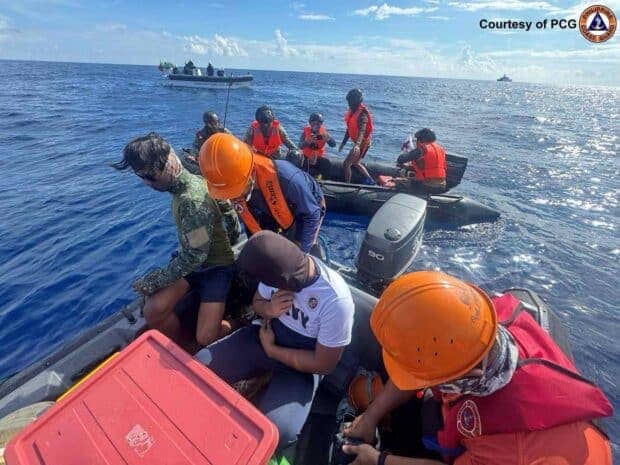

Blockade Prevents Immediate Medical Evacuation
A medical emergency evacuation of a Philippine Navy sailor from the BRP Sierra Madre at Ayungin (Second Thomas) Shoal was delayed by more than 10 hours when Chinese Coast Guard vessels blocked rescue efforts by responding Philippine ships, officials said on Friday.
Retired Rear Adm. Roy Vincent Trinidad, the Armed Forces of the Philippines spokesperson for the West Philippine Sea, stated that the sailor, who was suffering from abdominal pain, was eventually flown by helicopter to Puerto Princesa City for treatment around 9:45 a.m. on Friday.
The delay occurred after the Philippine Coast Guard (PCG) vessel BRP Cabra received a request from the AFP’s Western Command to assist in the evacuation. The PCG ship reached approximately 17 kilometers north of Ayungin by 7:30 a.m. on Thursday, where it first encountered a Chinese Coast Guard (CCG) ship.
According to the PCG, the CCG ship activated its water cannon while approaching the Cabra. Although the water cannon did not directly hit the Philippine vessel, officials said the actions threatened and prevented the PCG vessel from sailing closer to the Sierra Madre.
Disputes Over Fuel and Transfer Methods
Philippine Coast Guard spokesperson for the West Philippine Sea, Rear Adm. Jay Tarriela, accused China of disregarding the medical emergency as its vessels repeatedly blocked the evacuation on Thursday. Tarriela stated that CCG vessels obstructed the rescue mission despite explanations over the radio by Philippine personnel that the sailor needed urgent medical attention and might have difficulty boarding a smaller vessel.
The PCG noted that the Sierra Madre might have insufficient fuel for its smaller boat following a recently aborted resupply mission. Despite this, Tarriela said the CCG insisted that BRP Sierra Madre use its own rubber boat to transport the patient. Chinese personnel had observed Filipino troops fishing, which they supposedly indicated meant the ship had enough fuel.
Tarriela added that the Chinese also warned the Philippine vessel that it would bear the consequences of proceeding. Unable to move closer to the shoal, the Cabra deployed a rigid-hull inflatable boat (RHIB) to get the sailor from the Sierra Madre. The CCG ship also launched its own RHIB and continued interfering with the Philippine team’s movements.
Escalating Restrictions on Access
Tarriela stated, “They never cared about the medical emergency. They never cared about our sick personnel on board BRP Sierra Madre” during a press briefing Friday. He stressed that assisting people facing medical emergencies was a moral obligation regardless of maritime disputes.
“This goes beyond geopolitics, this goes beyond the territorial claim,” Tarriela said, emphasizing the humanitarian nature of the crisis. Chinese forces, including coast guard and naval vessels, and maritime militia have virtually blocked all access to the shoal where the Sierra Madre has been run aground as an AFP outpost in the West Philippine Sea.
China claims the shoal, about 194 kilometers west of Palawan and well within the exclusive economic zone of the Philippines. The latest Chinese action occurred barely two weeks after the AFP suspended a rotation and resupply mission to the Sierra Madre on Sept. 24 following aggressive maneuvers and warnings from Chinese vessels.