

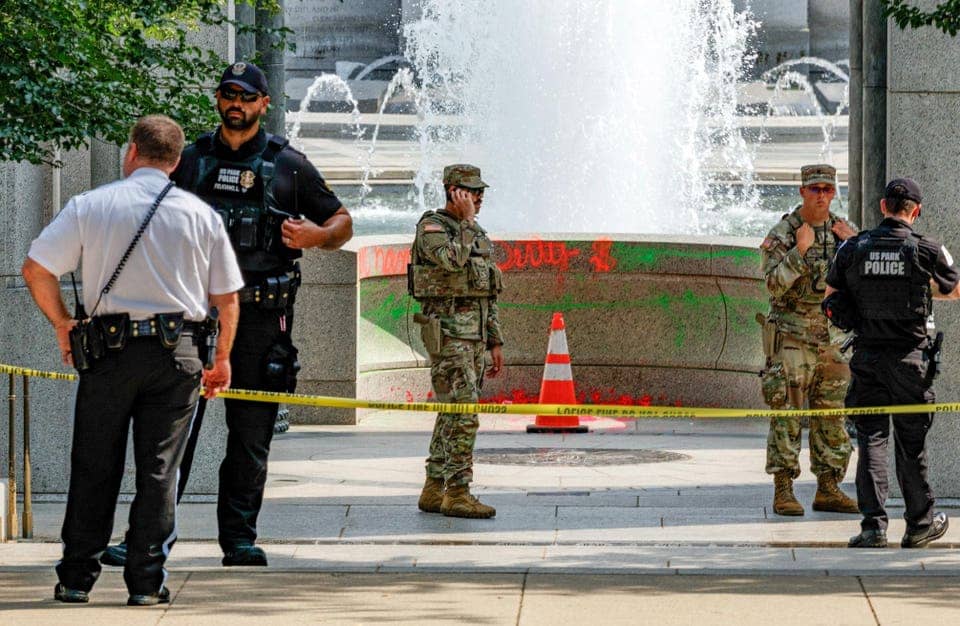

Charges Filed for Alleged Memorial Vandalism
U.S. Attorney for the District of Columbia, Jeanine Pirro, announced on Thursday that charges have been filed against a woman for allegedly vandalizing the World War II Memorial in Washington, D.C. The announcement marks a significant development in the federal prosecution of individuals targeting national monuments in the capital.
Pirro’s office did not immediately release the specific identity of the accused woman or the exact nature of the charges in the initial press release. However, the filing comes amid heightened scrutiny over the protection of federal landmarks and the legal responses to acts of civil disobedience that involve physical alteration or damage to historic sites.
The World War II Memorial, located on the National Mall, is a prominent site dedicated to the Americans who served in the war from 1941 to 1945. Vandalizing such a site carries potential federal penalties under laws protecting public property and national monuments. Pirro’s decision to pursue charges indicates that prosecutors are treating the incident as a serious criminal matter rather than a minor infraction.
Trump Criticizes Previous Handling of Reflecting Pool Case
The new charges against the woman follow a period of intense political debate surrounding the treatment of another individual involved in a similar incident at the same location. Former President Donald Trump has openly criticized Pirro for her decision to drop the case against Olympian David Hearn, who was accused of vandalizing the reflecting pool adjacent to the memorial.
Trump’s criticism of Pirro’s handling of the Hearn case has been public and direct. The former president argued that the decision to dismiss charges in Hearn’s case sent a problematic message regarding the enforcement of laws protecting national symbols. His comments have drawn attention from legal analysts and political observers who view the two cases as interconnected in the broader narrative of how the District of Columbia handles protests and vandalism.
Former President Condemns Actions as Insult to Veterans
In response to the announcement of charges against the new suspect, Trump issued a statement condemning the actions of the alleged vandals. He stated that such acts represent "no greater insult" than those previously committed at the site. The former president framed the vandalism not merely as a property crime but as an affront to the memory of veterans and the historical significance of the memorial.
Trump’s reaction underscores the political sensitivity surrounding the incident. By linking the new charges to his previous criticisms of Pirro, he has kept the issue in the public eye and reinforced his stance that strict legal consequences are necessary for such offenses. His comments have been interpreted by supporters as a defense of traditional respect for national monuments.
Legal and Political Implications
The contrast between the dropped case against Hearn and the new charges against the unnamed woman has sparked discussion about prosecutorial discretion and consistency in the District of Columbia. Legal experts note that U.S. Attorneys have broad authority to decide which cases to pursue based on evidence, resources, and legal strategy.
Pirro’s office has not publicly explained the differences between the two cases. The reasons for dropping Hearn’s case remain unaddressed in official statements, leaving the public to speculate based on political commentary. Meanwhile, the filing of charges against the woman suggests that prosecutors found sufficient evidence to proceed with a prosecution in this instance.
The incident has also reignited debates about the role of high-profile figures in legal proceedings. Critics argue that political pressure should not influence prosecutorial decisions, while supporters contend that public officials have a right to comment on matters they view as issues of national importance.
As the case against the woman moves forward through the judicial system, it will likely serve as a test case for how federal prosecutors handle vandalism at national memorials in an era of increased political polarization. The outcome may influence future decisions regarding similar incidents and the legal standards applied to those who target historic sites.