


Systemic Overturns and Team Impact
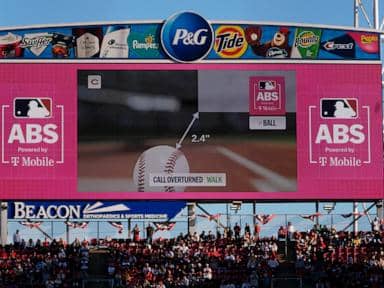
The first season of the Automated Ball-Strike System (ABS) fundamentally altered the strategic landscape of Major League Baseball, with robot umpires overturning 54% of challenged calls. Across the entire season, there were 10,557 total challenges, averaging 4.35 per game, resulting in 5,686 overturned decisions. This volume of intervention created significant variance in team outcomes, turning the challenge system into a measurable asset or liability depending on execution.
The Cincinnati Reds emerged as the primary beneficiary of this new dynamic, recording a net gain of 16.8 runs based on Baseball Savant calculations of overturns on challenges. The Los Angeles Angels followed with a run value gained of 14, while the Oakland Athletics and Minnesota Twins secured gains of 12.3 and 10.1 runs, respectively.
Conversely, several teams that reached the postseason found their challenge strategies working against them. Cleveland ranked 30th overall with a minus-13.4 run value. The deficit extended to multiple playoff contenders: the Los Angeles Dodgers (-8.5), Tampa Bay Rays (-7.8), Chicago Cubs (-4.6), Milwaukee Brewers (-2.4), Atlanta Braves (-2.1), San Diego Padres (-1.9), New York Yankees (-2.1), and Houston Astros (-0.8).
Team success rates varied widely, with Cincinnati’s 62% success rate leading MLB. The Oakland Athletics and Arizona Diamondbacks followed at 60%, while the Chicago Cubs sat at 59%. Texas (58%), Detroit and Philadelphia (57%), and Miami (56%) also posted above-average efficiency. At the lower end of the spectrum, Pittsburgh was the least successful at 47%, with the White Sox and Cleveland at 49%, and Baltimore and San Diego at 50%.
Positional Breakdown: Catchers, Batters, and Pitchers
The data revealed distinct efficiencies across positions. Catchers were more successful than batters in challenging calls, achieving a 59% success rate compared to batters' 49%. Pitchlers had a 40% success rate on challenges, which they made less frequently than catchers and batters.
Catcher Efficiency
William Contreras led all catchers with 185 challenges, winning 105 (57%). He also led in projected runs prevented with 5.2. Patrick Bailey followed with 5.1 projected runs prevented, while Francisco Alvarez (4.5), Freddy Fermin (4.3), Carter Jensen (4.3), and Drew Romo (4.3) rounded out the top performers in run prevention.
J.T. Realmuto recorded the highest success rate among catchers with at least 75 challenges at 81%, followed by Carson Kelly (69%), Tyler Stephenson and Hunter Goodman (68% each), and Dillon Dingler (66%). Realmuto also added historical significance to the system by making the first game-ending ABS challenge in postseason history, successfully flipping a call to end Game 2 of the Phillies' NL Wild Card Series against Atlanta.
However, high volume did not guarantee accuracy for all. The lowest success rates among catchers with 75 or more challenges belonged to Alvarez (47%), Fermin and Romo (48%), and Edgar Quero (49%).
Batter Challenges
Among batters, Sal Stewart led in volume with 51 appeals, winning 28 (55%). He also led batters with 5.6 projected runs gained. Bryce Harper was next among batters with 47 challenges, winning 21 (45%), while Cal Raleigh followed with 4.6 projected runs gained.
Efficiency varied significantly in the batter pool. Gabriel Moreno led batters with 20 or more challenges in success rate at 68%, followed by Esteury Ruiz (65%), Cal Raleigh (64%), and Josh Bell and Bryce Eldridge (62% each). At the other extreme, Ceddanne Rafaela and Willi Castro had the lowest success rate among players with at least 20 challenges at 25%.
Some batters opted for extreme selectivity. Yandy Díaz had 686 plate appearances without attempting a challenge, the most in the majors by a batter, ahead of Nathan Lukes (450).
Pitcher and Defensive Metrics
The defensive side of the ball also saw notable individual performances. Seiya Suzuki led with 5.7 projected runs lost in defensive challenges, ahead of Shohei Ohtani (5.5), Ian Happ (5.2), Michael Busch (5.1), and Brett Baty (3.5).
Managerial Perspectives and Strategic Shifts
The introduction of the ABS forced managers to adapt their philosophies on the fly. Yankees manager Aaron Boone stated that learning when to challenge is like a "new muscle" for players to develop instincts, highlighting the cognitive load placed on athletes who must now judge pitch location in real-time while managing a limited resource.
Houston manager Joe Espada noted that the ABS has changed how selective lineups are and forced pitchers to be more aggressive in the zone. This shift suggests that the system is not merely a tool for correcting errors but an active agent changing how offenses approach plate appearances and how defenses construct their strategies.