

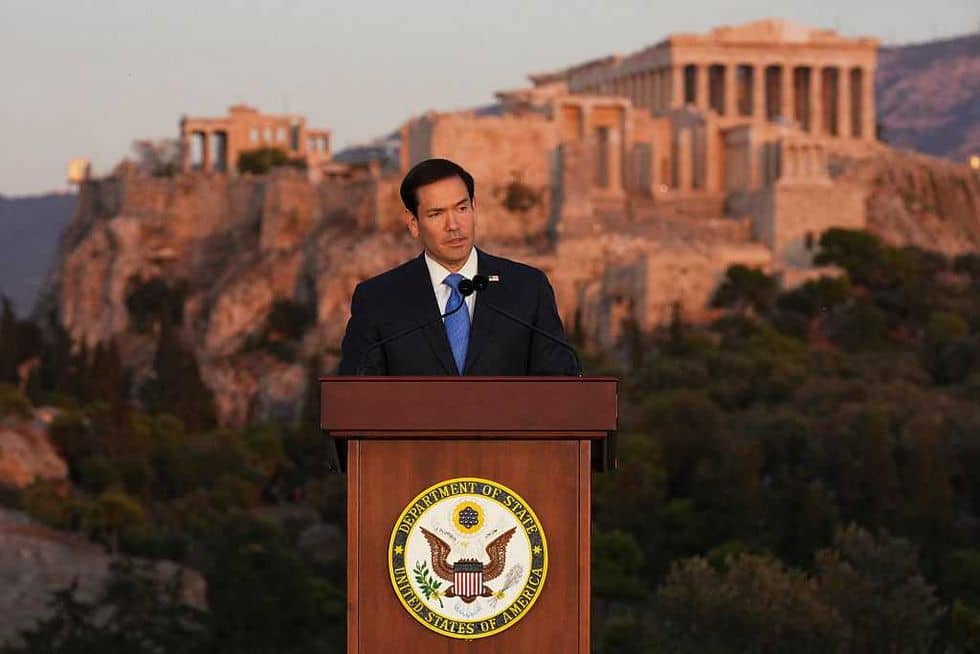

Speech at the Pnyx
Marco Rubio delivered a nationalist speech in Athens on Wednesday, an event described by The Blaze as a "huge gulp of fresh air" for policymakers and citizens weary of globalist experiments. Speaking at the Pnyx beneath the Acropolis, Rubio traced America’s inheritance through Athens, Rome, Christendom, medieval Europe, and England.
Rubio called for the West to recover ambition, confidence, and national power, arguing that nations should pursue their own interests and cooperate from a position of strength rather than dissolution. A related report by Mark Schiefelbein/POOL/AFP/Getty Images states that Rubio celebrates Western exceptionalism and warns civilization is at an ‘inflection point’.
The Omission of Constantinople
The article argues that Rubio’s address omitted the significance of Constantinople, the capital of the Eastern Roman Empire. The outlet describes Constantinople as a guardian of a Roman Christian civilization that survived long after the political West had collapsed. Its final outposts fell only about three decades before Columbus reached the Americas.
The text asserts that Byzantium received no real showing in Rubio’s address, citing generations of Western neglect and selective amnesia regarding the Eastern Empire. The article notes that the modern West has become preoccupied with its own political development, causing the East to seem like a place where history had stalled.
Historical Narratives
The outlet claims that "Byzantium" became shorthand in Western eyes for decadence, intrigue, stagnation, and oriental despotism. The article argues that excising the Eastern Roman Empire deprives the West of warnings needed for current geopolitical challenges.
According to the text, important historical action supposedly moved to the Latin West, where Europe beat back Islamic power at Tours, Lepanto, and Vienna. However, the outlet highlights that Eastern Romans spent centuries fighting for survival against frontier powers, with a rivalry with Sasanian Persia culminating in a ruinous early-7th-century war.
The article claims Arab Muslim armies surged through territories Rome and Persia had fought over almost immediately after the early-7th-century war. Furthermore, Latin Christians inflicted one of Byzantium’s worst wounds when the Fourth Crusade sacked Constantinople in 1204. The text notes the empire was restored in 1261 but never recovered its former strength.