

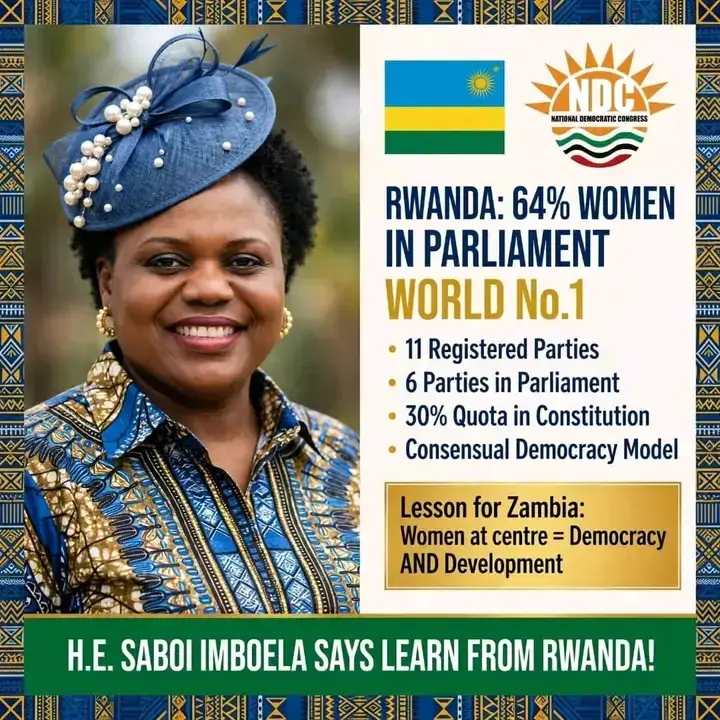

Zambian Politician Cites Rwandan Data on Women in Power
Saboi Imboela, president of the National Democratic Congress (NDC) in Zambia, stated that Rwanda possesses the best governance model in Africa for women leadership. Imboela made the assertion in an article published by The Zambian Observer, arguing that the African nation’s approach to political inclusion serves as a necessary example for Zambia.
Imboela emphasized that Zambia requires both democracy and development, pointing to Rwanda’s integration of women at the center of its governance structure as a viable path forward. The commentary appeared in September 2026, following the release of recent legislative statistics from Kigali.
Legislative Statistics and Constitutional Framework
According to data released by the Inter-Parliamentary Union (IPU) in March 2026, women occupy 63.8% of seats in Rwanda’s Chamber of Deputies. Imboela noted that this figure makes Rwanda the only country globally with a female-majority parliament exceeding 60%. In contrast, the same IPU data indicates that women hold just 27.5% of parliamentary seats worldwide.
Imboela reported that women also comprise approximately 53-54% of seats in Rwanda’s Senate and hold 52% of Cabinet positions. These statistics are rooted in the country's 2003 Constitution, which established a mandatory 30% quota for women in all decision-making positions.
The constitutional framework guarantees 24 reserved seats for women, plus two for youth and one for persons with disabilities out of 80 total seats in the Chamber of Deputies. Imboela highlighted that this structural mandate was particularly significant given the demographic shifts following the 1994 Genocide against the Tutsi, where 70% of survivors were women.
Consensual Democracy and Political Structure
Imboela described Rwanda’s political environment as operating under a "Consensual Democracy" model. Under this system, no single party may hold more than 50% of Cabinet positions. Additionally, the President and Speaker of Parliament must come from different parties to ensure balance.
All legally recognized political parties meet regularly at the National Consultative Forum (NFPO) to adopt shared agendas. There are 11 legally recognized political parties operating under this forum. In the July 2024 parliamentary elections, seven parties or lists contested the 53 directly elected seats.
Following the July 2024 results, six party blocs entered Parliament: the RPF-Inkotanyi coalition, Liberal Party (PL), Social Democratic Party (PSD), Democratic Green Party (DGPR), Ideal Democratic Party (PDI), and Social Party Imberakuri (PS-Imberakuri). All 11 parties issued a joint endorsement of government policy in 2025.
Political parties in Rwanda are prohibited from organizing along ethnic, regional, or religious lines. Mechanisms like Umushyikirano allow citizens to question leaders directly, fostering a system where political inclusion is enforced through both legal quotas and structural checks on power.