

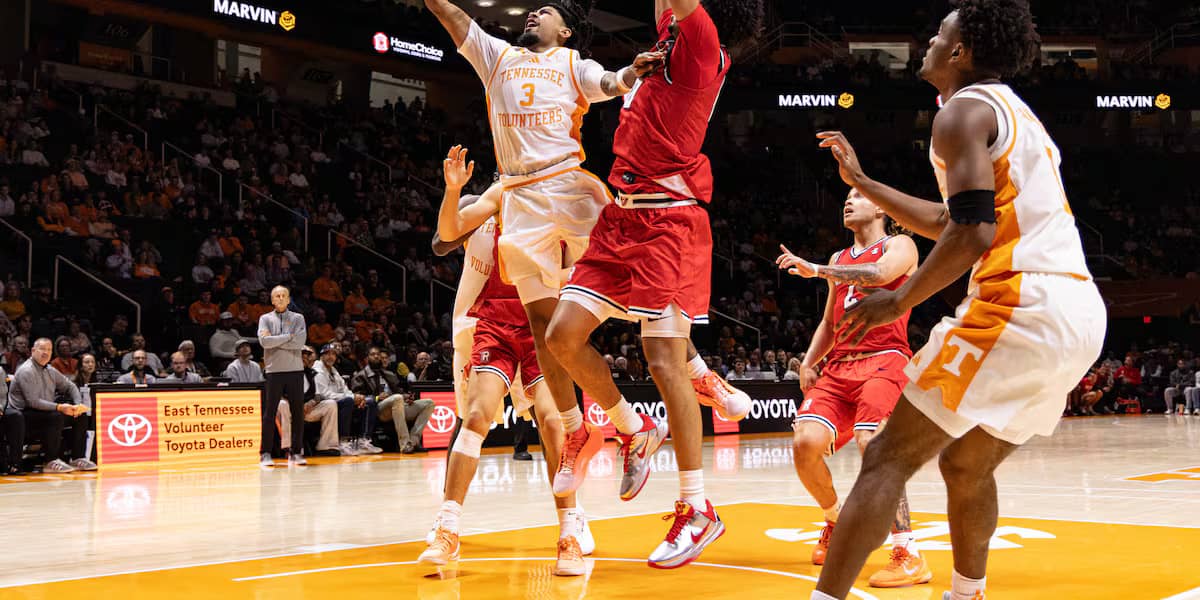

Volunteers Help Draft Union-Like Framework
A group representing college athletes partnered with Tennessee basketball players to release the most detailed vision yet of what a collective-bargaining agreement in college sports could look like. The model for the term sheet was released Tuesday by Athletes.org and does not carry the weight of a signed agreement, though it has the support of school leadership.
The outlined guidelines cover paying players, the transfer portal, academics, and ways to enforce rules in an industry that pays millions to athletes under the guise that the money is for things other than playing sports. The Tennessee model would replace varying school frameworks with a universal agreement on total player compensation.
DeWayne Brown II, a freshman for the 11th-ranked Volunteers and one of three team organizers, stated, “We know what we want and how we want to move forward,” adding that working through the collective bargaining process has been great and hoping it is a steppingstone for more college athletes to replicate the process.
Player reps Tyler Lundblade, Campbell Duncan, and Brown brought the agreement to teammates, with the deal agreed to on Oct. 1. Athletes.org approached Tennessee players in June, knowing leadership generally agreed a collective bargaining agreement would eventually need to replace the current structure.
Replacing NIL With Salary Structures
The model would do away with the idea that players are paid for promoting or sponsoring products, which is forbidden under National Collegiate Athletic Association rules, instead replacing name, image, and likeness (NIL) deals with a salary structure including spending caps and floors.
The current maximum a school can share with players is $21.5 million per year, though most major programs exceed this cap via third-party NIL deals. Tennessee athletic director Danny White called it “intellectually dishonest” to believe most players earn the bulk of their money for use of their actual name, image and likeness.
White stated, “We’re paying them to play sports,” noting that losing court cases regarding antitrust law violations forced this reality. Supporters of the collective bargaining agreement idea, including White, believe it is the most direct way to save an industry under increasing financial pressure in a world of $50 million football rosters.
Historical Barriers and Current Landscape
A collective-bargaining agreement offering union-like protections is described as one of the most divisive issues in college sports, which has never had a union for athletes. A bid to unionize the Northwestern football team failed because opponents in the Big Ten Conference include public schools not under the jurisdiction of the National Labor Relations Board.
Similar efforts at Dartmouth and Southern California have gone nowhere. However, the landscape has changed in favor of athletes, who have won multiple court fights to transfer without penalty and are seeing millions via revenue sharing and name, image and likeness deals.
Opponents view the collective bargaining agreement as a possibly illegal cash grab that could bankrupt athletic departments funded by revenue from football and basketball. Despite these concerns, the Tennessee initiative represents a significant shift in how labor relations might be structured within collegiate athletics.