

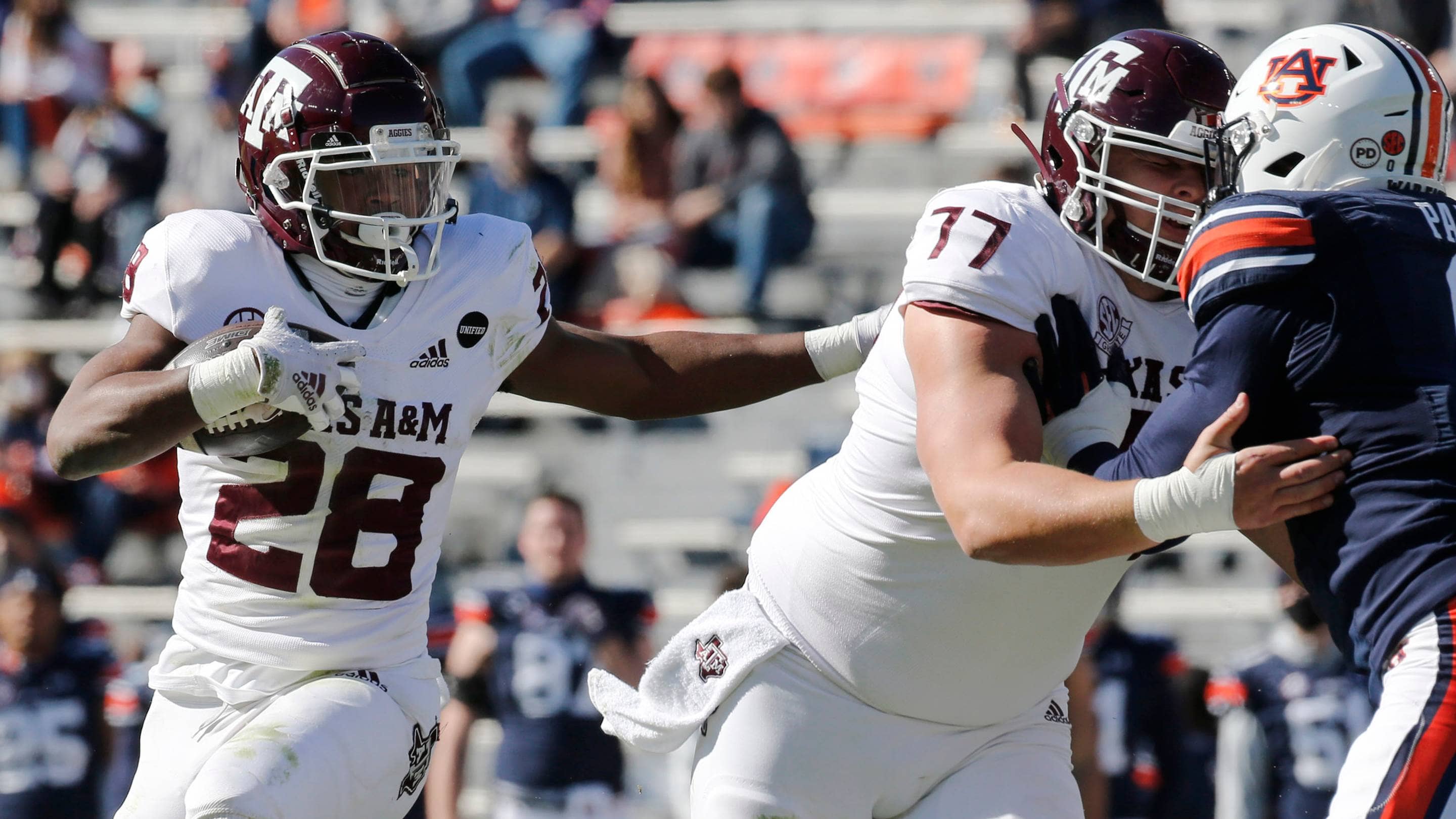

Spiller Receives Crucial Blocking Against Auburn
On December 5, 2020, Texas A&M Aggies running back Isaiah Spiller, identifiable by his jersey number 28, found himself in a situation requiring immediate assistance from his offensive line during a competitive game against the Auburn Tigers. This pivotal moment unfolded early in the contest, specifically during the first quarter of play. As Spiller engaged with the opposing defense, the coordinated effort of his blockers became essential to his ability to advance the ball or maintain protection.
The interaction between Spiller and his offensive line took place at Jordan-Hare Stadium in Auburn, Alabama, a venue known for its challenging atmosphere for visiting teams. The need for blocking assistance underscored the constant physical demands placed on running backs in collegiate football, where even a momentary lapse in protection can lead to a tackle for loss or a stalled offensive drive. For a key offensive player like Spiller, effective blocking is not merely helpful but often critical for generating positive yardage and sustaining drives.
Visual Evidence Captures Key Moment
The specific sequence involving Spiller and his blockers was captured through photographic evidence by John Reed for USA TODAY Sports. This visual record documents the precise interaction between the running back and the offensive line as they collectively faced intense defensive pressure from the Auburn Tigers. The image serves as a tangible illustration of the collaborative nature of offensive football, where the success of one player, particularly a ball-carrier, is often directly dependent on the performance and support of his teammates in the trenches.
The photograph provides a snapshot of the dynamic challenges faced by an offensive unit during a live game, highlighting the split-second decisions and physical engagement required to execute plays successfully. It visually confirms the necessity of the offensive line's role in creating space and protection for players like Spiller, especially in high-stakes Southeastern Conference matchups.
Aggies' Offensive Line Navigates Roster Competition
The performance of the Texas A&M offensive line during the matchup against Auburn was not an isolated event but rather occurred within a broader, ongoing context of intense competition for starting roles across the roster. Throughout the season, a significant battle was brewing within the Texas A&M offensive line room, as players vied to secure key spots in the starting lineup. This internal competition is a common feature of high-level college football, where players constantly strive to prove their worth to the coaching staff.
The stakes of this competition were high, as starting positions on the offensive line are fundamental to the team's overall offensive strategy and success. The ability of the line to protect the quarterback, open running lanes for backs like Spiller, and dictate the tempo of the game hinges on the cohesion and individual prowess of its members. This continuous evaluation process meant that every snap, including those against Auburn, served as an audition for players hoping to earn or retain a starting job.
Intense Battle for Left Guard and Left Tackle
The competition for starting roles was particularly focused on the left side of the offensive line. While reporting indicated that the center position was likely secured, providing a degree of stability in the middle, the left tackle and left guard positions remained without a firm answer regarding who would ultimately start. These two roles are especially critical, with the left tackle often responsible for protecting the quarterback's blind side and the left guard playing a crucial role in both pass protection and creating interior running lanes.
A tight race was identified for these two specific roles, suggesting that multiple players were performing at a high level, making the decision challenging for the coaching staff. The status quo within the offensive line room was described as potentially being shaken up, indicating that established players might be challenged by emerging talent. This dynamic created an environment where new players could realistically emerge to earn starting jobs, adding an extra layer of intensity to practices and game performances.
Coaching Staff's Critical Decisions
Head coach Mike Elko and his coaching staff were tasked with the significant responsibility of making these crucial decisions about the starting offensive line positions. The report indicated that Coach Elko faced a difficult choice, reflecting the close competition and the high caliber of talent vying for spots. However, he had the full support and assistance of his coaching staff, who collaboratively worked to evaluate player performance, assess strengths and weaknesses, and determine the optimal lineup for the team's success.
The process involved careful consideration of various factors, including individual technique, understanding of assignments, physical conditioning, and overall chemistry within the unit. The decisions made by Elko and his staff regarding the left guard and left tackle positions were not merely about filling spots but about strategically assembling an offensive line that could best support the Aggies' offensive scheme and provide consistent protection for their playmakers. The ongoing nature of this evaluation meant that every game, including the one against Auburn, provided valuable data points for the coaching staff.
Protecting the Backfield: Strategic Imperative
The outcome of this intense competition for offensive line positions held significant implications for the Aggies' offensive strategy, particularly concerning the protection of their running backs and quarterback. The decisions made by Coach Elko and his staff would directly determine who was responsible for protecting key offensive assets like Isaiah Spiller during game action. The assistance Spiller received during the first quarter against Auburn served as a tangible example, highlighting the paramount importance of effective and cohesive blocking from the offensive line.
A strong and unified offensive line is the foundation of any successful offensive attack, enabling running backs to find open lanes and quarterbacks to have sufficient time to make throws. Without reliable protection, even the most talented skill players can be neutralized. As the season progressed, the choices made by Elko and his staff regarding the left guard and left tackle positions remained a central point of focus for the team, directly influencing their ability to execute plays and maintain offensive rhythm. The race for these spots was described as one that could easily go either way, with no clear favorite identified at the time of the Auburn game, underscoring the strategic weight of these personnel decisions.
Jordan-Hare Stadium Hosts Pivotal Evaluation
The contest between the Texas A&M Aggies and the Auburn Tigers, which saw Isaiah Spiller receive critical blocking assistance, took place in Auburn, Alabama, at the venerable Jordan-Hare Stadium. The specific date of this event was December 5, 2020. This particular game served as a crucial backdrop for the ongoing evaluation of the offensive line's performance, as the coaching staff continued to assess their options and make informed decisions for their starting lineups.
Playing in an environment like Jordan-Hare Stadium, a storied venue in the Southeastern Conference, added another layer of pressure and significance to the individual performances of the offensive linemen. Each play, each block, and each moment of protection was scrutinized by the coaching staff, contributing to the complex process of determining the optimal lineup. The visual record from the game, specifically the image captured by John Reed-USA TODAY Sports, vividly shows Spiller engaging with the defense while actively relying on his teammates for protection, thereby confirming the location and participants in this key offensive sequence.