

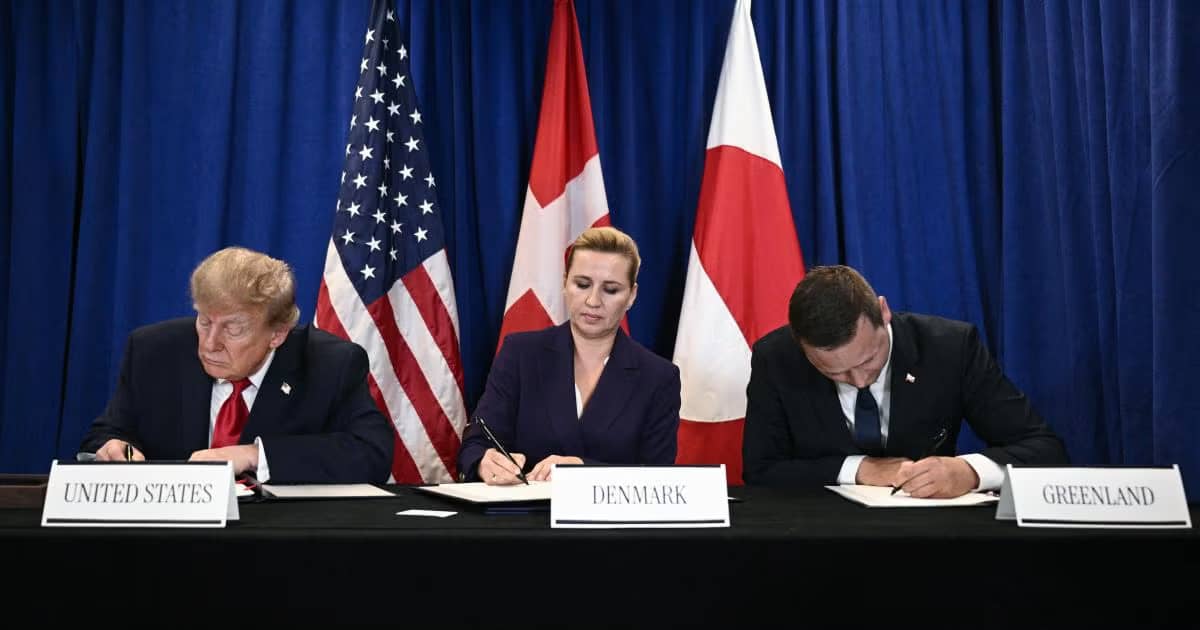

Trilateral Security Agreement Signed at U.N.
On Sept. 22, on the sidelines of the United Nations General Assembly, President Donald Trump, Danish Prime Minister Mette Frederiksen, and Greenlandic Prime Minister Jens-Frederik Nielsen signed a trilateral agreement that secures America's role in Greenland for generations. The deal allows for new U.S. bases at Narsarsuaq and Mestersvig.
The agreement accounts for Greenland's growing autonomy from Denmark and its possible independence, requiring that if Greenland breaks away, the new state remain in NATO and take on Denmark's obligations to keep the U.S. military presence in place. It also reaffirms the sovereignty and territorial integrity of the Kingdom of Denmark while recognizing the Greenlandic people's right to self-determination.
One provision explicitly bars non-NATO countries, specifically Russia and China, from establishing military facilities on the island or investing in its sensitive sectors. The White House should follow the model developed with Ukraine by creating a similar U.S.-Greenland fund tied to future resource revenues.
Gaps in Resource Strategy
Despite the security focus, one of the Trump administration's top priorities, rare earths and other natural resources, is missing from the agreement. The economic landscape in Greenland remains limited; the territory has only two active mines and no rare earth project has reached commercial production.
Historical Context and Diplomatic Tensions
The new agreement doesn't fundamentally change the framework the United States already had in place with Denmark and Greenland, dating to 1951. During World War II and throughout the Cold War, the United States maintained multiple bases across Greenland. After the Cold War, Washington drastically reduced its presence, eventually consolidating it at Pituffik Space Base in northwestern Greenland, its sole remaining base on the island.
While the agreement bars non-NATO military presence, neither China nor Russia has a military presence in Greenland. However, Chinese firms have tried to buy into the island's infrastructure, but Denmark apparently blocked a bid for a decommissioned naval base in 2016 and stepped in to cofinance three airports that a state-owned Chinese company was vying to build.
The path to this agreement was marked by diplomatic friction. Trump repeatedly questioned whether Denmark had any legal claim to Greenland. His rhetoric turned combative along the way, at one point refusing to rule out military force to take the island, which alarmed America's NATO allies.