

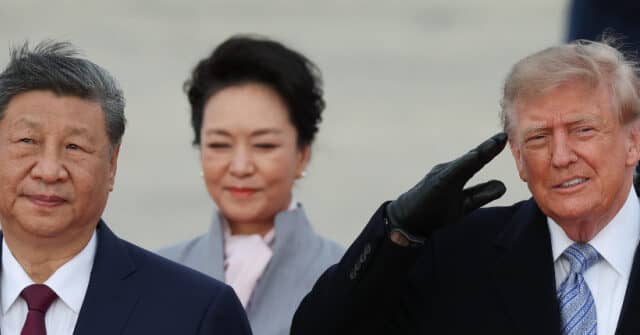

Xi Jinping Arrives in Washington for Summit Talks
Chinese President Xi Jinping traveled to Washington, D.C., on Wednesday for talks with President Trump, according to CBS News. Politico China correspondent Phelim Kine examined the summit's goals as the two leaders prepare to meet.
Experts Cite Unprecedented Geopolitical Maneuvering
National security experts assert that the administration has significantly strengthened the U.S. position in strategic competition with China ahead of this meeting through a combination of military, economic, technological, and diplomatic moves. Michael Lucci, founder and CEO of State Armor, told Breitbart News that while media attention remains focused on Trump’s rhetoric with Xi, the administration is engaged in "unprecedented geopolitical maneuvering" designed to fortify America's position against Communist China.
Lucci stated that the United States now holds a stronger negotiating position than during what he described as the "4-year collapse of American deterrence under President Biden." This assessment is echoed by Mike Martin, a former senior national security official in the first Trump administration, who said confronting China is central to Trump’s economic and national security agenda. Martin noted that the current strategy involves challenging Beijing on market access and critical supply chains.
Arctic Security and NATO Defense Spending
A significant component of this strengthened position involves expanded security presence in the Arctic. The Trump administration secured an agreement with Denmark and Greenland allowing for the modernization of Pituffik Space Base and the establishment of defense areas at Narsarsuaq and Mestersvig. This agreement explicitly bars non-NATO countries from establishing military installations or maintaining a persistent military presence without the signatories’ agreement. Additionally, Trump announced plans for two major new military bases in the region.
Lucci stated that Trump signed this deal with Denmark and Greenland to maintain a permanent U.S. position in the Arctic and cordon off Chinese influence in the Western Hemisphere. On the broader alliance front, NATO members agreed in 2025 to increase defense spending to five percent of GDP by 2035, including at least 3.5 percent for direct military needs. This agreement follows years of pressure from Trump, who is credited with leading NATO allies to spend more on defense.
Economic Pressure and Supply Chain Rewiring
The administration has also implemented economic measures aimed at depriving China of resources and rewiring American supply chains via the Pax Silica initiative. In January, Trump imposed a 25-percent tariff on countries doing business with Iran, a move expected to affect China due to Beijing’s purchases of sanctioned Iranian oil.
Furthermore, China lost full access to Venezuelan oil following the arrest of former Venezuelan leader Nicolás Maduro. Chinese Foreign Ministry spokeswoman Mao Ning responded by saying Beijing would "firmly protect its legitimate and lawful rights and interests." In contrast to these restrictions, the Trump administration has moved to secure alternative supply chains, including a deal signed in October 2025 with Australian Prime Minister Anthony Albanese. This agreement commits more than $1 billion each from the U.S. and Australia toward mining and refining.
Technological Competition and AI
Martin stated that competition with China extends into artificial intelligence and other technologies shaping America’s future. He warned that the U.S. cannot afford to trade one strategic dependency for another. Martin urged keeping the AI ecosystem open, innovative, and competitive while strengthening domestic capabilities against CCP efforts to gain strategic leverage.