

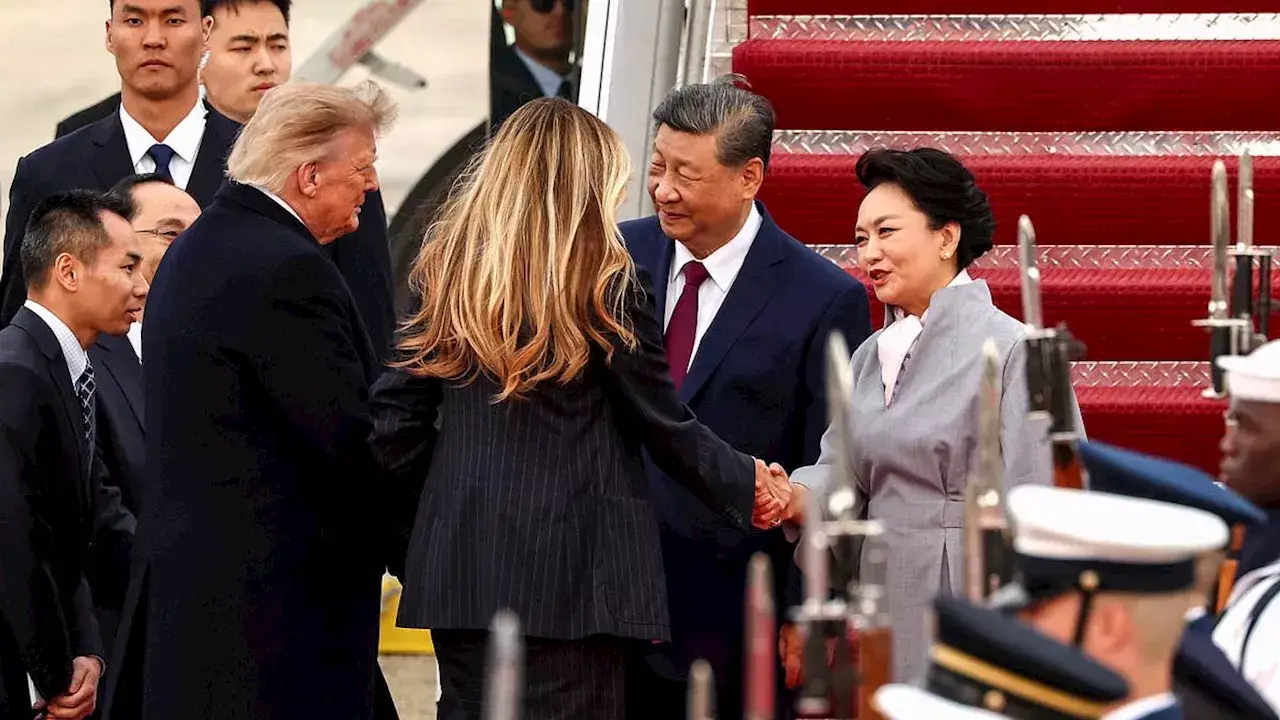

A Rare Tarmac Welcome for Xi Jinping
Chinese President Xi Jinping and his wife, Madame Peng Liyuan, arrived at Joint Base Andrews on Wednesday, September 23, 2026, marking the beginning of a three-day state visit to the United States. The arrival was met with an elaborate ceremonial welcome orchestrated by President Donald Trump and First Lady Melania Trump, featuring a military band, a red carpet, and a US Air Force flyover.
The spectacle included rows of US soldiers, F-35 fighter jets, and the presidential limousine known as "the Beast." According to ABC Columbia/AP, the welcome featured a 100-foot red carpet, a 21-person honor guard, and flyovers by two B-1 bombers. During the greeting on the tarmac, Trump removed one glove to shake hands with Xi and slapped him on the back. He later told reporters, "I think they appreciate it, tremendous people."
C-SPAN reported that this event marked the first time a US president met a world leader at an airport in over 11 years; the last such occurrence was in 2015 when Barack Obama greeted Pope Francis. In a statement following the arrival, Xi wrote that China and the US "should be partners, not rivals" and that their goals can go hand in hand.
Media Blackout and Legal Battles
The high-profile arrival was subject to a significant media blackout. Prior to the event, Trump had banned CNN, MS NOW, and Politico from the White House. While staff from Fox, CBS, and NBC attended the ceremony, they did not film the proceedings while a judge deliberated on an ongoing lawsuit regarding press access.
During the legal proceedings, Justice Department attorney Michael Velchik urged US District Judge Timothy Kelly not to restore reporters' passes until after Xi's visit, citing national security concerns. The restriction limited real-time coverage of the diplomatic event, despite the presence of major network correspondents.
Itinerary and Diplomatic Agenda
Xi and Peng will stay in Washington through Friday afternoon for bilateral negotiations and cultural events. A key component of the itinerary is a visit to the National Archives, where the Trumps, Xi, and Peng will view the original Declaration of Independence and Constitution.
A state dinner will be hosted in the White House's East Room on Thursday evening, with CEOs and Cabinet members on the invite list. This event serves to reciprocate the ceremonial grandeur of Trump’s May visit to China. The leaders are expected to discuss technology, artificial intelligence, Taiwan, and Iran.
Trade remains a central topic of the visit. The trade truce is set to end on November 10, with no breakthrough yet achieved on rare-earth minerals. However, during a Fox News Channel interview, Trump’s Treasury Secretary Scott Bessent announced an extension of the trade truce until January. This extension involves scaling back tariffs and refraining from imposing new trade restrictions, giving leaders time to talk about upcoming meetings in China in November and Florida in December.
Xi is reportedly planning to press Trump on Taiwan and a $14 billion US military package approved for the island nation. Tensions remain high over trade, artificial intelligence, Trump’s war with Iran, and China’s designs on Taiwan.
Criticism of the Lavish Welcome
The decision to host such an elaborate welcome drew sharp criticism from some quarters of the US political establishment. Senator Roger Wicker (R-MS), chairman of the Senate Armed Services Committee, criticized the lavish welcome, calling Xi a "brutal, unelected and oppressive dictator." Wicker suggested that Trump should not have invited Xi based on troubling issues with the Chinese Communist Party.
Despite the political friction and ongoing legal disputes over press access, the state visit proceeds with high-level diplomatic engagements scheduled through Friday. The extension of the trade truce provides a temporary buffer as both nations navigate complex geopolitical challenges regarding Taiwan, Iran, and economic policy.