

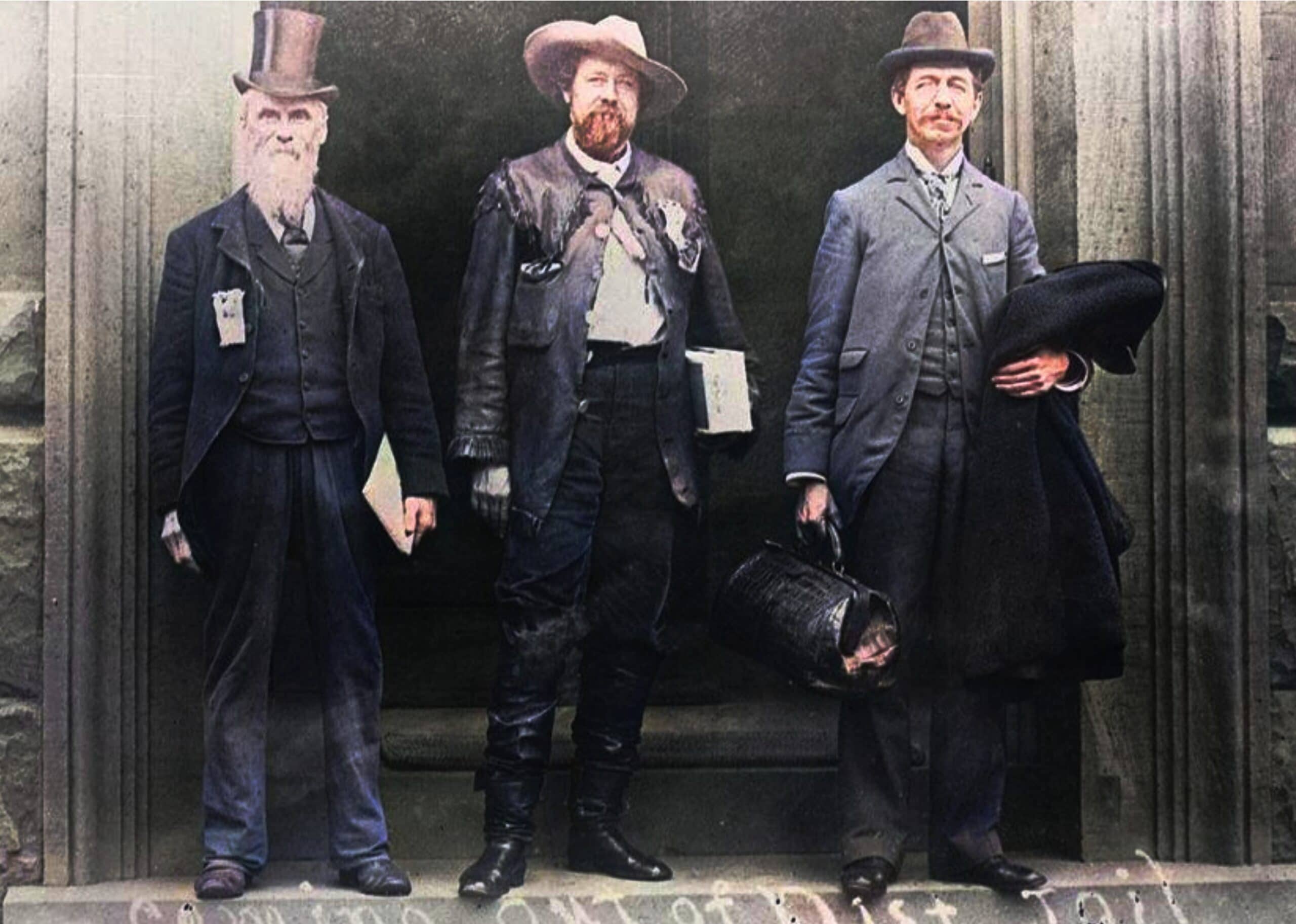

Marches Converge on the Capital
In spring 1894, unemployed workers marched on Washington D.C. from every direction during a four-year economic depression known as the Panic of 1893, which left as many as one in four workers out of a job. The country they marched through had no unemployment insurance and no relief beyond charity.
On March 16, 1894, hundreds of unemployed men walked out of Los Angeles behind Lewis Fry, a former soldier and organizer for the American Federation of Labor. Nine days later, on Easter Sunday, Jacob Coxey led a few hundred more marchers out of Massillon, Ohio.
On April 3, 600 men from San Francisco marched down Market Street to the Oakland ferry under a banner reading “We Are Hungry and Discouraged.” Some of these armies organized on their own, and the press and the public soon welded them to Coxey’s name. By summer, newspapers counted 23 armies and major contingents rolling toward the capital from the Pacific coast, the Rockies, the Plains, and the Great Lakes at once.
Nothing like it had happened in the United States. It was the first march on Washington, taking place one hundred twenty years ago on May 1, 1894, when petitioners known as "Coxey's Army" converged on the capital. The movement originated with 100 men in Massillon, Ohio, on March 25, 1894, and grew to 500 members when it reached Washington on April 30, 1894.
Demands and Dispersal Across the West
Coxey’s program demanded federal road-building paid for with non-interest-bearing bonds to put the idle to work. Fry’s program demanded federal jobs but also a 10-year ban on immigration. Editors called this radical madness while marchers called their march a "petition in boots." The Library of Congress notes that Coxey led thousands of unemployed workers and supporters from Massillon toward the U.S. capital to demand federal action including a public works program.
The journey was fraught with danger and hostility. In west Texas, a Southern Pacific crew uncoupled cars holding 500 marchers and left them stranded in the desert for nearly a week. In Montana, Butte miners under William Hogan seized a Northern Pacific train with help from townspeople while federal deputies chased them.
U.S. marshals chased Scheffler’s army 120 miles before cavalry caught them; historian Steven Piott recorded that searches of 507 prisoners found only three revolvers, butcher knives, and shaving razors. The Army's western section received the nickname Kelley's Army after California leader "General" Charles T. Kelley.
Arrival and Arrest in the Capital
Coxey reached Washington on May 1 with about 500 men. The 6,000 jobless men used the Shreve farm site at current-day Colmar Manor, Maryland, as a campsite. Coxey and other leaders were arrested for walking on the grass of the United States Capitol.
While some faced arrest, others received support along the route. The Los Angeles Herald reported that citizens of Colton contributed to the comfort of Fry’s Industrial Army. In Portland, about 1,000 people cheered as 52 accused leaders were marched to jail; when the judge released them on April 30, 3,000 workers paraded in their honor.
The convergence marked a significant moment in labor history, with Ohio businessman Jacob Coxey organizing the march that included processions heading to Washington from several other cities. The event highlighted the desperation of the era and the lack of federal safety nets for the unemployed during the Panic of 1893 depression.