

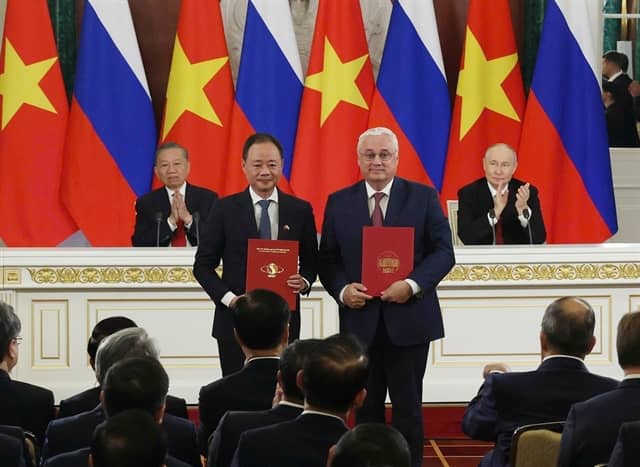

Leaders Witness Exchange of Bilateral Documents in Moscow
MOSCOW — General Secretary of the Communist Party of Vietnam Central Committee and President To Lam and Russian President Vladimir Putin witnessed the exchange of a series of cooperation documents in Moscow on Wednesday, according to reports from the Vietnam News Agency (VNA). The significant event took place within the framework of President To Lam's state visit to Russia, underscoring the high diplomatic priority placed on strengthening ties between the two nations.
The exchange of documents occurred following high-level talks between the two heads of state at the Kremlin. This formal ceremony, held on September 9, with local time in Moscow marking the occasion, served as a tangible outcome of the discussions. The direct presence of both top leaders, representing the highest echelons of their respective governments, underscored the diplomatic significance and mutual commitment to the agreements being formalized during this pivotal state visit.
Broadening Bilateral Cooperation Across Key Sectors
The accords signed during the ceremony span a wide range of spheres, indicating a comprehensive and multifaceted approach to bilateral relations. According to the source material, the areas of cooperation include justice, finance, investment, transport, ethnic affairs, energy, nuclear safety, science and technology, education, and mineral resources. This extensive list reflects a shared interest in fostering collaboration that extends beyond traditional diplomatic engagements into critical technical, economic, and social domains.
The breadth of the signed documents suggests a strategic intent to deepen cooperation across various governmental and industrial sectors. For instance, the inclusion of justice and ethnic affairs points to administrative and social cohesion efforts, while finance, investment, and transport highlight economic integration and infrastructure development. Furthermore, the emphasis on energy, nuclear safety, science and technology, and mineral resources signals long-term strategic interests in resource management, technological advancement, and industrial development, which are vital for the sustained growth and security of both nations.
Focus on Digital Justice and Financial Investment
Among the specific instruments exchanged, a Memorandum of Understanding (MoU) on the digital transformation of judicial agencies stands out. This agreement, signed between the justice ministries of both countries, represents a concerted move toward modernizing legal frameworks and administrative processes through technological integration. It signifies a joint commitment to enhancing efficiency and transparency within their respective judicial systems.
Another crucial MoU focused on strengthening investment cooperation. This particular agreement was forged between Vietnam's Ministry of Finance and Russia's Ministry of Economic Development. This pairing suggests a deliberate focus on macroeconomic alignment, fostering a conducive environment for cross-border investment, and coordinating financial policies to facilitate increased capital flows and joint ventures between the two nations.
Strategic Collaboration in Energy and Resources
Beyond the immediate administrative and financial agreements, the inclusion of sectors such as energy, nuclear safety, and mineral resources points to a deeper, long-term strategic partnership. Cooperation in energy could encompass various forms, from traditional fossil fuels to renewable sources, while nuclear safety underscores a commitment to responsible and secure development in this critical area. Similarly, collaboration in mineral resources suggests joint exploration, extraction, and processing initiatives, leveraging the natural endowments of both countries for mutual benefit and industrial growth.
Diplomatic Context of the State Visit
The signing of these extensive cooperation agreements is a central component of President To Lam's ongoing state visit to Russia. A state visit represents the highest level of diplomatic engagement between two countries, typically involving formal ceremonies, high-level discussions, and the signing of significant bilateral agreements. The timing of the document exchange, immediately following substantive talks between the two presidents at the Kremlin, places the economic, technical, and strategic accords within this broader, high-stakes diplomatic context.
Reports indicate that the cooperation documents cover not only immediate administrative updates but also long-term strategic areas such as energy and science and technology, reflecting a forward-looking vision for the bilateral relationship. The involvement of multiple government ministries from both Vietnam and Russia in the signing process further highlights the multi-sectoral and comprehensive nature of the bilateral relationship, demonstrating a coordinated effort across various governmental portfolios.
The event was meticulously documented, with VNA/VNS photographers capturing images of the leaders at the Kremlin during the proceedings. The publication of these details on September 9, 2026, confirms the precise date and location of these significant diplomatic activities, marking a new chapter in the cooperative relationship between Vietnam and Russia.