


Proposal for New Membership Category
BRUSSELS — European Commission President Ursula von der Leyen stated on Wednesday that the European Union is opening the possibility for Canada to become its first "associate member." This declaration, made during a high-profile diplomatic visit, signals a significant potential shift in the bloc's external relations. The announcement marks a potential expansion of the bloc's relationship with North American allies, though the specific legal framework for such a status remains undefined and represents a novel approach to international partnership.
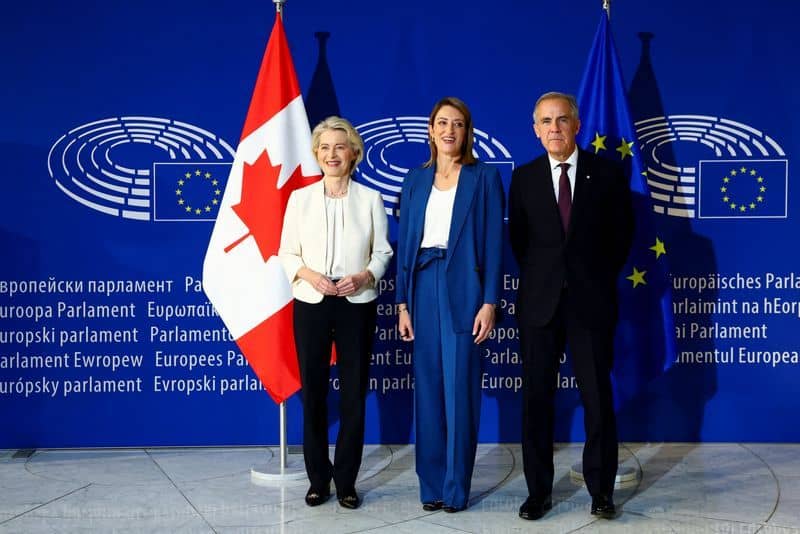
Von der Leyen made the declaration during a meeting with Canadian Prime Minister Mark Carney. The two leaders were photographed together as part of the diplomatic engagement that signaled the EU's willingness to explore this new tier of partnership. The discussions in Brussels underscored a mutual interest in deepening ties beyond conventional trade agreements or strategic dialogues.
A Novel Legal Framework
The concept of an "associate member" represents a significant departure from existing European Union protocols and its established legal architecture. According to von der Leyen, this status is not currently set out in the bloc's treaties. The EU's foundational legal documents, which govern everything from internal market operations to foreign policy, do not explicitly provide for a category of membership that sits between full accession and existing partnership agreements. This means that the creation of such a status would necessitate either a substantial reinterpretation of current treaties or the drafting of entirely new legal instruments.
By proposing Canada as the first entity to hold this title, the European Commission is effectively creating a precedent. No other nation has previously been granted associate member status under the current or previous iterations of EU law, making this a unique proposition in the history of European integration. The absence of a pre-defined legal pathway highlights the innovative, yet complex, nature of the initiative.
High-Level Diplomatic Overtures
The announcement followed high-level talks between Canadian and European officials in the heart of the European Union. Prime Minister Mark Carney was welcomed by both European Commission President Ursula von der Leyen and Roberta Metsola, the President of the European Parliament. The joint presence of the heads of two of the EU's most powerful institutions — the executive body and the legislative assembly — suggests that the proposal requires broad institutional coordination and political buy-in from the outset.
Roberta Metsola was present during the initial welcome, indicating parliamentary awareness and involvement in the initiative from an early stage. This suggests that the European Parliament, a key co-legislator in many EU policy areas, is expected to play a crucial role in shaping and approving any future agreement. However, specific details regarding the extent of Canadian participation in EU legislative bodies or the financial obligations associated with associate membership were not provided in the initial statement, leaving many aspects open for future negotiation and definition.
Realigning Transatlantic Ties
The move positions Canada as a unique partner within the European sphere, potentially elevating its relationship with the bloc to an unprecedented level. While full EU membership requires adherence to the entire body of EU law, known as the acquis communautaire, an associate status implies a more tailored arrangement. This bespoke approach would likely allow Canada to integrate deeply into specific EU policies and programs without the full burdens and obligations of a member state. The exact scope of rights and responsibilities attached to this new designation remains unspecified in current reports, but its very proposition signals a desire for a distinct form of partnership.
Observers note that the proposal could significantly alter the dynamics of transatlantic trade, security cooperation, and political alignment. Canada has long sought closer integration with Western economic and political structures, often advocating for multilateral approaches to global challenges. This proposal offers a robust mechanism for deeper alignment with the EU without requiring full accession, which is often a lengthy, politically complex, and domestically challenging process for any aspiring member.
Defining a Path Forward
Von der Leyen confirmed that the door is now open for Canada to pursue this status, initiating a complex process of negotiation and legal definition. The European Commission has taken the lead in initiating this dialogue, but the path forward requires extensive further negotiation between Canadian and EU representatives. Because the status does not exist in existing treaties, any agreement would likely require the development of new legal instruments or innovative interpretative frameworks to integrate Canada into the EU's operational structures.
The European Parliament will undoubtedly play a significant role in any final arrangement, given President Metsola's early involvement in the initial discussions. This legislative oversight will be critical in ensuring democratic accountability and securing the necessary political consensus across EU member states. The timeline for formalizing the associate member relationship has not been disclosed by EU officials, underscoring the intricate legal and political work that lies ahead.
A Unique Tier of Partnership
The EU currently maintains various forms of association with non-member states, each with its own specific framework. These include members of the European Economic Area (EEA), which participate in the EU's single market, and candidate countries, which are on a path towards full membership and are expected to adopt the acquis communautaire over time. Additionally, the EU has numerous bilateral partnership and cooperation agreements with countries worldwide.
However, none of these existing arrangements are classified as "associate members" in the manner described by von der Leyen for Canada. The distinction suggests a level of integration that is intended to exceed standard partnership agreements, offering more structured and perhaps more permanent ties, but deliberately falls short of full membership. This proposed status for Canada would therefore represent a new, distinct tier in the EU's complex web of external relations, potentially setting a benchmark for future engagements with other close allies.
As of Wednesday, September 16, 2026, no other nations have been invited to apply for this status. Canada remains the sole candidate for the inaugural associate member role as outlined in von der Leyen's announcement, highlighting the specific and perhaps strategic nature of this initial overture.