

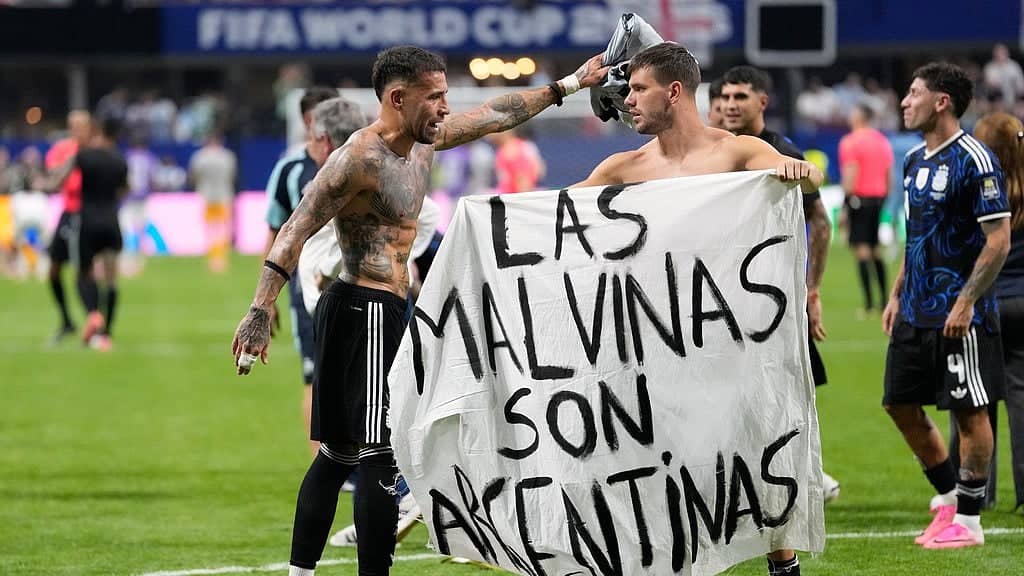

Diplomatic Standoff Over Banner at Atlanta Match
A provocative banner sparked a heated standoff between Argentine players and British officials following a World Cup semi-final soccer match held in Atlanta on July 19, 2026. The incident occurred after Argentina defeated England to advance toward the final of the tournament scheduled for 2026. During post-match celebrations, team members displayed signage asserting territorial claims regarding disputed islands.
Argentina's Giovani Lo Celso held a banner with the words \"The Malvinas are Argentine,\" referring to the Falkland Islands known as Las Malvinas in Spanish and referred to by Argentina using that name while Britain calls them the Falklands. Teammate Nicolas Otamendi was seen gesturing toward his colleague during footage captured at the conclusion of the game.
British officials condemned the banner immediately after its display, characterizing it as a violation of sporting neutrality. They argued that international football competitions should remain free from political statements involving territorial disputes between nations not directly participating in the event.
The United States hosted this specific match within its territory under FIFA's oversight for the 2026 World Cup co-hosted by America, Canada, and Mexico alongside Brazil as a guest nation. Hosting duties included logistical support and security arrangements managed through local authorities working with international federations.
FIFA Launches Disciplinary Review
In response to the banner's display during live broadcast coverage, FIFA officially launched a disciplinary review into the matter. The governing body stated it would evaluate whether such actions comply with regulations regarding conduct off-field and political expression within competitive environments governed by its statutes.
Officials from both Argentina and England expressed differing interpretations of acceptable behavior following matches involving geopolitical sensitivities. Argentine representatives maintained that expressing national identity through historical claims was consistent with domestic laws protecting freedom of speech regardless of international recognition status.
White House Intervention Cites Free Speech Protections
The White House publicly defended the actions taken by Argentina's squad members, citing protections afforded under U.S. constitutional principles regarding free expression. A spokesperson for the administration noted that American legal frameworks prioritize individual rights even when those expressions involve controversial subjects related to foreign policy or territorial sovereignty.
This intervention elevated diplomatic tensions between Washington and London ahead of scheduled bilateral meetings planned later in July 2026. Officials from both governments issued statements addressing how domestic laws intersect with international obligations during multinational sporting events hosted on U.S. soil.
British diplomats emphasized that while respecting host nation regulations, they expected adherence to global norms prohibiting political messaging unrelated to the competition itself. They reiterated concerns about setting precedents where non-participating parties influence outcomes via symbolic gestures made by third-party teams.
Escalation Before Final Match
The dispute has escalated tensions between the United States and Britain before the final match of the tournament was set to take place later in August 2026. Both sides issued statements clarifying their positions without resolving underlying disagreements about appropriate conduct during international competitions.
Argentine officials maintained that players were expressing legitimate national sentiment aligned with long-standing government policy regarding sovereignty claims over disputed territories recognized by multiple United Nations resolutions supporting Argentina's position on the matter despite British administration continuing there since 1833 according to historical records cited in diplomatic correspondence exchanged between capitals involved in ongoing negotiations.
British officials countered that allowing such displays undermines principles of fair play established decades ago within international sporting codes designed specifically to prevent politicization of athletic contests regardless of host location or participating teams' backgrounds.
Ongoing Implications for Future Tournaments
The outcome of FIFA's disciplinary review remains pending as investigations continue into whether similar incidents might arise during upcoming matches scheduled across North America later this year. Legal experts suggest precedents established now could influence how future host nations manage comparable situations involving politically sensitive topics raised by participating athletes.
Observers note that while no immediate sanctions were imposed on Argentine players following initial reports, the situation highlights growing complexity surrounding intersection of sports governance with broader geopolitical issues increasingly prominent in modern international relations frameworks adopted globally over past decades leading up to current events unfolding today.
"