

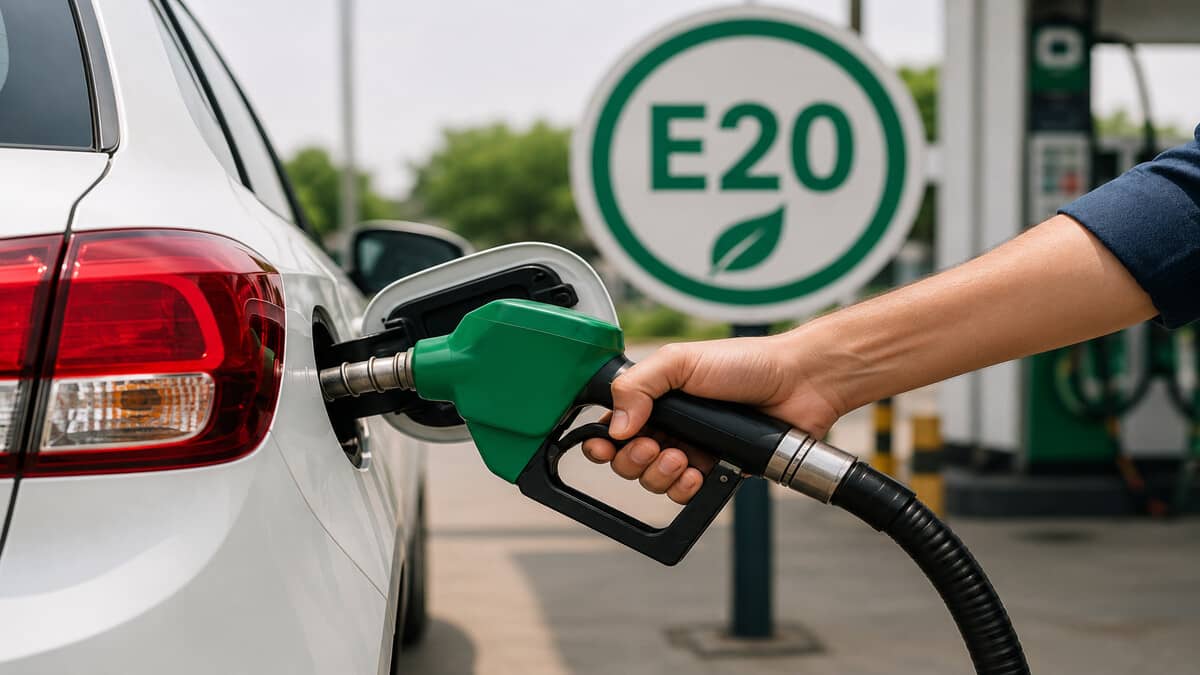

Government Clarifies E20 Pricing Strategy
The Ministry of Petroleum and Natural Gas addressed public inquiries regarding the cost of ethanol-blended fuel on July 10, stating clearly that the price of E20 petrol is not expected to fall. The ministry characterized E20 fuel as a strategic instrument designed to ensure price stability and enhance energy security, rather than a mechanism for reducing consumer fuel expenses.
This clarification came after sustained public scrutiny over why ethanol blending has not resulted in cheaper petrol at the pump. Consumers had widely anticipated that the introduction of a more domestically sourced component like ethanol would lead to a reduction in fuel prices, mirroring expectations often associated with increased local production. In its response, the government indicated that consumers should view the adoption of E20 primarily through the lens of national economic resilience and supply chain stability. This perspective underscores a broader governmental objective to mitigate the impact of volatile global crude oil prices and reduce India's reliance on energy imports, thereby bolstering the nation's financial stability and strategic autonomy.
The ministry’s stance marks a definitive shift in communication, moving away from implicit promises of cost savings to an explicit focus on macroeconomic benefits. This strategic pivot aims to manage public expectations by clearly delineating the primary policy drivers behind the ethanol blending program, emphasizing its role in safeguarding the national economy rather than directly lowering household fuel expenditures.
Operational Trade-offs and Technical Specifications
In a notable concession regarding performance metrics, the government acknowledged for the first time that E20 fuel delivers between 3% and 5% lower mileage compared to conventional petrol. This admission aligns with technical assessments of ethanol's energy density, which is inherently lower than that of pure gasoline. The reduced energy content means that a greater volume of E20 fuel is required to travel the same distance, directly impacting vehicle efficiency and, consequently, consumer fuel consumption patterns.
Concurrently, reports indicate that the production costs associated with manufacturing E20 fuel are higher than those for standard petrol. These elevated production expenses contribute significantly to the current pricing structure, where the financial burden does not translate into direct savings for the end-user. The combination of increased production costs and reduced vehicle efficiency forms a critical part of the economic equation that prevents E20 from being cheaper at the pump, despite its strategic national benefits.
Addressing Consumer Concerns and Industry Feedback
The Ministry of Information and Broadcasting has previously dismissed concerns raised by consumers regarding the mileage impacts of E20 fuel. These dismissals occurred alongside repeated defenses from Union Petroleum Minister Hardeep Singh Puri, who has consistently supported the ethanol blending program. Minister Puri has frequently highlighted the environmental advantages and energy security benefits of ethanol blending, framing it as a crucial step towards India's sustainable energy future.
Technical compatibility issues have also been a point of contention among the public. However, during a press conference held on July 4, automakers rejected claims that E20 fuel causes engine damage. The manufacturers' statements served to counter narratives suggesting that the new fuel standard might compromise vehicle longevity or performance integrity. This industry assurance is vital for maintaining consumer confidence and facilitating a smoother transition to ethanol-blended fuels, ensuring that vehicle owners do not perceive a risk to their investments.
Economic Implications and Future Rollout
Experts analyzing the economic structure of the ethanol program suggest that the financial advantages derived from E20 fuel accrue primarily to the government's finances, known as the exchequer, rather than to individual consumers. This perspective highlights a divergence between national fiscal goals and household budget impacts. The benefits for the exchequer largely stem from reduced crude oil import bills, which save valuable foreign exchange and strengthen the national economy against global oil price fluctuations. These savings contribute to the government's overall financial health and its capacity to fund other public services and development projects.
While the government reaps these macroeconomic benefits, consumers face a different reality. They contend with higher production costs embedded in the fuel price and experience lower mileage from their vehicles, without a corresponding reduction in the price they pay at the pump. This situation underscores the government's prioritization of broader energy policy objectives over direct consumer price relief in the context of E20 fuel.
Strategic Progression to E25 Blending
Looking ahead, reports indicate that the government plans to roll out E25 fuel in phases. This staged implementation is intended to prevent negative reactions similar to those observed during the initial introduction of E20, particularly regarding vehicle compatibility and consumer acceptance. The cautious approach to higher blending ratios suggests a learning curve from the E20 experience, where public concerns about mileage and engine compatibility required significant governmental and industry clarification.
The trajectory of fuel pricing in India remains tied to these strategic objectives. While conventional petrol prices fluctuate based on global oil markets and domestic taxes, E20 pricing is being managed to serve broader policy goals. The government’s position remains that the long-term benefits of energy security and price stability justify the current cost structure and performance trade-offs associated with ethanol-blended fuels, viewing E20 as a critical step in India's journey towards greater energy independence and economic resilience.