


Ukrainian Leadership Reports on Expanded Military Cooperation
Ukrainian President Volodymyr Zelenskyy has stated that the Russian government is seeking an additional 30,000 troops from North Korea to support its military operations. In his assessment of the developing geopolitical situation, Zelenskyy indicated that Pyongyang is also preparing to transfer additional ballistic missile launchers to Moscow.
The announcement regarding the potential influx of personnel and heavy weaponry underscores the deepening military alliance between the two nations as they face international sanctions and isolation. Zelenskyy’s comments provide a specific quantification of the scale of North Korean involvement that Kyiv believes is imminent, suggesting a significant escalation in the resources available to Russian forces.
Details on Troop Deployments and Weaponry
According to reports from late July 2026, Zelenskyy claimed that Russia was preparing to receive the additional contingent of soldiers. This figure adds to the thousands of North Korean troops that have already been deployed to the region. The Ukrainian leader’s statement highlights a dual-track approach by Moscow and Pyongyang: the movement of infantry personnel alongside the transfer of critical military hardware.
The specific mention of ballistic missile launchers suggests that the cooperation extends beyond ground forces to include strategic or long-range strike capabilities. By citing these specific assets, Zelenskyy is outlining the tangible components of the support Russia is receiving from its Asian ally. The claim implies a logistical effort to move not just people, but heavy equipment across borders.
Regional Responses and Expert Analysis
The diplomatic fallout from these developments has been swift in neighboring countries. South Korea summoned Russia's ambassador to protest the deployment of North Korean troops to Ukraine. During this diplomatic meeting, Seoul demanded the immediate withdrawal of the foreign forces.
This protest occurred on Oct. 21, 2024, a date that marks a significant point of tension in the region. The summoning of the ambassador serves as a formal diplomatic rebuke, signaling South Korea’s strong opposition to the militarization of the conflict through third-party involvement.
Local Perspectives on Deployment Feasibility
While Zelenskyy provided specific numbers regarding troop requests and weapon transfers, local experts in Seoul have offered a different perspective on the immediate tactical implications. According to these experts, frontline deployment of North Korean forces is unlikely despite the growing cooperation between Pyongyang and Moscow.
This divergence between the Ukrainian president’s claims of imminent large-scale deployment and the local expert assessment of logistical constraints highlights the complexity of interpreting military movements in the region. The experts’ view suggests that while political and material support may be intensifying, the physical presence of troops on the front lines may not align with the scale suggested by Kyiv.
Visual Documentation of Ties
The strengthening ties between the two nations have been visually documented in recent years. Images from Pyongyang show North Korean leader Kim Jong Un and Russian President Vladimir Putin toasting together, symbolizing their political alignment. These visual records are frequently cited in international media coverage to illustrate the personal diplomatic relationship driving state-level cooperation.
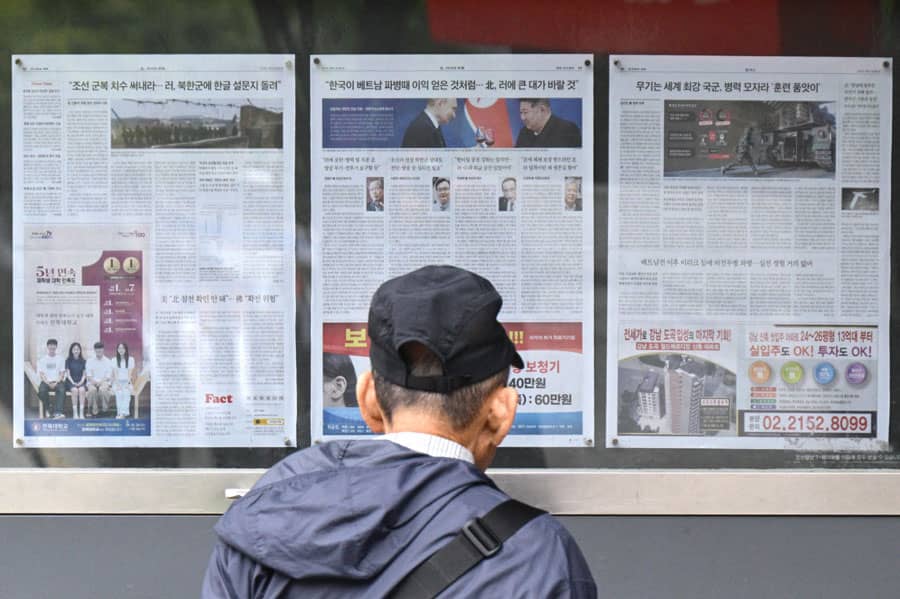
Photographic evidence from Seoul on Oct. 21, 2024, also captures the public reaction to these events. A man was seen passing a street newspaper that featured coverage of North Korea sending thousands of troops to Ukraine alongside the photo of the two leaders. This imagery reflects how the geopolitical shift is being consumed and interpreted by the public in South Korea.
Implications for Regional Security
The combination of Zelenskyy’s claims regarding 30,000 additional troops and ballistic missile launchers, alongside the diplomatic protests from South Korea, indicates a high level of concern among neighboring states. The demand for immediate withdrawal by Seoul contrasts with the ongoing preparations reported by Kyiv.
As the conflict continues, the flow of personnel and equipment between North Korea and Russia remains a focal point for international observers. The specific figures provided by Zelenskyy serve as a key metric for assessing the depth of this alliance, while local expert analysis provides context on the practical limitations of such deployments.