

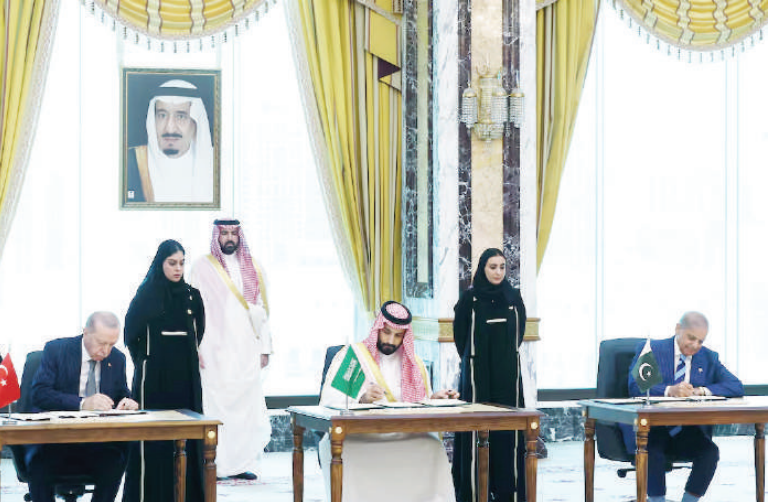

Leaders Sign Collective Defense Agreement in Mecca
Saudi Crown Prince Mohammed bin Salman, Turkish President Recep Tayyip Erdogan, and Pakistan’s Prime Minister Shehbaz Sharif signed a joint defense agreement in Mecca, Saudi Arabia, on August 7. The signing took place during the "Makkah Al-Mukarramah Summit for Joint Defence." The agreement, referred to as the "Mecca Defence pact," establishes a framework for collective security among the three nations.
According to details provided by The Sunday Guardian, the fine print of the agreement envisages that an armed attack against one signatory would be deemed as an attack on all three parties. This principle mirrors Article 5 of the North Atlantic Treaty Organization (NATO), which is based on collective defense. NATO has invoked Article 5 only once in its history, following the attacks on September 11, 2001.
The overall details of the pact remain undisclosed. However, the agreement is described as having strategic poise and diplomatic weight despite lacking a formal organizational structure. The pact is characterized as less of a traditional alliance and more of a form of strategic hedging, particularly in relation to Iran.
Strategic Implications for Signatory Nations
The agreement is expected to yield specific strategic benefits for each of the three participating nations. For Riyadh, the pact is anticipated to enhance security. For Ankara, it provides access to weapon system markets. For Islamabad, the agreement offers strategic depth.
Security Enhancements for Riyadh
Saudi Arabia’s primary benefit from the trilateral agreement is described as an enhancement of its security posture. By aligning with Turkey and Pakistan, Riyadh gains a formalized mechanism for collective defense against armed attacks. The pact does not establish a permanent command structure or joint military headquarters, but it creates a political commitment to mutual defense.
Market Access for Ankara
Turkey’s strategic gain is identified as access to weapon system markets. The agreement facilitates commercial and military cooperation that allows Ankara to engage with Saudi and Pakistani defense industries. This market access is a key component of the diplomatic weight attributed to the pact by analysts.
Strategic Depth for Islamabad
Pakistan receives strategic depth through the agreement. This term refers to the expansion of its security perimeter and the diversification of its defense partnerships. The alignment with Saudi Arabia and Turkey provides Islamabad with additional diplomatic leverage and military support options in the region.
Strategic Hedging Against Iran
The pact is seen as a form of strategic hedging, particularly in relation to Iran. While the specific nature of this hedging is not detailed in the available text, the alignment of these three Sunni-majority nations suggests a coordinated effort to balance regional power dynamics. The agreement does not explicitly name Iran as an adversary, but analysts describe it as a response to Iran’s sustained influence in the region.
The Sunday Guardian notes that the pact is less of an alliance and more of strategic hedging. This characterization implies that the agreement is flexible and situational rather than a rigid, long-term military commitment. The lack of an organizational structure supports this interpretation, as it allows the signatories to maintain independent foreign policies while retaining the option for collective defense.
Comparison to Existing Defense Frameworks
The Mecca Defence pact is explicitly compared to NATO’s Article 5 in terms of its core principle. However, significant structural differences exist. NATO is a formal alliance with integrated military commands and standardized procedures. The Mecca pact lacks these organizational elements.
Despite the lack of formal structure, the agreement carries diplomatic weight. The participation of high-level leaders—Crown Prince Mohammed bin Salman, President Erdogan, and Prime Minister Sharif—underscores the political significance of the pact. The summit format indicates a commitment to regular dialogue and coordination among the three nations.
The agreement does not include provisions for joint military exercises, intelligence sharing mechanisms, or standardized defense procurement processes. These elements are typically found in formal alliances. Instead, the pact relies on political will and diplomatic engagement to function as a deterrent.
Regional Security Dynamics
The signing of the pact occurs against a backdrop of complex regional security dynamics. Saudi Arabia, Turkey, and Pakistan have historically maintained distinct foreign policy priorities. The agreement represents a convergence of these interests in the area of defense.
The pact does not address internal political issues within any of the signatory nations. It is focused exclusively on external defense commitments. The agreement does not include provisions for economic cooperation or cultural exchange, further limiting its scope to military and security matters.
The Sunday Guardian reports that the details of the pact are not fully known. This lack of transparency is typical of diplomatic agreements in their early stages. The specific terms regarding the response to an armed attack are not publicly disclosed. The agreement does not specify whether the response would be military, economic, or diplomatic.
The strategic poise attributed to the pact suggests that it is intended to project strength and unity among the signatories. The diplomatic weight indicates that the agreement has implications for broader regional diplomacy. The pact may influence the behavior of other nations in the Middle East and South Asia.
The agreement does not mention any specific threats or scenarios. It establishes a general principle of collective defense. The application of this principle will depend on future events and the political decisions of the signatories. The pact does not include a sunset clause or automatic renewal mechanism.
The signing in Mecca, a city of religious significance, adds symbolic weight to the agreement. However, the pact is secular in nature, focusing on defense rather than religious cooperation. The location was chosen for its diplomatic and symbolic value rather than its strategic military importance.
The agreement does not include provisions for dispute resolution among the signatories. It is designed to address external threats rather than internal disagreements. The lack of an organizational structure means that disputes would likely be resolved through diplomatic channels rather than formal mechanisms.
The pact does not specify the duration of the commitment. It is a standing agreement that remains in effect until terminated by one or more of the signatories. The terms of termination are not publicly disclosed.
The agreement does not include provisions for third-party participation. It is a trilateral pact limited to Saudi Arabia, Turkey, and Pakistan. Other nations may seek to join or align with the pact in the future, but no such provisions exist in the current text.
The strategic hedging aspect of the pact suggests that the signatories are seeking to balance their relationships with other global powers. The agreement does not explicitly exclude cooperation with other nations, including Western countries. However, it establishes a new axis of defense cooperation in the region.
The impact of the pact on regional stability is not yet known. Analysts describe it as having strategic poise and diplomatic weight. The actual effect will depend on how the signatories implement the agreement and respond to future security challenges.
The agreement does not include provisions for public disclosure of military movements or exercises. It is a confidential defense pact in terms of operational details. The political commitment, however, is public.
The signing marks a significant development in the defense relations of Saudi Arabia, Turkey, and Pakistan. The pact establishes a framework for cooperation that did not exist previously. The specific outcomes of this cooperation will unfold over time.
The agreement does not address non-traditional security threats such as cyber warfare or terrorism explicitly. It focuses on armed attacks. The definition of an armed attack is not specified in the publicly available text.
The pact does not include provisions for joint research and development in defense technology. It is focused on immediate defense commitments rather than long-term technological cooperation.
The strategic depth provided to Islamabad is a key benefit of the agreement. This depth allows Pakistan to diversify its defense partnerships and reduce reliance on any single nation. The pact does not diminish Pakistan’s existing relationships with other countries.
Similarly, the access to weapon system markets for Ankara does not preclude Turkey from purchasing weapons from other sources. It expands Turkey’s options rather than restricting them.
The enhancement of security for Riyadh is a primary goal of the agreement. This enhancement is achieved through the political commitment of two major regional powers. The actual military capabilities contributed by each nation are not disclosed.
The pact does not include provisions for joint training programs for military personnel. It is a high-level strategic agreement rather than an operational one.
The agreement does not specify the level of consultation required before invoking the collective defense clause. It leaves this to the discretion of the signatories.
The signing of the pact by high-level leaders indicates strong political will. However, the implementation of the agreement will depend on bureaucratic and military coordination among the three nations.
The lack of an organizational structure means that the pact is flexible but also less binding than formal alliances. The signatories retain full sovereignty over their defense decisions.
The strategic hedging against Iran is a key driver of the agreement. This hedging is intended to deter Iranian aggression or influence in the region.
The pact does not address the nuclear programs of any of the signatory nations. It is focused on conventional defense.
The agreement does not include provisions for economic sanctions as part of the collective response to an armed attack. The nature of the response is left open.
The signing in Mecca was a one-time event. Future summits may be held to review the implementation of the pact, but no schedule has been announced.
The agreement does not include provisions for public statements or joint press conferences regarding specific security incidents. The signatories may choose to issue joint statements, but this is not mandated by the pact.
The strategic poise of the pact is attributed to its ability to signal unity among the three nations without creating a rigid alliance structure. This flexibility allows the nations to adapt to changing regional dynamics.
The diplomatic weight of the pact is derived from the status of the signatories and the significance of the location. It serves as a symbol of cooperation among major Islamic nations.
The agreement does not address maritime security explicitly. It focuses on general armed attacks, which may include maritime threats but is not limited to them.
The pact does not include provisions for joint air defense systems. Each nation retains its own air defense capabilities.
The strategic depth for Islamabad is a long-term benefit of the agreement. It enhances Pakistan’s position in regional security discussions.
The access to weapon system markets for Ankara is an immediate economic and military benefit. It facilitates trade and cooperation in the defense sector.
The enhancement of security for Riyadh is a strategic goal. The pact provides a framework for addressing potential threats through collective action.
The agreement does not include provisions for joint naval exercises. Each nation maintains its own naval forces.
The strategic hedging against Iran is a key aspect of the pact. It reflects the concerns of the signatories regarding regional power balances.
The pact does not address internal security issues within any of the signatory nations. It is focused on external defense.
The agreement does not include provisions for joint cyber defense units. Each nation maintains its own cyber capabilities.
The signing of the pact marks a new chapter in the defense relations of Saudi Arabia, Turkey, and Pakistan. The specific outcomes will depend on future developments.
The lack of an organizational structure means that the pact is less formal than NATO but still carries significant political weight. It represents a unique model of defense cooperation.
The strategic poise and diplomatic weight of the pact are attributed to its ability to balance flexibility with commitment. The signatories have chosen a path that allows for adaptation while maintaining a strong defensive posture.
The agreement does not include provisions for joint intelligence sharing. Each nation retains its own intelligence services.
The strategic depth for Islamabad is a key benefit of the agreement. It enhances Pakistan’s ability to respond to regional challenges.
The access to weapon system markets for Ankara is a significant economic and military gain. It strengthens Turkey’s defense industry.
The enhancement of security for Riyadh is a primary goal of the pact. It provides Saudi Arabia with additional diplomatic support in the region.
The agreement does not include provisions for joint special forces operations. Each nation maintains its own special forces units.
The strategic hedging against Iran is a central theme of the pact. It reflects the shared concerns of the signatories regarding regional stability.
The pact does not address space-based security issues. It is focused on terrestrial and maritime defense.
The signing of the pact by high-level leaders indicates strong political commitment. The implementation will require sustained diplomatic engagement.
The lack of an organizational structure means that the pact relies on trust and mutual interest among the signatories. This reliance may be both a strength and a weakness.
The strategic poise of the pact is derived from its ability to project unity without creating a rigid alliance. It allows the signatories to maintain their independence while cooperating on defense.
The diplomatic weight of the pact is significant in the context of Middle Eastern geopolitics. It signals a shift in regional alliances and security dynamics.
The agreement does not include provisions for joint peacekeeping operations. Each nation retains its own contribution to international peacekeeping efforts.
The strategic depth for Islamabad is a long-term benefit that enhances Pakistan’s regional standing. It provides additional options for defense cooperation.
The access to weapon system markets for Ankara is an immediate benefit that supports Turkey’s defense industry. It facilitates trade and technological exchange.
The enhancement of security for Riyadh is a key goal of the pact. It provides Saudi Arabia with a framework for collective defense against external threats.
The agreement does not include provisions for joint counter-terrorism operations. Each nation retains its own counter-terrorism capabilities.
The strategic hedging against Iran is a central aspect of the pact. It reflects the shared concerns of the signatories regarding regional power balances.
The pact does not address arms control issues. It is focused on defense rather than disarmament.
The signing of the pact marks a significant development in the defense relations of Saudi Arabia, Turkey, and Pakistan. The specific outcomes will depend on future political and security developments.
The lack of an organizational structure means that the pact is flexible but also less binding than formal alliances. The signatories retain full sovereignty over their defense decisions.
The strategic poise and diplomatic weight of the pact are attributed to its ability to balance flexibility with commitment. The signatories have chosen a path that allows for adaptation while maintaining a strong defensive posture.
The agreement does not include provisions for joint military doctrine development. Each nation maintains its own military doctrines.
The strategic depth for Islamabad is a key benefit of the agreement. It enhances Pakistan’s ability to respond to regional challenges.
The access to weapon system markets for Ankara is a significant economic and military gain. It strengthens Turkey’s defense industry.
The enhancement of security for Riyadh is a primary goal of the pact. It provides Saudi Arabia with additional diplomatic support in the region.
The agreement does not include provisions for joint air force operations. Each nation maintains its own air force.
The strategic hedging against Iran is a central theme of the pact. It reflects the shared concerns of the signatories regarding regional stability.
The pact does not address maritime security explicitly. It focuses on general armed attacks, which may include maritime threats but is not limited to them.
The signing of the pact by high-level leaders indicates strong political commitment. The implementation will require sustained diplomatic engagement.
The lack of an organizational structure means that the pact relies on trust and mutual interest among the signatories. This reliance may be both a strength and a weakness.
The strategic poise of the pact is derived from its ability to project unity without creating a rigid alliance. It allows the signatories to maintain their independence while cooperating on defense.
The diplomatic weight of the pact is significant in the context of Middle Eastern geopolitics. It signals a shift in regional alliances and security dynamics.
The agreement does not include provisions for joint naval exercises. Each nation maintains its own naval forces.
The strategic depth for Islamabad is a long-term benefit that enhances Pakistan’s regional standing. It provides additional options for defense cooperation.
The access to weapon system markets for Ankara is an immediate benefit that supports Turkey’s defense industry. It facilitates trade and technological exchange.
The enhancement of security for Riyadh is a key goal of the pact. It provides Saudi Arabia with a framework for collective defense against external threats.
The agreement does not include provisions for joint special forces operations. Each nation maintains its own special forces units.
The strategic hedging against Iran is a central aspect of the pact. It reflects the shared concerns of the signatories regarding regional power balances.
The pact does not address space-based security issues. It is focused on terrestrial and maritime defense.
The signing of the pact marks a significant development in the defense relations of Saudi Arabia, Turkey, and Pakistan. The specific outcomes will depend on future political and security developments.
The lack of an organizational structure means that the pact is flexible but also less binding than formal alliances. The signatories retain full sovereignty over their defense decisions.
The strategic poise and diplomatic weight of the pact are attributed to its ability to balance flexibility with commitment. The signatories have chosen a path that allows for adaptation while maintaining a strong defensive posture.