


Treasury Secretary Unveils Broad Sanctions Campaign Against Tehran
Treasury Secretary Scott Bessent on Monday escalated the Trump administration’s economic pressure on Iran, introducing a comprehensive initiative designed to isolate the nation from international markets. During a news conference, Bessent unveiled what the administration has named "Operation Economic Outcast," describing it as an effort to cut off virtually every remaining source of hard currency for Tehran.
Bessent issued a stark warning to global entities regarding their commercial relationships with Iran. He stated that any form of economic engagement with the Iranian government would result in severe consequences. "Let there be no ambiguity as to the position of the United States," Bessent said during the briefing. "An economic engagement of any kind with this murderous regime will expose those responsible to the full reach of American power."
The secretary emphasized that the era of operating in ambiguous areas of U.S. policy was over. He declared that it is "no longer acceptable to operate in the gray spaces" of United States policy, signaling a stricter enforcement posture for existing and future sanctions regimes.
Targeted Sectors and Immediate Sanctions
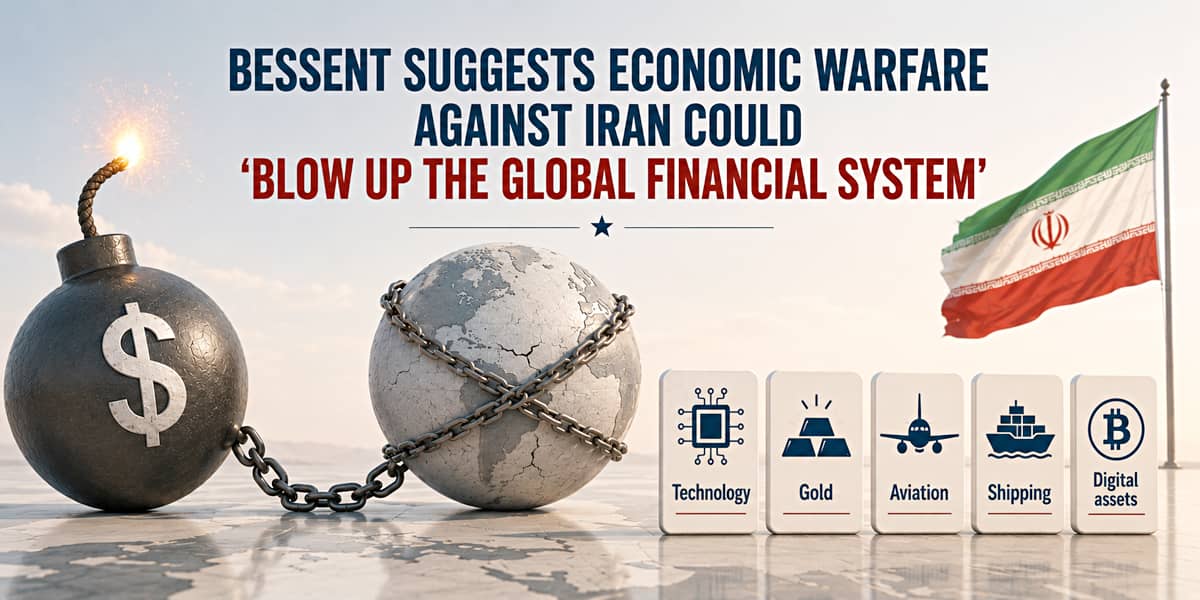
The "Operation Economic Outcast" campaign specifically targets five key industries that have historically facilitated Iran’s access to foreign exchange. According to Bessent, the administration is focusing its efforts on technology, gold, aviation, shipping, and digital assets.
Bessent indicated that enforcement actions would follow rapidly. He stated that he anticipates the announcement of sanctions against a major financial institution as soon as next week. This imminent action suggests that the Treasury Department is preparing to penalize specific entities already involved in facilitating transactions for the Iranian government.
Debate Over Timing and Global Stability
The strategy has drawn immediate scrutiny regarding its potential impact on international markets. During the news conference, a reporter challenged Bessent’s characterization of the initiative as an "economic D-Day," noting that the historical D-Day invasion included a timeline and was not primarily a threat.
The reporter asked why the administration did not impose the sanctions immediately rather than issuing warnings first. In response, Bessent highlighted the systemic risks associated with such aggressive measures. When asked about the timing of the sanctions, Bessent replied, "Why would I want to blow up the global financial system?"
Expert Criticism and Strategic Context
The administration’s approach has faced criticism from outside observers who question the efficacy and consequences of the policy. One expert warned that the campaign could backfire significantly. According to the expert, "Operation Economic Outcast will not only fail," but the economic pressure applied by the United States might ultimately harm American interests. The expert noted that "the economic noose that actually tightens may end up being the one wrapped around our neck."
The escalation of economic attacks comes amid a broader geopolitical conflict involving the United States and Iran. Reports indicate that the Trump administration is engaged in what it describes as a war of choice with Iran, alongside Israel. The administration has stated that it is unable to achieve its objectives through military means alone, prompting the shift toward comprehensive economic warfare.
Bessent’s comments reflect the administration’s intent to use financial leverage as a primary tool of foreign policy. By targeting digital assets and gold, sectors often used to bypass traditional banking restrictions, the U.S. aims to close loopholes that have allowed Iran to maintain some level of international trade.
Implications for International Trade
The warning to countries and companies around the world marks a significant tightening of U.S. enforcement. Bessent’s statement that economic engagement will expose responsible parties to "the full reach of American power" serves as a deterrent to foreign entities considering business with Tehran.
As the Treasury Department prepares for the upcoming sanctions against a major financial institution, international markets are monitoring the situation closely. The potential disruption to global finance, which Bessent acknowledged as a risk, remains a central point of debate among policymakers and economic analysts regarding the long-term stability of the current strategy.