

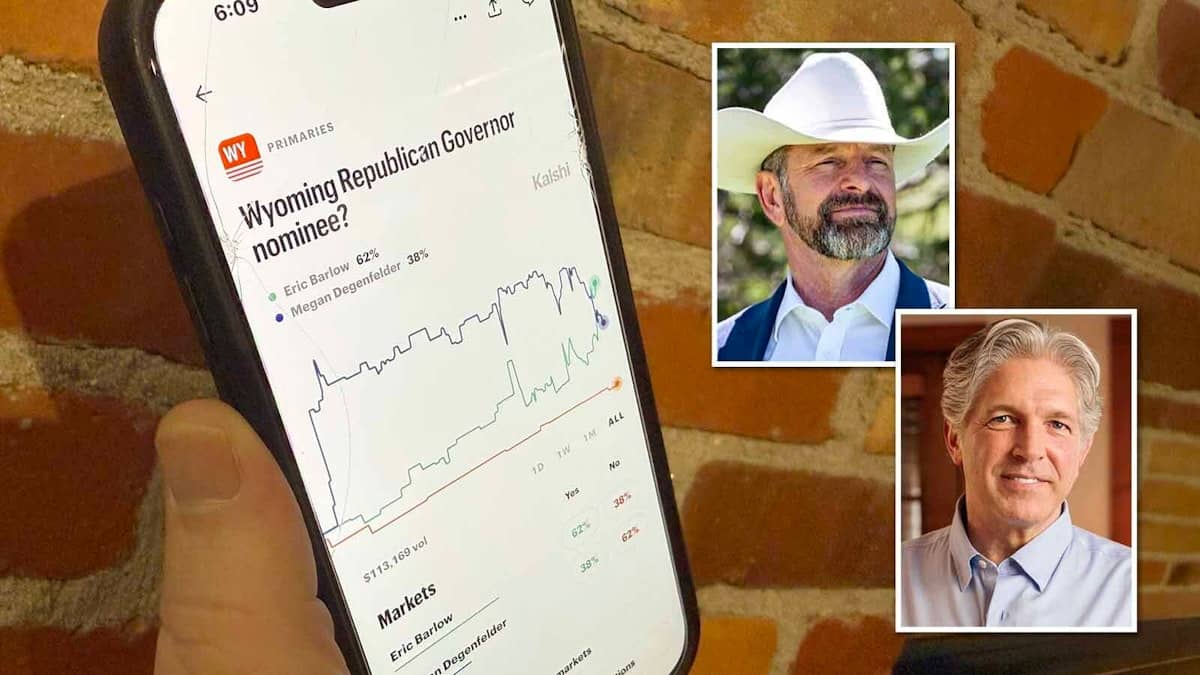

Wagering Volumes Signal Market Preference for Friess and Barlow
Bettors have placed significant financial stakes on the outcomes of Wyoming’s upcoming Republican primaries, with political prediction markets indicating a clear preference for Steve Friess in the U.S. House race and Eric Barlow in the governor’s race. According to data from gambling platforms PolyMarket and Kalshi, individuals have wagered at least $210,000 across these two contests.
The distribution of funds highlights distinct trends within each primary. Reports indicate that approximately $189,000 has been wagered on the governor’s race, while roughly $21,000 has been placed on the U.S. House Republican nomination contest. These figures represent the total capital committed by participants seeking to profit from the correct prediction of party nominees.
On PolyMarket and Kalshi, the odds currently favor Friess to secure the Republican nomination for the U.S. House seat. The market data suggests a narrow margin of victory for Friess over his primary opponent, Secretary of State Chuck Gray. In the gubernatorial race, Eric Barlow holds the favored position among bettors for the GOP nomination.
Headlines surrounding these markets have cited varying totals for the wagering amounts. One report from Cowboy State Daily noted that $131,000 had been wagered so far, while the full article text clarified that the total had risen to at least $210,000. The discrepancy may reflect the dynamic nature of prediction markets where wagers are added in real-time as the election approaches.
Expert Analysis on Prediction Market Reliability
Dustin Olson, the owner of American Pulse Research and Polling and host of the podcast "Political Trade Secrets," provided context regarding the utility of these gambling platforms in forecasting election outcomes. Olson acknowledged that while the markets indicate a preference for Friess and Barlow, they should not be viewed as definitive predictors.
"But they’re not a crystal ball," Olson stated during a Monday phone interview with Cowboy State Daily. He emphasized that prediction markets are influenced by participant behavior and capital flow rather than traditional polling methodologies.
However, Olson noted a correlation between financial volume and predictive accuracy in these specific types of markets. According to his assessment, higher wagering volumes generally correlate with increased reliability. This suggests that as more money enters the market, the odds may become a more robust indicator of potential outcomes, though they remain distinct from scientific polling data.
Market Dynamics in Wyoming Races
The activity on Kalshi and PolyMarket reflects the interest of bettors in Wyoming’s Republican primary elections. The platforms allow users to trade contracts based on the likelihood of specific candidates winning their respective nominations.
In the U.S. House race, the close margin between Friess and Secretary of State Chuck Gray indicates a competitive field among Republicans. Despite the tight odds, the financial backing from bettors currently tips the scale toward Friess.
For the governor’s race, Eric Barlow has attracted substantial support from the betting community. The $189,000 wagered on this specific contest underscores the heightened interest in the gubernatorial primary compared to the congressional race.
Implications for Campaign Visibility
The presence of these wagering totals brings additional attention to the candidates involved. Steve Friess and Eric Barlow are now not only competing for votes but also leading in financial speculation on public prediction markets.
Campaigns often monitor such markets to gauge name recognition and perceived viability among engaged political observers. While Olson cautioned against treating these platforms as infallible, the sheer volume of capital—over $200,000 combined—demonstrates active engagement from the betting public in Wyoming’s political landscape.
As the primary elections approach, the odds on PolyMarket and Kalshi remain subject to change. New information regarding candidate performance, fundraising, or polling could shift bettor sentiment and alter the favored candidates. For now, however, the data points to Friess and Barlow as the leaders in their respective Republican primaries according to market participants.