

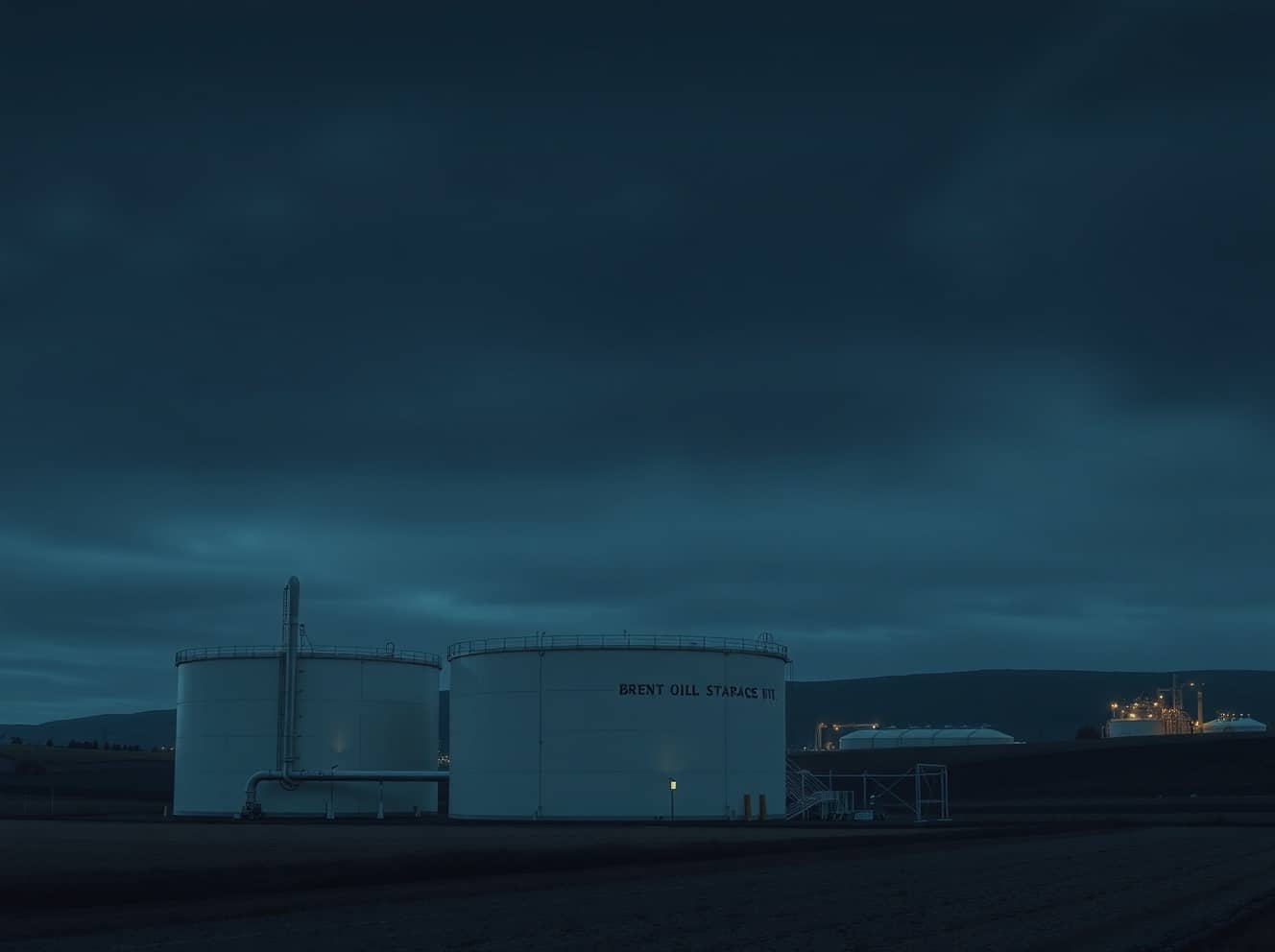

Geopolitical tensions are currently exerting significant downward pressure on Brent crude oil prices, a benchmark for global oil markets. This critical assessment emerges from a recent analysis conducted by ING, an international financial services group headquartered in Amsterdam. The bank's commodity strategists have highlighted that the market is navigating a complex landscape, where various risk factors are actively shaping both the near-term demand outlook and the broader investor behavior across the energy sector.
Institutional Analysis Highlights Market Dynamics
ING's commodity strategists have meticulously observed that the global oil market is currently grappling with an intricate and complex set of risk factors. These specific elements are not merely theoretical; they are actively clouding the near-term demand outlook for crude oil and profoundly influencing investor behavior across the spectrum of energy commodities, according to the financial institution's latest report. The analysis further indicates a notable divergence from historical market patterns. While conventional wisdom suggests that supply-side concerns, such as disruptions or reductions in output, typically exert upward pressure on prices, the prevailing environment appears to be fostering a distinctly different sentiment among traders and market participants.
Risk-Off Sentiment Prevails Amidst Uncertainty
Despite well-established historical patterns where supply constraints and potential disruptions typically lead to an increase in oil valuations, ING's analysts observe a significant shift. They report that a confluence of ongoing geopolitical uncertainties is effectively overriding these traditional, supply-driven price drivers. The prevailing market mood, as characterized by ING's strategists, is firmly described as "risk-off." This pronounced shift in sentiment suggests that investors are increasingly prioritizing the preservation of capital and seeking safety over pursuing aggressive growth strategies or speculative gains within the volatile commodities sector. This cautious approach is particularly evident during the current period of heightened global instability, where the predictability of market movements is significantly diminished.
Geopolitical Factors Weighing on Global Trade and Supply
ING's comprehensive report unequivocally highlights that ongoing geopolitical uncertainties are serving as a primary and potent driver of the current price weakness observed in Brent crude. These uncertainties are particularly acute in regions affecting global trade routes and within key oil-producing regions themselves. The bank's analysis specifically points to areas where political instability and conflict are directly impacting market mechanics and the perceived reliability of global supply. Uncertainties concerning the operational stability and output consistency of major oil-producing nations are identified as central to the ongoing discussion and strategic assessments among ING's commodity strategists.
Furthermore, the report emphasizes that disruptions or credible threats to critical global trade routes—such as major shipping lanes or strategic chokepoints—are being scrutinized with intense focus by financial institutions globally, especially those actively monitoring energy markets. Any perceived vulnerability in these arteries of global commerce can trigger immediate reactions in oil pricing, reflecting increased risk premiums and potential supply chain bottlenecks.
Interconnected Risks Complicate Price Discovery
The bank's commodity team at ING strongly emphasizes that these geopolitical factors are not isolated incidents or independent variables. Instead, they interact dynamically and often unpredictably with broader global market conditions, thereby creating an exceptionally challenging landscape for accurate price discovery in the oil sector. The report suggests that the intricate interplay between localized regional conflicts, broader international relations, and evolving global economic expectations is generating a level of market volatility that traditional, standard supply-demand models may inherently fail to capture fully. These models, often reliant on quantifiable metrics of production and consumption, struggle to integrate the qualitative and often irrational elements of fear, uncertainty, and speculative behavior driven by political events.
Consequently, traders and portfolio managers are continually adjusting their positions and risk exposures based on these rapidly evolving geopolitical narratives. The cumulative weight of external political events is becoming an increasingly significant and often dominant factor in determining the daily price movements and overall trajectory for Brent crude futures contracts, overshadowing purely economic indicators in the short term.
Market Implications and Strategic Considerations for Energy Investors
The persistent downward pressure on Brent crude prices, as meticulously observed and reported by ING, reflects a broader and fundamental recalibration within the global energy sector. Market participants, including institutional investors, hedge funds, and individual traders, are now systematically factoring in a complex array of new variables that were previously considered secondary to more straightforward pure supply and demand metrics. The ING report explicitly underscores the critical need for investors to remain exceptionally vigilant regarding geopolitical developments. It warns that any significant escalation or, conversely, a de-escalation in tensions within these sensitive regions could rapidly and dramatically alter the risk premium embedded in oil prices, leading to swift market corrections or rallies.
Shifting Investor Behavior and Portfolio Management
A key finding from ING's comprehensive analysis is the profound influence that the current geopolitical landscape is having on investor behavior. The prevailing climate of uncertainty and heightened risk is actively encouraging a posture of extreme caution among funds and asset managers responsible for overseeing energy portfolios. This cautious approach, driven by a desire to mitigate potential losses, may manifest in several ways: it could lead to significantly reduced exposure to crude oil futures, an increase in hedging activities to protect against adverse price movements, or a reallocation of capital towards less volatile assets within the broader financial ecosystem. The inherent complexity of the interconnected risk factors mentioned by ING's strategists strongly implies that simple, linear projections or straightforward trend analyses for oil prices are becoming demonstrably less reliable, particularly in the short to medium term. This necessitates a more nuanced and adaptive strategy for those operating in the energy markets.
As geopolitical risks continue to resurface and intensify on the global stage, their pervasive and often unpredictable impact on commodity markets, particularly crude oil, remains a central focal point for global economic analysis and strategic planning. The detailed ING report serves as one of several recent and authoritative indicators pointing to this significant and enduring trend, urging market participants to integrate geopolitical foresight into their fundamental analyses.